June 01, 2022

There is no one-size-fits-all when it comes to saving and investment strategies. However, there are best practices that can help you achieve your financial goals while minimizing risk. Here’s some tips on how to make the best financial decisions for your retirement nest egg. 

Saving for retirement is one of the best financial strategies you can take part in. Everyone will hopefully retire at some point in their lifetime. Saving early on in life for your golden years will help prevent you from running out of money. Whether you’re on track for retirement or need to catch up, a Fiduciary financial advisor can help prepare you for your later years.

Here’s a look at 5 saving and investing tips that will help you maximize your savings for retirement.

What is a Retirement Savings Plan?

Having a retirement savings plan is essential to securing your financial security later in life. By utilizing various retirement savings accounts, you can maximize your tax savings, invest in the index funds, and take advantage of compound interest —  leaving you with more money when the time comes to retire.

Take Advantage of Your 401(k) or 403(b) Company Match

401(k) and 403(b) plans are qualified tax-advantaged retirement plans offered by employers to their employees. If your workplace offers a retirement plan and a company match, it’s always best practice to contribute up to the maximum your company offers. It is financially beneficial to take advantage of your 401(k) or 403(b) early on in your career.

401(k) plans are offered by for-profit companies to eligible employees who contribute pre or post-tax money through payroll deduction. 403(b) plans are offered to employees of non-profit organizations and the government. You should always see what kind of retirement packages are offered with the company you work for to see where you can better invest and save your money.

Apply for Retirement Savings Credits

If you are a lower- or middle-income taxpayer, you may claim a saver’s tax credit for up to 50% of your retirement plan contribution. If you are married and filing jointly with an adjusted gross income (AGI) of below $68,000 for 2022 ($66,000 for 2021), and you contribute to a qualified retirement plan, you may be eligible for a tax credit.

The income limit for heads of household is $51,000 for 2022 and for single filers and married persons filing separately is $34,000.The maximum credit for 2021 and 2022 is $2,000 for married couples filing jointly and $1,000 for single filers (applied against the maximum contribution amounts: $4,000 for married couples filing jointly and $2,000 for single filers.

Contribute to a Health Savings Account

Healthcare costs are one of the highest growing expenses in the country. High-deductible health plans and health savings accounts are a golden retirement planning opportunity. This tool can not only be used to pay for healthcare expenses but can also be used to squirrel away additional funds for retirement.

Contributions are 100% tax-deductible, and funds unused for medical expenses may continue to be invested and grow over time. One of the best things about an HSA plan is that the distributions made on qualified medical expenses are tax-exempt. People over the age of 55 can keep and save an additional $1,000 per year. It’s important to remember that a traditional IRA is funded with pre-tax dollars whereas a Roth IRA is funded with after-tax dollars. Choose the one that works best for your tax situation.

Use the Backdoor Roth IRA to Increase Savings

For 2022, the AGI phase-out contribution range for Roth IRAs for married couples filing jointly is $204,000 to $214,000 and for single taxpayers and heads of households is $129,000 to $144,000. If your current income is too high and makes you ineligible to contribute to a Roth IRA, there’s another way in. First, contribute to a traditional IRA. There is no income ceiling for contributions to a non-deductible traditional IRA, although there is a limit to what can be contributed.

The IRS caps the contribution limit to $6,000 or $7,000 if you are 50 or over.After the funds clear, convert the traditional IRA to a Roth IRA. That way the funds can compound for the future and be withdrawn tax-free, as long as you meet the withdrawal guidelines.

Retire in the Right State

When it comes time to retire, you should look and see what states don’t have state income taxes. Alaska, Florida, South Dakota, New Hampshire, Tennessee, Wyoming, Texas, and Nevada are just some of the states that don’t have state income taxes. Colorado routinely ranks among the top tax-friendly states for retirees. The state income tax range is a low, flat rate of 4.63%, and you get a fair deduction on retirement income.

A good thing to note is that a majority of states don’t tax social security. Before packing up and moving, evaluate all of the taxes in your proposed new home state.

Fund Your Retirement Accounts with Side Hustles

Side jobs can be an excellent way to make money. Instead of using this cash to purchase a new car or upgrade your appliances, consider using it to fund your retirement accounts. If you haven’t maxed out your IRA contribution, this would be a great option.

Whether you are flipping furniture, tutoring students, or completing freelance work, using side hustles to save money for retirement can be a great way to save money and jump start your retirement investments.

Last Thoughts

It’s important to look at your retirement plan and see if any of our tips could maximize your savings. If you’re like most people, qualified-retirement plans, Social Security, personal savings and investments are expected to play a role. Once you have estimated the amount of money you may need for relocating in retirement, a sound approach involves taking a close look at your potential retirement-income sources.

At Agemy Financial Strategies, we want you to know we’re here to help you navigate retirement and any questions that come up during your retirement process. As Fiduciary advisors, it’s our duty to act on your behalf in finding the right solutions for your individual wants and needs.

For more information on our retirement and financial planning services, contact us here today.
March 31, 2022

When it comes to retirement, the conversation is usually about money. Did you save enough? Did you start saving on time? Will it be enough to cover your expenses? Many retirees are taking the stress out of these concerns by choosing a phased retirement. But what is phased retirement, exactly? Let’s take a look… 

When you begin preparing for retirement you slowly begin to ease into your new lifestyle. Such as activities you used to enjoy before you worked 9-5 everyday. No one likes sudden change, most of us think about retirement as a transition. If you like transitioning into life changes, a phased retirement may be for you.

What is a Phased Retirement?

Phased retirement is just like it sounds – a path towards retirement where you slowly begin taking more vacations, working fewer hours and essentially becoming part-time on your own time.

There’s a commonly stated stat that proclaims that about 10,000 Baby Boomers hit retirement age every day in the US. That means that they are now eligible for retirement. Despite the fact that retirement is changing – Boomers are working far longer than other generations who reach retirement age – the fact remains that Boomers are starting to make a big exit from the workforce, taking a lot of their skills, knowledge, and proven leadership skills with them.

The phased method is gaining momentum due to this reason and several others; One being people are living longer, for financial and personal reasons they may need to phase into retirement to keep a steady stream of income that will last 20+ years. The second reason being jobs are becoming less manual and can be performed at home. The pandemic was a great indicator of this. Lastly, more employers are becoming more accommodating towards phased employee exits due to baby boomers reaching retirement.

New Shift in Retirement Trends

The idea of retirement shifted from working until you’re 65, to completely stopping work and living off your savings, pension and Social Security until you die. As of late, the whole paradigm has shifted. Some individuals want to be financially independent and retire early, where they save and invest carefully now so they can enjoy a long retirement while young enough to appreciate it.

People on the other end of that spectrum may find their careers to be satisfying enough that they plan to work their whole lives. Realistically, both these retirement goals may end up utilizing some kind of phased retirement. Regardless of the many reasons one may have, a phased retirement should be considered as a future retiree’s plan. The reasons can be both financial and emotional, however, they both bear consideration, even if it’s only a backup retirement strategy.

Pros and Cons of a Phased Retirement 

This alternative to the traditional here-today, gone-tomorrow method of leaving one’s job has become fairly popular among Baby Boomers in recent years. But before you make a decision on whether to embark on this transitioning journey, be sure to know both the benefits and drawbacks of a phased retirement.

The Main Financial Motivators

The two main financial motivators in retirement are driven by government benefits: Medicare and Social Security. Both have age considerations. Medicare doesn’t happen until age 65 and Social Security shouldn’t happen until at least age 67 – which is considered full retirement age.

So what happens if you want to retire earlier than these ages? You may consider phasing out of work rather than just quitting. This way you can afford to live comfortably before your government benefits kick in.

The Main Personal Motivators

Why should you consider a phased approach to retiring? One reason might be that you haven’t been retired before, and a phased approach allows you ease into your golden years. Phased retirement can give you a chance to try things before 100% committing. It’s important to remember that retirement is not a one size fits all plan, and it looks different for everyone based on their needs.

With phasing intoretirement, you can test how retirement will work for you. Specifically, by leaving your current job, and potentially finding a job that involves less hours, less stress, or fewer commitments. You can see if you really want to take on your beloved hobby that much. Or you can take on some of the volunteer work you’ve wanted to do for years, and see how you handle having more time on your hands.

Further Pros: 

Financial stability. During phased retirement, workers can still collect a paycheck, just for less money. They can supplement their pay with withdrawals from company-sponsored retirement plans if necessary.

  • Continue accumulating wealth. If your employer offers a phased retirement plan, there may be provisions that allow you to continue saving for retirement or earning retirement benefits through a pension. That means you don’t miss out on opportunities to add to your wealth, even if you’re working less.
  • Mental/emotional health. One of the negative side effects of retirement is that workers may feel lost or without purpose once they’re no longer on the job. Working on a part-time basis during a phased retirement can yield mental and emotional benefits if it makes older employees feel fulfilled.
  • Prepare for the real thing. Phasing retirement and continuing to work reduced hours can give you an idea of what life might be like once you fully retire. This can help you decide how you want to use your time or even whether retiring is what you truly want to do.

Problems a Phased Retirement

While phased retirement offers a slew of positives for your business, there are quite a few downsides that your plan will have to address if you want it to be successful:

  • Could reduce your pension.  If you work for an employer that offers a defined benefit pension plan (the kind that guarantees monthly payouts), the plan’s formula may penalize you for taking phased retirement. These pensions often base their payments on your average salary during your final years at the employer.
  • It could halt your 401(k) contributions. Your employer might not let you continue participating in its retirement savings plan if you cut back to part-time work.
  • The potential to lose your health care coverage or pay more for it. Many employers don’t offer healthcare to part-time employees or charge these workers higher premiums than full-time employees. So if you begin phased retirement before Medicare kicks in at age 65, you might find yourself uninsured and facing steep out-of-pocket health costs.
  • Possibly smaller life insurance benefits for your spouse. Often, the size of employer-sponsored life insurance death benefits is a multiple of your salary. By cutting your pay, you could also be cutting the insurance payout.
  • It could reduce your Social Security payments. Your Social Security benefits are determined by your average earnings during your 35 highest-income years. If your phased retirement’s reduced salary means you will need to start collecting Social Security before the program’s full retirement age (now between 66 and 67), you’ll see your benefits cut byas much as 30 percent.

So, with a phased retirement program, retirees can slowly make the switch instead of abruptly changing their entire lives. But there are many laws, regulations, and other compliance issues that need to be addressed before implementing a plan and plans need to be flexible enough to ensure that they do not impact other benefits. With all of that, phased retirement can be great if a company wants to go through the motions of creating one and it suits your retirement outlook.

Final Thoughts

Phased retirement is a concept, not a particular legal or employment status. Your employer may be willing to let you work reduced hours, cut out stressful job responsibilities, or time-share with another employee. Whatever the case may be, attention should be brought upon the details of the transition. Cutting back on hours could be ideal unless it disqualifies you for your company’s health insurance or other benefits.

Whatever your retirement strategy, there are risks to identify and manage as you navigate retired life. One key factor remains the same: the more you prepare, the less surprises you’ll face along the way.

At Agemy Financial Strategies, our first priority is helping you take care of yourself and your family. Click here to connect a convenient time for your complimentary 30 minute consultation. Our Fiduciary financial advisors in Guildford, CT and Denver, CO are looking forward to speaking with you.

May 18, 2022

Crises during retirement can come in many forms: recession, divorce, pandemic, catastrophic medical expenses, natural disaster, disability, care for an elderly family member, or loss of an income source. However, we’re here to assure you that you can retire during a financial crisis, you’ll just need to prepare yourself.

The thought of being hit with a major negative event that could affect your finances can keep anyone awake at night. After bolstering savings, paying down debt, building up cash, and making sure all of your financial affairs are in order…it’s a lot to contemplate. Unfortunately, the environment you retire into can have a big impact on your retirement savings.

However, a solid financial plan can help you prepare. Here are our top ways to ensure you’re best prepared for whatever the future may bring.

Build Your Emergency Fund

We’ve said it before and we’ll say it again: Make sure you have enough saved to pay for unexpected events. Having some extra funds available for emergencies is an essential component of your overall financial well-being, with enough cash to cover six months of expenses being a common recommendation. Try the following steps to build up your fund, after all, the more you save, the less likely a crisis will affect you.

1. Set several smaller savings goals, rather than one large one. That will ensure you don’t stress your cash flow, making it too easy for you to rationalize abandoning your savings routine.

2. Create a system for making consistent contributions. There are a number of different ways to save, and as you’ll read below, setting up automatic recurring transfers is often one of the easiest.

3. Regularly monitor your progress. Find a way to regularly check your savings. Whether it’s an automatic notification of your account balance or writing down a running total of your contributions, finding a way to watch your progress can offer gratification and encouragement to keep going.

4. Park it somewhere safe. Money market funds and high-interest savings accounts are two good places to park your emergency fund. You need safe, liquid options so that your money is accessible in times of need.

5. While You’re at it, Build a Reserve Fund Too. To be better prepared, create options for your future self to deal with a shock. Building cash reserves above a normal emergency fund, eliminating debt to lower fixed monthly payments, or working part time can help create financial slack to help you be agile as your retirement life unfolds.

Protect Your Cash Flow

Having a monthly budget is essential to keeping track of your financial health. Do you know where your money goes every month? If not, understanding your personal cash flow will help you better manage — and measure — your funds, should the worst happen. Cash flow refers to your income minus expenses over a set period of time. This term is helpful for both individuals and businesses as it can clearly indicate what direction finances are heading.

Anyone can determine their cash flow by creating a budget. All you need to do is write down your monthly income, including sources of passive income, and then subtract all your expenses. Instead of focusing on a single month, you may want to track your expenses for three months.

In the Event of a Crisis

If – or sadly, when – a crisis hits, you need to know what to do, and fast. Start by making some immediate cutbacks and rebuild from there.

1. Cut back expenses: Small changes add up. Make your coffee at home, reduce energy consumption, cancel unnecessary expenses like luxury food deliveries and even changing your cell phone packages can all add up.

2. Make more drastic changes: To cut back further, consider selling your second home/rental property, downgrade your car, take on a second job, refinance your mortgage, let your child help pick up their college expenses.

Start with the smaller changes and resort to the major changes if needed down the line. To better prepare for an unexpected financial shock, you need a sense of other funds they might have access to such as home equity line of credit or 401(k) loans.

Maximize Your Liquid Savings

Finally, cash accounts, such as checking, savings, and money market accounts—as well as certificates of deposit (CDs) and short-term government investments—will help you the most in a crisis. You’ll want to turn to these resources first because their value doesn’t fluctuate with market conditions, unlike stocks, index funds, exchange-traded funds (ETFs), and other financial instruments in which you might have invested.

Having liquid assets like cash is smart for any portfolio, especially during an economic downturn. Not only does cash come in handy for taking care of life’s unexpected expenses, it can also free you to take advantage of opportunities.

Final Thoughts

Life is unpredictable. So one last way to protect yourself for the future is by keeping your financial house in order now. You might think you don’t have the time or money to deal with these things on a regular basis, but they can create much larger disruptions of your time and finances if you ignore them. A solid financial plan will include various projections to help you determine whether your assets will provide you with the income required to fund your retirement, and prepare for life’s major downturns.

Specializing in retirement income planning, Agemy Financial’s objective is to see that their clients can retire and stay retired. Our purpose is to educate retirees – whether that be planning for retirement, legacy planning, wealth management, or just holding your hand when it’s time to leap into retirement or out of a financial crisis.

Be prepared – and stay prepared – with our Fiduciary advisors at Agemy. Contact us here today to get started

May 17, 2022

Retiring from work? Congratulations! But before you tick off your retirement bucket list, you need to tick off your retirement to-do list. 

If there’s one thing this year has taught us, it’s that things can change quickly. Putting money away when you don’t have any immediate need for it can be a little difficult. With this in mind, we urge you to think a little into the future.

Setting financial goals is a big step towards becoming financially secure before and in retirement. Whether it’s setting short-term, midterm, or long-term financial goals, you’ll be working towards something specific for your individual needs and circumstances. Financial goals are savings, investment or spending targets you hope to achieve over a set period of time. The stage of life you’re in usually determines what type of goals you wish to achieve.

Here are 6 goals to have for your finances before you reach retirement.

1. Crunch Those Numbers

Before you retire, you should take the time to understand how much you’ll need in retirement and how your accounts will provide income. Budgeting may not be the most fun, but it can help you spend less than you earn. With a budget, you can successfully account for where your money is going and start thinking about where you can begin saving. Start by categorizing your spending.

For example, you could create budget categories for food, rent, savings, nights out on the town, Netflix, and so on. Next, look at your total monthly income and expenses. Using your after-tax income, allot a certain amount of money to different categories in your budget. There are many apps out on the market that automate your budgeting for you, but you should also consider consulting with a financial planner to help you plan how much you’ll need, how much you currently have saved, and how to fill in any gaps. You will also want to take the time to estimate your expenses in retirement to confirm you have the income to cover them.

2. Put Your Savings Strategy on Auto-Pilot

Bigger is better when it comes to your savings account. While saving can seem hard, automating your savings will make it significantly easier. By setting up automatic transfers to your savings account from your checking account, you can put your savings strategy on auto-pilot and you’ll hardly even notice the money is gone.

Start by automatically saving 10% of your income with each paycheck. You can typically set up automatic transfers online or by talking to your bank. Automating your savings can make the process easier and help you build wealth effortlessly.

3. Get Up to Speed on Insurance

Make this a top priority as you’re planning to retire so you don’t spend any time uninsured. Your options depend on your age, but the most common types include:

  • Life Insurance: The greatest benefits of life insurance include the ability to cover your funeral expenses and provide for those you leave behind.
  • Health Insurance: If you don’t have health insurance through an employer, check with trade organizations or associations about possible group health coverage.
  • Long-Term Care Insurance: Here’s the good news: our life expectancies are longer than ever. But that means we’re likelier than ever to need some sort of long-term care during our lifetimes.
  • Long-Term Disability Insurance: A policy that guarantees income replacement is optimal. More often policies pay out between 40% to 70% of your income. The cost of disability insurance is based on many factors, including age, lifestyle, and health.
  • Auto Insurance: To make sure you get the right insurance for you, compare several rate quotes and the coverage provided, and check periodically to see if you qualify for lower rates based on your age, driving record, or the area where you live.
  • Travel Insurance: After all, what is retirement if you can’t enjoy some trips away?

4. Self-Care Security

Want to know one of the best things to invest in? Yourself. It may bring returns on your happiness, success and even salary. Think about what new skills could beef up your resume, and look for learning opportunities in your community or online that could help you move your career forward.

Not only that, think about what you want to accomplish in the future. Think about the things you;ve always wanted to pursue but didn’t have the time to do. Perhaps it’s going back to school to get your MBA, or you’re looking to learn a new trade such as coding. You can easily look into resources and classes on LinkedIn or take up a Masterclass. By investing in yourself, you can become more well-rounded.

What’s most important is your health. So focusing on eating well and moving your body daily is essential to enjoying your golden years to their fullest.

5. Keep Growing Your Money

A secret weapon to jump-start your retirement is time. The magic of compounding interest can turn just a little bit of savings into a large nest egg. Strive for saving 10% to 15% for retirement through your employer-sponsored 401(k). If you’re eligible, make sure you contribute enough to get a company match, at least! It’s free money and a sweet job perk. Also, consider getting extra tax benefits by contributing to a Traditional or Roth IRA.

If you work for yourself, you might want to check out retirement plans for self-employed people. Options like a SEP-IRA can help you save for retirement on a tax-deferred basis, just like employees on company plans.

Just remember, after you’ve retired, your retirement income plan may include two sources:

Guaranteed income sources.

  • Social Security, if you’re taking it now
  • Pensions (traditional defined benefit plan)
  • Annuities

Assets to fund retirement.

  • Individual retirement accounts (IRAs) and retirement plans (401(k), 403(b), ESOP)
  • Personal savings (CDs, bank and money market accounts)
  • Investments (stocks, bonds, mutual funds, real estate)
  • Wages in retirement (example: part-time job)

6. Sit Down with Your Financial Advisor

Still not sure where to start on your financial strategy? Consider sitting down with a financial advisor. By taking a look at your entire financial situation, they can help you establish a customized plan designed to meet your short- and long-term goals. Then, your financial advisor can help you select suitable products and services designed to put your plan into action.

At Agemy Financial Strategies, our firm exists for the purpose of helping people achieve their personal and financial goals. Our philosophy is to deliver quality financial programs and teach principles for successful living. We work hard to deliver a dependable retirement income strategy, in any market, so that you can enjoy the “best” of your lives during retirement.

Final Thoughts

The best thing about setting goals and financial planning is you can review and update your goals and monitor your progress in reaching them. In the process, you will find that both the small things you do on a daily and monthly basis and the bigger things you do every year and over the decades will help you achieve your financial goals.

We want you to know we’re here to help you navigate retirement and any questions that come up during your retirement process. As Fiduciary advisors, it’s our duty to act on your behalf in finding the right solutions for your individual wants and needs.

For more information on our retirement and financial planning services, contact us here today.
May 16, 2022

We’ve covered the pros and cons of retiring in Connecticut and Colorado, but in today’s blog, we compare the two to help make that life-changing decision a little easier. 

Many people choose to move somewhere different to spend their golden years in a beloved place that provides comfort and resources.

Whether you’re considering moving out of, into, or remaining in Connecticut or Colorado for your golden years, Agemy Financial Strategies can help.  As a financial firm based in Connecticut, with offices in Colorado, we can offer you first hand experience and knowledgeable advice on how to manage your retirement in these beautiful states.

First, here’s a look back at some of the pros and cons to think about.

Pros & Cons Of Connecticut

Pro 1: The crime rate in Connecticut has been steadily falling

Did you know that Easton, Ridgefield, and Madison top the state’s safety rankings? Just another reason to spend your retirement here. There’s a sense of safety which is comforting to anyone. Connecticut is well known for its great small community atmosphere. Many residents boast their small town feels more like a family.

Some of the best cities to live in are in Connecticut because their record of safety continues to improve. The state is experiencing its lowest crime rate in decades, with the overall ratio being about 20 incidents per every 1,000 residents. The rate of violent crime is only 2 per 1,000, which makes most communities a safe place to raise a family and let your kids outside to play in the front yard. Compared to other places you could live along the East Coast, you’ll find Connecticut has a lot to offer.

Pro 2: Connecticut residents live longer

Debate all you want about quality of life in Connecticut, but duration of life in the state is indisputable. Connecticut has the fifth-highest life expectancy in the United States, according to data provided by the Centers for Disease Control and Prevention.

Connecticut residents can expect to live an average of 80.4 years, with females at 82.9 and males at 77.9. The findings, published earlier this year in the National Vital Statistics Reports, reviewed 2018 population estimates, state-level mortality and each state’s death and population figures that year for older Medicare beneficiaries.

Con 1: The cost of a house is high in Connecticut

The pandemic has sent CT house prices through the roof and drained the inventory.

Zillow reports that the median home value in Connecticut is about $348,047. With an extremely low supply of available homes for sale and skyrocketing demand, some would-be buyers feel as though it is becoming increasingly difficult to afford the cost of moving into a new home. The highest median home price and most drastic change over the last two years is in Fairfield County, where there was an increase of 43.5% to more than $400,000.

How long can this housing spike remain? That all depends on the supply. According to the Berkshire Hathaway HomeServices report, total 2022 home sales are not expected to reach 2021 numbers simply because Connecticut real estate agents are running out of inventory.

Con 2: The cost of living is high in Connecticut

There’s no point in beating around the bush here: Connecticut is an expensive state, and living costs are higher than the national average. The cost of living in Stamford (one of Connecticut’s most expensive cities) is only 17% lower than Manhattan, New York. Compared with all other states, Connecticut has the eighth highest overall cost of living.

In general, living in dense, urban metro areas is more expensive than living in more rural areas. Connecticut is home to four metropolitan areas. The most expensive in the state is the Bridgeport-Stamford-Norwalk metro area, where the cost of goods and services is 15.3% higher than the national average and 9.2% higher than the statewide average. If you can afford to live here, then there are plenty of advantages for you to enjoy. Fewer people are finding it possible to do. Plus the rural areas present a cheaper-cost of living if you want to spend your golden years out of the metro hustle and bustle.

Pros & Cons Of Colorado

Now that you have a sense of the pros and cons of living in Connecticut, we can jump into the pros and cons of living in Colorado.

Pro 1: Access to Quality Medical Care

Colorado rounds out the top ten for overall health care in America. The state has some of the highest-quality medical care available with access to top-level hospitals. Though some remote areas may lack the ease of access, most of the population is never far from premium medical care.

Additionally, health care costs less in Colorado than in many other states. Thanks to significant policy moves, Colorado made strides to improve affordability and serve as a model for other states.

Pro 2: Retirement Communities are an Abundance

Traditionally, people tend to retire in warmer states such as Florida. You might be surprised to see that trend change as more retirees venture to Colorado. The state saw a significant jump in the number of people retiring there since 2010. 

Aside from having more people your age to connect with, Colorado has some impressive retirement communities to make it even easier. Get the best of everything with neighbors your age and loads of activities to keep you as social and busy as you want to be.

Con 1: Prepare for the Cost of Living

One of the biggest things that Colorado and Connecticut have in common is that the price of livin in both states is high. The Taxes are better in Colorado, but you may notice a bump in the cost of living. Depending on where you currently reside, you may need to pay a little more for some things.

While you may pay substantially more for housing, you should only see a slight uptick in groceries and transportation. On the other hand, most people should see a drop in health care costs and even spend less on utilities. It’s a good idea to do your research so that you don’t get sticker shock! Try using a comparison calculator for a ballpark idea.

Con 2: Being Mindful of Wildlife

There are a lot of pros to being surrounded by nature, but the biggest con would be being mindful of the wildlife that comes with it. Some people love to see moose, deer, and other beautiful animals roaming through their yards, but not all Colorado wildlife is welcome. Colorado has some dangerous creatures that can do damage if you’re not prepared.

Though animal attacks remain rare in Colorado, it’s still something to consider before retiring there. Education goes a long way, and you can easily prepare to handle the wildlife. Here’s a rundown of the most common animals that could pose a risk.

Comparing the Two

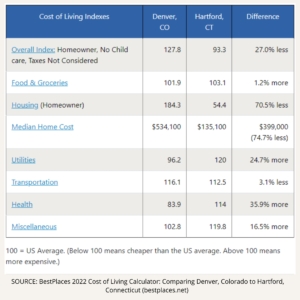
According to BestPlaces.net’s 2022 Cost of Living Calculator: Denver, Colorado vs Hartford, Connecticut

A salary of $100,000 in Denver, Colorado could decrease to $71,082 in Hartford, Connecticut (assumptions include Homeowner, no Child Care, and Taxes are not considered.)
Comparison Highlights
– Overall, Hartford, Connecticut is 27.0% cheaper than Denver, Colorado
– Median Home Cost is the biggest factor in the cost of living difference.
– Median Home Cost is 74% cheaper in Hartford.

Final Thoughts

Now that you know some of the pros and cons of retirement in both states, it’s important to look at your retirement plan and see if this is something that would benefit you. Both states have a lot to offer. Once you have estimated the amount of money you may need for relocating in retirement, a sound approach involves taking a close look at your potential retirement-income sources.

At Agemy Financial Strategies, we want you to know we’re here to help you navigate retirement and any questions that come up during your retirement process, including relocation opportunities. As Fiduciary advisors, it’s our duty to act on your behalf in finding the right solutions for your individual wants and needs.

For more information on our retirement and financial planning services, contact us here today.

May 04, 2022

Not many places on Earth compare to the beauty of Colorful Colorado. The unassuming plains, enticing terrain and abundance of wildlife are just a few of the benefits that see so many flocking there to live out their retirement years. But is the hype well-deserved? Read on to find out more…

Many Americans choose to uproot somewhere new to spend their golden years in a beloved place that provides comfort and resources. Maybe you want mountains or beach backdrops for your morning coffee. Perhaps you crave access to golf courses, bike trails, or lakes for fishing. If you’re thinking of where to retire, have you considered retiring in Colorado?

It’s currently one of the best options in the United States for retirees. Even if you haven’t considered the Centennial State before, you may want to give it a look now. To help you decide if Colorado is the right place to spend your retirement, we compiled a list of the top pros and cons of retiring in Colorado.

When it comes to relocating to or from the state of Colorado, there are a number of benefits and a few drawbacks you should consider. Whether you’re considering moving out of, into, or remaining in Colorado for your golden years, Agemy Financial Strategies can help.

Our head office is in Connecticut, but did you know that we now have a base here in Colorado? Equipped with first-hand knowledge, we can offer you experienced advice on how to manage your retirement in this beautiful state. But before making such a life-changing decision, here’s a look at some of the pros and cons to think about.

Pros of Retiring in Colorado

Enjoying the Scenery

Colorado is home to some of the most beautiful countryside in America with its impressively massive mountains, towering trees, rolling plains, crystal clear lakes, and soft sand dunes. With trails for every fitness and experience level, you’re never too far from nature.

There’s something about waking up to have your morning coffee with the mountains out your window. Of course, you can always take your fill of sand at Great Sand Dunes National Park & Preserve. Are you craving a dip in the water? Visit one of the many sparkling lakes or rivers winding through the state!

Here are just some of the many places you can easily visit when retiring in Colorado:

Pay Lower Taxes in Retirement

Colorado routinely ranks among the top tax-friendly states for retirees. The state income tax range is a low, flat rate of 4.63%, and you get a fair deduction on retirement income. Sales tax may run higher in the state, but it doesn’t apply to groceries or medication. Another great reason to retire in Colorado, there’s no estate tax. You can leave money to your family without paying hefty fees, which is a huge perk.

Access to Quality Medical Care

Colorado rounds out the top ten for overall health care in America. The state has some of the highest-quality medical care available with access to top-level hospitals. Though some remote areas may lack the ease of access, most of the population is never far from premium medical care.

Additionally, health care costs less in Colorado than in many other states. Thanks to significant policy moves, Colorado made strides to improve affordability and serve as a model for other states.

Retirement Communities are an Abundance

Traditionally, people tend to retire in warmer states such as Florida. You might be surprised to see that trend change as more retirees venture to Colorado. The state saw a significant jump in the number of people retiring there since 2010. 

Aside from having more people your age to connect with, Colorado has some impressive retirement communities to make it even easier. Get the best of everything with neighbors your age and loads of activities to keep you as social and busy as you want to be.

Cons of Retiring in Colorado

Prepare for the Cost of Living

Taxes are better in Colorado, but you may notice a bump in the cost of living. Depending on where you currently reside, you may need to pay a little more for some things. 

While you may pay substantially more for housing, you should only see a slight uptick in groceries and transportation. On the other hand, most people should see a drop in health care costs and even spend less on utilities. It’s a good idea to do your research so that you don’t get sticker shock! Try using a comparison calculator for a ballpark idea.

Severe Weather

Coloradoans see an abundance of sunny days every year, but that doesn’t mean they’re exempt from severe weather. Depending on where you settle in the state, you could face high winds, hail, and even wildfires. Additionally, some parts of the state receive high levels of snow that make it challenging to get around.

Be prepared for the occasional damaging storm. In 2017, parts of Colorado saw enormous balls of hail that caused billions of dollars of damage. The large hail balls damaged homes and vehicles around Denver, but it wasn’t the first incident in the state. 

Dangerous Wildlife

There are a lot of pros to being surrounded by nature, but the biggest con would be being mindful of the wildlife that comes with it. Some people love to see moose, deer, and other beautiful animals roaming through their yards, but not all Colorado wildlife is welcome. Colorado has some dangerous creatures that can do damage if you’re not prepared. 

Though animal attacks remain rare in Colorado, it’s still something to consider before retiring there. Education goes a long way, and you can easily prepare to handle the wildlife.

Dreaded Traffic

The horror traffic stories are true. In some parts.  Due to the popularity of Colorado, some residents have been irked by the overcrowding, and in very populated areas, traffic congestion is also a problem.  These are somehow inevitable consequences of a popular place. As more and more people move to live there, the population increases and overcrowding continues.  For retirees wishing to live in Colorado, the overcrowding can be a problem if you were hoping to move into a quiet and calm environment. 

Final Thoughts

To summarize, Colorado has great weather, the pension taxes are lower than in most states, and lots of retirees live there with several retirement communities all over. On the flip side, Colorado’s living expenses are high, and some people have complained of overcrowding and traffic congestion in some areas.

Now that you know some of the pros and cons of retirement in Colorado, it’s important to look at your retirement plan and see if retiring here would benefit you. If you’re like most people, qualified-retirement plans, Social Security, personal savings and investments are expected to play a role. Once you have estimated the amount of money you may need for relocating in retirement, a sound approach involves taking a close look at your potential retirement-income sources.

At Agemy Financial Strategies, we want you to know we’re here to help you navigate retirement and any questions that come up during your retirement process, including relocation opportunities. As Fiduciary advisors, it’s our duty to act on your behalf in finding the right solutions for your individual wants and needs. 

For more information on our retirement and financial planning services, contact us here today.
May 03, 2022

Connecticut is known for many things including its picturesque landscape. Whether it’s jobs, housing, or culture you want to know about, we’ve looked in detail at some of the pros and cons of retiring in Connecticut to make your decision easier.

As you near retirement, your mind may wander to fulfilling your life’s dreams; and for many, that involves relocating. After all, retirement is a time for freedom.

Some people move to be closer to or farther away from family while others take this step for health or financial reasons. But the relocation trend seems to be wavering. Despite COVID forcing up to 3 million Americans to retire earlier than planned, the number of retirees who moved in 2021 dropped to 226,000—roughly 43% fewer than in the year previous. It’s also the lowest number of American retirees in the last five years! So why are fewer retirees relocating? COVID again, the housing market and lack of retirement savings played a part for sure. But as the country and world begin to get back to a new normal, we expect to see the numbers rise once more.

When it comes to relocating to or from the state of Connecticut, there are a number of benefits and a few drawbacks you should consider. Whether you’re considering moving out of, into, or remaining in Connecticut for your golden years, Agemy Financial Strategies can help. As a financial firm based in Connecticut, we can offer you experienced and knowledgeable advice on how to manage your retirement in this beautiful state. But before making such a life-changing decision, here’s a look at some of the pros and cons to think about.

Pros of Retiring in Connecticut

1. There are numerous opportunities to enjoy the outdoors in Connecticut

If you’re an outdoorsy person, you’ll love what the state has to offer. You might not think about a visit to the beach as a top priority in Connecticut, but you’re only two hours away from the ocean at the furthest point when living here. You’ll find several popular options to visit, including Hammonasset Beach State Park, Ocean Beach Park, or the beautiful Calf Pasture Beach in Norwalk. In fact, the state boasts nearly 100 miles of coastline along the Long Island Sound and is crossed by four major rivers, providing residents with plenty of beautiful scenery and outdoor recreational opportunities.

It is a fantastic place for hiking, which includes a stretch of the Appalachian Trail. Most of the state parks have opportunities for you to enjoy, and a handful of forest preserves make for the perfect autumn trek. There is a little bit of something for everyone to love when you live in Connecticut.

2. Connecticut offers an abundance of entertainment

The entertainment scene in Connecticut is also lively for those who enjoy going to a weekend show. If you love the performing arts, New Haven’s College Street Music Hall is the place you want to be. It reopened in 2015 after being vacant for more than a decade. Now it’s the place for artists who come through the area, attracting acts that would normally skip over the state when traveling between Boston and New York City.

Retirees in Connecticut will love taking their grandchildren to explore the country’s oldest amusement park. In fact, the state is credited with inventing the amusement park. Bridgeport, Connecticut is home to the longest continuously operating amusement park in the United States.

3. The crime rate in Connecticut has been steadily falling

Did you know that Easton, Ridgefield, and Madison top the state’s safety rankings? Just another reason to spend your retirement here. There’s a sense of safety which is comforting to anyone. Connecticut is well known for its great small community atmosphere. Many residents boast their small town feels more like a family. 

Some of the best cities to live in are in Connecticut because their record of safety continues to improve. The state is experiencing its lowest crime rate in decades, with the overall ratio being about 20 incidents per every 1,000 residents. The rate of violent crime is only 2 per 1,000, which makes most communities a safe place to raise a family and let your kids outside to play in the front yard.

It is still a good idea to have insurance in place for any of the more expensive items you have in your home. Compared to other places you could live along the East Coast, you’ll find Connecticut has a lot to offer.

4. Connecticut residents live longer

Debate all you want about quality of life in Connecticut, but duration of life in the state is indisputable. Connecticut has the fifth-highest life expectancy in the United States, according to data provided by the Centers for Disease Control and Prevention.

Connecticut residents can expect to live an average of 80.4 years, with females at 82.9 and males at 77.9. The findings, published earlier this year in the National Vital Statistics Reports, reviewed 2018 population estimates, state-level mortality and each state’s death and population figures that year for older Medicare beneficiaries.

5. Connecticut grants seniors access to a tuition-free degree

Last but by all means not least, Connecticut allows senior citizens to take college classes and earn a degree tuition-free. At the University of Connecticut (UCONN), seniors can take undergraduate courses on a non-credit basis for $15/semester. Senior citizens working toward a degree do not have to pay tuition but do have to pay university and activity fees.

Cons of Retiring in Connecticut

1. It can get really cold in Connecticut 

If you’re older, the cold weather can be a deal breaker for some. If residents aren’t leaving Connecticut because they’re trying to find work somewhere else, then there’s an excellent chance that they’re going because of the weather. The average temperature in the winter in Hartford is below 20°F. The coastal part of the state sees 15 snow days each year, with accumulation levels reaching three feet. Norfolk gets even more of the white stuff, averaging almost 80 inches per year.

Definitely a consideration for those who suffer in colder months.

2. The cost of a house is high in Connecticut

The pandemic has sent CT house prices through the roof and drained the inventory.

Zillow reports that the median home value in Connecticut is about $348,047. With an extremely low supply of available homes for sale and skyrocketing demand, some would-be buyers feel as though it is becoming increasingly difficult to afford the cost of moving into a new home. The highest median home price and most drastic change over the last two years is in Fairfield County, where there was an increase of 43.5% to more than $400,000.

How long can this housing spike remain? That all depends on the supply. According to the Berkshire Hathaway HomeServices report, total 2022 home sales are not expected to reach 2021 numbers simply because Connecticut real estate agents are running out of inventory.

3. The cost of living is high in Connecticut

There’s no point in beating around the bush here: Connecticut is an expensive state, and living costs are higher than the national average. The cost of living in Stamford (one of Connecticut’s most expensive cities) is only 17% lower than Manhattan, New York. Compared with all other states, Connecticut has the eighth highest overall cost of living.

In general, living in dense, urban metro areas is more expensive than living in more rural areas. Connecticut is home to four metropolitan areas. The most expensive in the state is the Bridgeport-Stamford-Norwalk metro area, where the cost of goods and services is 15.3% higher than the national average and 9.2% higher than the statewide average. If you can afford to live here, then there are plenty of advantages for you to enjoy. Fewer people are finding it possible to do. Plus the rural areas present a cheaper-cost of living if you want to spend your golden years out of the metro hustle and bustle.

The Verdict

While many people stay in their homes until they’re forced to relocate for medical or financial reasons, reports show that those who move to a new place are actually happier than those who remain in their homes. Will the above information sway your decision of relocating in retirement?

Connecticut housing is expensive, the cost of living is above average, and property taxes are high. But while the cost of living is high in Connecticut, the quality of life matches it, with income, health, and education ranking well above average.

At Agemy Financial Strategies, we are based in the state for a reason. That reason being we simply love location, the lifestyle it provides and the spirit of the people living here.

If you love it, too, the cons are worth working through with the right financial plan in place. But for those who can’t get over the weather or cost of living, then relocating to a less expensive and warmer climate may be for you.

Final Thoughts

Now that you know some of the pros and cons of retirement in Connecticut, it’s important to look at your retirement plan and see if this is something that would benefit you. If you’re like most people, qualified-retirement plans, Social Security, personal savings and investments are expected to play a role. Once you have estimated the amount of money you may need for relocating in retirement, a sound approach involves taking a close look at your potential retirement-income sources.

At Agemy Financial Strategies, we want you to know we’re here to help you navigate retirement and any questions that come up during your retirement process, including relocation opportunities. As Fiduciary advisors, it’s our duty to act on your behalf in finding the right solutions for your individual wants and needs.

Stay tuned next week when we explore the pros and cons of retiring in Colorado.

For more information on our retirement and financial planning services, contact us here today.

April 18, 2022

Most Americans follow the “classic” method of estate planning, that goes from older generations to their younger ones. However, that perspective doesn’t take into consideration some opportunities to increase family after-tax wealth.

Effective estate management enables you to manage your affairs during your lifetime and control the distribution of your wealth after death. An effective estate strategy can spell out your healthcare wishes and ensure that they’re carried out – even if you are unable to communicate. It can even designate someone to manage your financial affairs should you be unable to do so.

It usually involves creating a living trust for the purpose of avoiding conservatorship in the event of incapacity and avoiding probate upon death. There is no question that being able to avoid the cost, expense, frustration, and other hassles with conservatorship and probate is worth the legal fee in creating such an important document.

Sadly, many Americans have not seen additional benefits of creating a living trust beyond avoiding conservatorship and probate. However, there is much more than meets the eye. The idea behind Reverse Estate Planning is that adult children can use an array of standard tax and estate planning strategies to transfer assets to their parents in a tax-advantage way.

Here’s what you need to know about Reverse Estate planning, and if it might be for you.

Reverse Estate Planning 101

When most individuals consider Estate Planning, they look “downstream” to future generations. They think about how to structure the Estate Plan so as to provide for children, grandchildren, and other younger beneficiaries.

The perspective has always been, “How can we benefit future generations?” And while this is a key aspect of any Estate Plan, there is not enough focus on the reverse, also known as “Upstream Estate Planning”. You should also focus upon how gifts and inheritances you expect to receive should be structured in order to benefit you.

The idea is the adult children can use an array of standard tax and estate planning strategies to transfer assets to their parents in tax-advantaged ways. The parents then use their lifetime exemptions to pass that wealth to their younger generations through either their estates or lifetime gifts. They might even benefit their adult children at little or no tax cost by passing the money to irrevocable trusts the adult children can’t control.

It’s also a good way for family members to make loans. For example, the adult children can take out low-interest loans for their parents. The parents use the loan incomes to buy assets that are expected to grow. At some point, they repay the loans and let the appreciation pass through their estates tax-free to the younger generations, either directly or through trusts. Or the parents can make lifetime gifts to the grandchildren or the trusts, using part of their lifetime exemptions.

Is Reverse Estate Planning for You?

As mentioned, traditional Estate Planning usually involves creating a Living Trust for the purpose of avoiding conservatorship in the event of incapacity and avoiding probate upon death. There is no question that for the vast majority of Americans, being able to avoid the cost, expense, frustration, and other hassles with conservatorship and probate is worth the legal fee in creating a Living Trust.

Nowadays however, most of the widely-used strategies for transferring wealth to younger generations also can be used to transfer wealth to the older generation.

Some adult children who have more assets than parents and can help take care of the older generation. In these cases, Reverse Estate Planning can play a valuable role. Some families would also benefit by using Reverse Estate Planning to pass assets now to the older generation so their excess exemptions can be used to transfer assets tax free for the benefit of their grandchildren or later generations.

Be aware, the lifetime estate and gift tax exemptions might not remain at their current levels much longer. The 2017 tax law is scheduled to expire after 2025, which would cut the exemptions in half. So, if Reverse planning seems like a good idea for your loved ones, now is the time to take advantage of it.

Final Thoughts

The key is to be aware of the concept of “Reverse” or “Upstream” Estate Planning and if it’s for you, you should ask your benefactors if they’d be willing to sign a Heritage Trust and make a modification to their Estate Plan.

There’s no better time to plan for the future than right now.  At Agemy Financial Strategies, our first priority is helping you take care of yourself and your family. We want to learn more about your personal situation, identify your dreams and goals, and provide you with the highest level of service.

Whether you think Reverse Estate Planning is for you or you’d like to explore a more traditional Estate Planning route, reach out to our Fiduciary advisors here to instantly book the day and time you’d like to connect with us for your complimentary 30 minute consultation. Our financial advisors in Guildford, CT and Denver, CO are looking forward to speaking with you.

April 14, 2022

First held on April 22nd 1970, we appreciate the awareness that Earth Day has brought to protecting our environment and the urgency that it’s instilled in all of us. As we strive to better our world this Earth Day, there are some takeaways that we can apply to our personal finances.

Earth Day comes around only once a year but reducing, reusing, and recycling can become an everyday habit. Not just for the environment, but financially as well. This year you can take action to save money in a sustainable way.

April 22 is Earth Day, a yearly celebration of the beauty that Mother Earth gifts her residents every year. With the holiday often comes a reminder that we need to be doing more to preserve our land, water and precious resources. In fact, Americans create 4.5 pounds of waste every single day—1,643 pounds a year—and three times more than the global citizen’s average.

Here are a few things you can start working on to reduce your carbon footprint financially.

Go Paperless – Sign up for eStatements

Tired of having your mailbox full of unwanted statements that end up in the trash? There’s an easy fix for this! Most financial institutions are taking steps to reduce their environmental impact by having their customers enroll in eStatements. It’s a win-win for both ends.

You may be incurring a small monthly fee — which some banks charge for paper statements — that can be eliminated by going paperless. Some financial institutions may provide a monetary perk for those who enroll in eStatements. Switching to online statements is significantly easier because they are readily accessible through your online account. Making for a simpler and more cost-effective solution.

Minimize Your Spending to Help Reduce Waste

Cutting back on unnecessary purchases will both help you put more money into savings and reduce waste from store packaging. According to the recent report by the Environmental Protection Agency (EPA), the containers and packaging category had the most plastic tonnage at over 14.5 million tons in 2018.

Here are a couple things you can do to minimize unnecessary spending and reduce waste:

  • Budgeting – This is the number one thing that helps to control spending and avoid unnecessary purchases.
  • Understand and recognize marketing traps that make us buy what we don’t need. Amazon is a big player in this, even when you search things you may need they include other items that might interest you on Facebook or Instagram. Understand how these traps work and avoid them by not buying into them.

Adjust Your Commute

Most people are used to working from home, especially after the coronavirus pandemic shut down offices and workspaces. If your work allows you to, see if you can continue working at home for part of the week. Some workplaces have adopted a hybrid work model where you come into the office two or three days out of the week and work from home the days you’re not in the office.

Better yet, see if you can limit your business travel by opting into more virtual meetings and conferences. That might free up even more cash, with the average American spending $1,186 on gasoline in 2019, according to the U.S. Energy Information Administration. (Let’s not begin to talk what that number is today with inflated gas prices!)

Look out for tax credits that can reward you for sustainable decisions

Saving money on energy costs and helping the environment are a big incentive you can take advantage of. You might be able to claim tax credits and other tax-advantaged opportunities at both the state and federal level by “green-ifying” your home.

Those tax credits range from the well-known to the obscure. If you own property, consider participating in one of the U.S. Department of Agriculture’s various environmental assistance programs, such as the Conservation Reserve Program (CRP) that pays a yearly rental payment in exchange for farmers removing environmentally sensitive land from agricultural production. There might be more options exclusive to your area.

Work with a tax advisor and Fiduciary financial planner to help you track down all that could be out there for you.

How Agemy Financial Strategies Can Help

Who knew Earth Day could provide so much inspiration for improving upon your personal finances? If you’re looking for ways to save holistically for Earth Day and beyond, look no further. Working with the advisors at Agemy Financial Strategies can help you get ready for the future and future generations. Because making just a couple adjustments to your financial lifestyle can be greatly beneficial in the long run.

Click here to instantly book the day and time you’d like to connect with us for your complimentary 30 minute consultation. Our financial advisors in Guildford, CT and Denver, CO are looking forward to speaking with you. 


Happy Earth Day to you and yours. Here’s to a happy, healthy and wealthy future ahead.

April 13, 2022

If you’re reading this, chances are you’re running a bit late with your tax return this year. No worries, and no need to panic! Agemy Financial Strategies’ Fiduciary advisors are here to help you sort everything out just in time to make Monday’s deadline. 

Tax Day is Monday, April 18th, 2022. If you’re unsure about which items you need for a last-minute tax appointment, you’ve stumbled across the right post, we’ll provide you with an up to date tax checklist that will make your appointment run smoothly.

Most taxpayers will be required to file their federal income tax return by April 18. However, there are some exceptions to this deadline and it’s certainly not the only date to mark on your financial calendar this year. Individuals who are self-employed, who file an extension or who are at an age when minimum distributions are required, for example, need to be aware of other important tax deadlines.

Here are the 2022 tax day tips you need to know.

Request a transcript from the IRS

Individuals can actually request a transcript from the IRS of your account history from all of 2021. It includes everything you need regarding wage and income information throughout the year. So if you misplaced any important documents such as a W-2 or a 1099 form, this is where you can rely on to find that information. For this all you need is your social security number, and you can view this information immediately online or have it mailed to you.

Re-visit your return from last year

Unless you’ve had a drastic life change over the last year such as marriage, divorce or children, most likely your tax return from the year prior will be an excellent place to start. Whether you’re employed through a company or if you’re self-employed, or even if you went through a bout of unemployment, having last year’s return handy may help to recall certain memories of deductions you typically make, any missing income, and/or expenses related to job searching and looking for new clients. This also will save you the hassle of recalculating the square footage of your home office cubicle.

Look for any stray documents and receipts 

Let’s be honest with ourselves here, if you’re just now starting your tax return, that probably means you aren’t the person who also has their paperwork filed away neatly or scanned into a document safekeeping app on your iPad. Time to drag out the box of receipts, and look through any miscellaneous income statements and payments that may need to be included in your tax return. This also includes downloading your bank and credit card statements and do a scan of emails for any non-profits you may have donated to over the past year.

Calculate in any random pay days

Did you win big in Vegas this year, receive a big bonus, or stocks took off in 2021? If you can recall it, the IRS already knows about it as well. How you file these types of incomes will completely vary depending on how you came up with the money. Contact us at Agemy Financial Strategies if you have questions on how this should be filed.

Verify. Verify. Verify again. 

If there’s anything that should be double and triple checked, that would be your tax return. As they say, the devil is in the details. Returns can be flagged for even the smallest of mistakes, perhaps a stray zero or a missing income figure.

An important note that is commonly missed: If you owe a penalty of some sort and you provide your routing number for direct withdrawal, or you list that the account is savings rather than a checking account, the IRS won’t be able to process your payment. That means even if your bank account is entered correctly, you’ll receive a penalty for a failure to pay.

Don’t forget to send it in!

Make sure to mail or e-file this year by Monday, April 18th, 2022. This seems pretty obvious and straightforward right? You would be surprised at how often people complete their taxes, only to set them aside and forget about them, and never get back to it. Maybe you’re thinking that you and your family don’t owe anything and weren’t expecting any refund. The potential consequence of this? Thousands in failure-to-file penalties. Make a reminder to yourself on your phone, in your calendar, and anywhere you need to make sure you have all of your ducks in a row by the due date.

More from Agemy Financial Strategies

Tax season is almost coming to a close. We just reviewed your tax checklist of the most common things to remember. When in doubt, it’s best to call your financial advisor to ensure nothing is forgotten.

Still a bit lost and need help with your 2021 taxes? Don’t panic, Agemy Financial Strategies is here to help you.Contact us today, and we’ll help you with a personalized plan to ensure you properly file and check all the confusing tax boxes. We’ll also evaluate your current tax strategy for 2022 to make sure you’re not paying more tax that you need to.