Posts

Retirement is no longer a distant dream—it’s a financial milestone that requires careful planning, especially in a changing economic climate like 2025.

One of the most common questions we hear at Agemy Financial Strategies is: “How much do I really need to retire comfortably?”

The answer? It depends on your lifestyle, health, location, tax exposure, and goals. In this guide, we’ll help you explore what “comfortable” really means and how much it might take to get there in today’s economic environment.

Defining “Comfortable” Retirement for the Wealthy

Only 27% of Americans feel very confident in their ability to maintain a comfortable retirement lifestyle, according to this EBRI Study.

So why are so few assured they’re on the right track?

The average American might target $1 million to $1.5 million for retirement. But for high-net-worth individuals, the equation is far more nuanced.

Comfort, in your case, often includes:

  • Multiple properties or vacation homes

  • Extended travel (domestic and international)

  • Financial support for adult children or grandchildren

  • Gifting and philanthropic goals

  • Concierge healthcare or long-term care services

  • Ongoing investment and business interests

  • Legacy planning and wealth transfer strategies

These ambitions require far more than average savings. They demand proactive planning, liquidity, and insulation from market, tax, and longevity risks.

What the Numbers Say in 2025

In 2025, the retirement landscape for HNWIs is more complex than ever. Here’s what you’re up against:

  • Inflation: Core inflation remains elevated, eroding purchasing power over time. A luxury lifestyle that costs $300,000 annually today may exceed $500,000 in two decades.

  • Longevity: High-net-worth retirees tend to live longer, with many planning for a 30-year retirement or more.

  • Healthcare Costs: According to a recent report, a 65-year-old couple can expect to spend over $330,000 on healthcare in retirement—and that doesn’t include long-term care or private medical services.

  • Tax Law Sunset: The 2026 tax law sunset could dramatically alter planning needs for HNWIs. Provisions of the 2017 Tax Cuts and Jobs Act are set to expire in 2026, meaning today’s favorable estate and income tax rules could soon disappear.

  • RMD Planning: For those with large retirement accounts, Required Minimum Distributions (RMDs) can create substantial tax burdens if not managed strategically.

3 Key Questions to Ask Yourself

Before determining your “magic number,” ask:

1. What lifestyle do I want to maintain?
Estimate annual expenses for travel, real estate upkeep, insurance, taxes, and discretionary spending.

2. What risks must I hedge against?
Consider market volatility, rising healthcare costs, longevity risk, and tax uncertainty.

3. What legacy do I want to leave?
Wealth transfer, charitable foundations, and multigenerational support can significantly affect how much you need.

A Closer Look at Retirement Spending for HNWIs

Many affluent retirees underestimate just how much their lifestyle costs, especially when it involves more than one home, frequent travel, or private schooling for grandchildren.

Expense Category

Estimated Annual Range (HNWIs)

Core Living Expenses

$150,000 – $300,000+

Travel & Leisure

$50,000 – $150,000+

Property Maintenance

$25,000 – $100,000+

Philanthropy/Gifting

$20,000 – $250,000+

Healthcare & Insurance

$30,000 – $100,000+

Wealth Advisory Fees

Varies (0.5% – 1% of AUM)

Note: The estimated spending ranges provided are illustrative and based on aggregated insights from financial industry sources, based on aggregated data from Fidelity, Schwab, UBS, the Spectrem Group, and high-net-worth lifestyle spending reports featured in publications such as Barron’s, Forbes, and CNBC Wealth. Actual expenses will vary based on individual circumstances, lifestyle choices, geographic location, and health status. These figures are intended for educational purposes and do not constitute personalized financial advice.*

How Much Capital Do You Need? The 4% Rule Isn’t Enough

The traditional “4% rule” suggests withdrawing 4% annually from your retirement savings to avoid running out of money. For a $10 million portfolio, that would provide $400,000 per year.

But the 4% rule was built on historical data that may not hold in today’s economy. Instead, consider:

  • Tax drag: Withdrawals from pre-tax accounts may be reduced by 30%+ in taxes.

  • Lifestyle inflation: Expenses tend to rise in the early and late stages of retirement.

  • Market conditions: Sequence of returns risk could derail early retirement years.

  • Long-term care needs: Costs that can exceed $100,000/year if private or specialized.

Many HNWIs aim for a 3% or lower withdrawal rate, which means you’ll need $12–15 million in investable assets to support a $350,000+ annual lifestyle with added flexibility.

Asset Allocation for a Comfortable Retirement

Preserving and growing wealth during retirement requires balance:

  • Income-generating assets: Dividend-paying stocks, municipal bonds, and real estate.

  • Tax-efficient vehicles: Roth IRAs and charitable trusts.

  • Growth potential: Carefully selected equities, private equity, and alternatives.

  • Protection: Insurance products, structured notes, and guaranteed income strategies.

Consider reflecting both your lifestyle ambitions and your desire for capital preservation.

Planning for Longevity and Legacy

For high-net-worth retirees, the goal is often twofold:

  1. Help ensure income for life.

  2. Transfer wealth tax-efficiently.

Considerations for Long-Term Planning:

  • Trusts to shield assets from probate and help minimize estate taxes.

  • Gifting strategies to help reduce taxable estate while supporting heirs during your lifetime.

  • Charitable giving through donor-advised funds or private foundations.

  • Life insurance for liquidity and legacy leverage.

Without strategic planning, taxes could significantly reduce what your heirs receive, especially with estate tax exemptions set to drop in 2026.

Taxes: The Hidden Retirement Threat

It’s also important for high-net-worth retirees to be vigilant about taxes. RMDs, capital gains, and income from investments can push you into the highest tax brackets—even in retirement.

Strategies to Consider in 2025:

Your retirement plan should include a tax strategy that anticipates law changes and helps minimize lifetime tax liability.

How Agemy Financial Strategies Can Help Retirees Thrive

At Agemy Financial Strategies,we’re experienced in helping affluent individuals and families design a retirement strategy as unique as their lives. We understand the complexities of preserving multi-million-dollar portfolios, managing tax liability, and helping protect wealth for future generations.

Here’s what we offer:

We don’t believe in one-size-fits-all planning. We believe in personalized, proactive wealth strategy built on trust, transparency, and long-term vision.

Final Thoughts: What’s Your Number?

There’s no single dollar amount that defines a “comfortable retirement” for high-net-worth individuals. For some, $5 million in assets is enough. For others, it’s $20 million or more. The real question isn’t just how much, but how well your wealth is positioned to support your future.

The earlier you begin planning—or adjusting—the more control you’ll have.

Ready to Define Your Retirement Number?

📞 Schedule a private strategy session with Agemy Financial Strategies today.
Let’s help you retire not just comfortably, but confidently.

Frequently Asked Questions

1. How much does a high-net-worth individual really need to retire comfortably in 2025?
It depends on your lifestyle, spending goals, and family legacy plans. Many HNWIs aim for $10–20 million in investable assets to generate $300,000+ in annual income, help preserve purchasing power, and leave a meaningful legacy.

2. Should I still be concerned about taxes in retirement if I’ve already accumulated wealth?
Yes. Large RMDs, capital gains, and income distributions can push you into top tax brackets. Without proactive planning—like Roth conversions, QCDs, or charitable trusts—your tax exposure could erode long-term wealth.

3. What role does longevity play in my retirement number?
Affluent individuals often have access to better healthcare and longer life expectancy. Planning for a 30- to 35-year retirement helps ensure you won’t outlive your savings or compromise your lifestyle in later years.

4. How should I adjust my asset allocation once I retire?
Your portfolio should shift toward income-generating, tax-efficient, and lower-volatility assets, while maintaining enough growth potential to keep pace with inflation and evolving spending needs.

5. How can Agemy Financial Strategies help high-net-worth individuals plan for retirement?
We’re experienced in advanced retirement income strategies, tax mitigation, legacy planning, and personalized wealth management. Our fiduciary approach helps ensure your plan is built to preserve, protect, and grow your wealth for decades to come.

Disclaimer: This content is for educational purposes only and should not be considered financial or investment advice. Please consult with the fiduciary advisors at Agemy Financial Strategies before making any investment decisions.

In honor of National Small Business Week | May 4–10

At Agemy Financial Strategies, we believe that small business owners are the backbone of the American economy. With offices in Denver, CO and Guilford, CT, our team of fiduciary advisors proudly serves entrepreneurs who work tirelessly to grow their businesses, support their families, and serve their communities. This National Small Business Week, we’re sharing practical and forward-thinking financial planning tips to help business owners navigate tariffs and economic volatility, preserve their wealth, and turn business income into lasting retirement income.

1. Create a Strong Financial Foundation

Before anything else, it’s essential to separate personal and business finances. Open dedicated business checking and savings accounts, and track all expenses and income accurately. This simplifies tax preparation and provides a clear view of your business’s financial health.

Tip: Use accounting software to streamline financial management and identify patterns in cash flow.

2. Build an Emergency Fund

Economic uncertainty is a growing challenge. From inflation and interest rate fluctuations to supply chain disruptions, today’s market presents unique risks. Every small business should maintain an emergency fund covering at least 3 to 6 months of operating expenses.

Tip: This fund can be a lifesaver during downturns and allows you to keep your business running without resorting to high-interest credit.

3. Diversify Your Revenue Streams

Depending too heavily on one product, service, or client can leave your business vulnerable if demand drops or a key account is lost. To reduce risk and increase stability, consider offering related services, launching digital products, or reaching new customer segments. Diversifying how your business earns revenue can help you stay resilient in a changing economy.

Tip: In volatile times, diversification can help smooth out revenue and increase long-term stability.

4. Maximize Tax Efficiency

Taxes can be one of the biggest expenses for a small business owner. Strategies like selecting the right business structure, utilizing Section 179 deductions, or contributing to a retirement plan (like a SEP IRA or Solo 401(k)) can significantly reduce your tax burden.

Check out personalized tax strategies for clients in Connecticut here and Colorado here.

Tip: Work with a financial advisor who understands tax laws and can help you take full advantage of available deductions.


5. Establish a Business Succession Plan

Whether you’re planning to retire, sell your business, or pass it to a family member, a solid succession plan is essential. It protects your legacy and helps ensure a smooth transition. Read more on succession planning here. 

Tip: Begin succession planning early, even if retirement feels far off. This gives you more flexibility and options.

6. Turn Business Income Into Retirement Income

Many small business owners reinvest all profits into their companies and delay saving for retirement. But your business is not a retirement plan by itself.

Strategy:

  • Set up a retirement account like a Solo 401(k), SEP IRA, or Defined Benefit Plan depending on your income and goals.
  • Contribute consistently, even if it’s a modest amount.
  • Consider investing in dividend-producing assets that can create passive income during retirement.
  • Develop an exit strategy that includes the sale or partial sale of your business to fund your retirement plan.

Read more on retirement income strategies here.

Tip: Transitioning from business owner to retiree takes planning. Let a fiduciary advisor help you structure your finances to generate income beyond your business.

7. Preserve Your Wealth Amid Economic Volatility

With market volatility top of mind in 2025, wealth preservation strategies are critical. Diversify investments across asset classes, consider insurance to mitigate risk, and evaluate your portfolio regularly.

Tip: Don’t go it alone. Fiduciary advisors, like our team at Agemy Financial Strategies, are legally and ethically obligated to act in your best interest.

Final Thoughts: Make a Plan, Stick to It, Adjust as Needed

Financial planning isn’t a one-time task—especially for small business owners. It requires regular reviews, adjustments, and expert guidance. During National Small Business Week, take the time to evaluate your current strategies and look for opportunities to strengthen your financial future.

At Agemy Financial Strategies, we help small business owners in Colorado and Connecticut make informed decisions that support their goals, protect their wealth, and turn hard work into lasting financial security.

🔗 Schedule a complimentary consultation at agemy.com


Frequently Asked Questions (FAQs)  

Q: What’s the best retirement plan for small business owners?
A: It depends on your income level, number of employees, and financial goals. Popular options include Solo 401(k)s, SEP IRAs, and Defined Benefit Plans. A fiduciary advisor can help determine the most tax-efficient strategy for you.

Q: How much should I save for retirement as a small business owner?
A: Aim to save 15-25% of your income annually, but any consistent amount is a strong start. The key is to begin early and adjust as your income grows.

Q: Can I sell my business to fund retirement?
A: Yes. Many owners plan to sell their business as part of their retirement strategy. Start planning your exit early to maximize value and minimize tax consequences.

Q: How can I protect my business from economic downturns?
A: Build an emergency fund, diversify income sources, review your business insurance, and work with a financial advisor to create a contingency plan.

Q: Why work with a fiduciary financial advisor?
A: Fiduciary advisors are legally obligated to act in your best interest. At Agemy Financial Strategies, we provide transparent, objective guidance tailored to your unique business and personal financial goals.


Disclaimer: The information provided in this article is for educational and informational purposes only and should not be considered financial, tax, or legal advice. Individual financial situations vary, and readers are encouraged to seek personalized guidance from the qualified financial professionals at Agemy Financial Strategies before making investment decisions.

Real estate has long been a cornerstone of wealth-building, offering opportunities for steady income, diversification, and long-term growth. For those approaching retirement, it’s not just about whether to include real estate in your portfolio—it’s about choosing the right approach to suit your goals and lifestyle.

Deciding what to do with yourself in the period between Christmas and the New Year can feel confusing for us all. More unsettling? The daunting decision between Real Estate Investment Trusts (REITs) and direct property ownership! While the festivities take a quick break, use your time off to research each option, as each has its own benefits and challenges, making it essential to understand how they align with your financial plans.

This blog dives into the pros and cons of both strategies, helping you make informed decisions and position your real estate investments for success in retirement.

What Are REITs? 

Real Estate Investment Trusts (REITs) own, operate, or finance income-generating real estate. They pool funds from multiple investors, allowing shareholders to own a portion of large-scale properties without directly managing them. REITs are traded on public stock exchanges, making them an accessible and liquid investment vehicle.

More than 45% of American households own REITs, nearly double the estimate from two decades ago. They can be a good fit if you want the diversification benefits of real estate without the commitment and responsibilities of directly owning property. To better understand how REITs work, let’s explore the three main types available to investors, each with unique features and benefits:

  1. Equity REITs: These REITs focus on owning and managing properties. Some examples include apartment complexes, office buildings, and shopping malls. Investors have the potential to earn income through rental revenue.
  2. Mortgage REITs: Investing in mortgages and mortgage-backed securities has the potential to generate income from interest payments.
  3. Hybrid REITs: These combine the strategies of equity and mortgage REITs, offering potential income from rent and interest.

Now that we know more about what REITs entail let’s look at the pros and cons.

Pros of REITs

  1. Liquidity

One of the most significant benefits of REITs is their high liquidity. Since REIT shares are traded on stock exchanges, investors can quickly buy or sell them, unlike physical real estate transactions, which can take weeks or months. This liquidity is particularly advantageous for investors needing immediate access to funds without being locked into long-term real estate ownership.

  1. Diversification

REITs allow investors to spread their exposure across various properties, sectors, and geographies. For example, a single REIT may include assets like shopping malls, apartment complexes, healthcare facilities, and industrial warehouses. This built-in diversification can help reduce the risk of potential loss that could occur if an individual property or sector underperforms. It’s an efficient way to participate in the real estate market without the concentration risk of owning one or two properties.

  1. Accessibility

REITs offer a low barrier to entry compared to direct property ownership. Instead of needing tens or hundreds of thousands of dollars for a down payment on a property, investors can gain exposure to real estate markets with the cost of a single REIT share. This accessibility can make REITs a practical choice for small-scale investors or those just starting to diversify their portfolios into real estate.

Cons of REITs

  1. Market Volatility

Since REITs are traded on stock exchanges, they are subject to the same market volatility as other publicly traded securities. Their values can fluctuate based on economic conditions, interest rates, or changes in investor sentiment, regardless of the underlying real estate performance. This volatility can be challenging for investors seeking stability or those uncomfortable with the stock market’s swings.

  1. Limited Control

Investing in REITs means relinquishing decision-making power to the REIT’s management team. Investors cannot control which properties the REIT buys, sells, or develops. This lack of control can be a drawback for those who prefer a hands-on approach to managing their investments or want to focus on specific property types or locations.

  1. Tax Implications

While REITs often pay attractive dividends, these payouts are typically taxed as ordinary income rather than benefiting from the lower tax rates associated with qualified dividends or long-term capital gains. This can result in a higher tax burden for investors, particularly those in higher tax brackets. For tax efficiency, REITs may be better suited for tax-advantaged accounts like IRAs or 401(k)s.

What Is Direct Property Ownership? 

Direct property ownership involves purchasing and owning physical real estate, such as residential properties, commercial spaces, or undeveloped land. Investors earn income by leasing the property or profiting from its appreciation over time. This approach requires hands-on involvement or the hiring of property management services.

Unlike REITs, direct ownership gives investors full control over property management and decision-making. However, it comes with responsibilities like tenant management, property upkeep, and navigating real estate market fluctuations.

Let’s look deeper at the pros and cons of direct property ownership.

Pros of Direct Property Ownership

  1. Building Equity

One of the primary benefits of direct property ownership is the ability to build equity over time. As you pay down the mortgage, your ownership stake in the property increases. This creates a valuable asset that can be leveraged for future investments or financial needs. Unlike other investments, real estate allows you to combine equity growth with income generation, such as rental payments, making it a powerful wealth-building tool.

  1. Potential for Appreciation

Real estate has a historical tendency to appreciate over time, offering investors the potential for substantial capital gains. Investors can benefit from increasing property values by holding long-term property long-term, particularly in growing markets or areas with rising demand. This potential for growth makes real estate a valuable component of a long-term investment strategy.

  1. Inflation Hedge

Real estate is often considered a natural hedge against inflation because property values and rental income typically rise over time, outpacing it. This ability to preserve and potentially increase purchasing power during inflationary periods makes real estate a reliable store of value. This characteristic makes direct property ownership particularly attractive for investors seeking long-term stability.

Cons of Direct Property Ownership

  1. Illiquidity

One of the most significant drawbacks of owning physical property is its lack of liquidity. Unlike REITs or stocks, selling a property can take several months and involves high transaction costs, including real estate agent commissions, closing fees, and potential repairs or upgrades to prepare the property for sale. This lack of liquidity can be a drawback for retirees who need quick access to funds.

  1. Management Burden

Direct property ownership requires active involvement, making it far from a passive investment. Owners are responsible for property maintenance, tenant relations, and compliance with local laws and regulations. Even when hiring a property manager, the owner is ultimately accountable for decisions and outcomes, which can still demand time and effort.

  1. Market Dependency

The value and income real estate generates are heavily influenced by local market conditions, economic trends, and interest rate fluctuations. For instance, an economic downturn or oversupply of rental properties in a specific area can lead to declining property values and rental income. Similarly, rising interest rates can make mortgages more expensive, reducing affordability and demand. These factors can create unpredictable fluctuations in income and value, requiring property owners to carefully research and monitor market conditions to mitigate risks.

Key Considerations for Investors

Choosing between REITs and direct property ownership depends on your financial goals, time horizon, risk tolerance, and tax strategy. Each option has unique strengths and potential drawbacks; understanding these factors can help you make an informed decision.

  1. Financial Goals: If you’re seeking consistent income with minimal effort, REITs may be the better choice as they provide potential dividends and require no active management. On the other hand, direct property ownership may be ideal for those prioritizing control over their investment and potential long-term property appreciation.
  2. Time Horizon: REITs’ liquidity and ease of access can benefit investors nearing retirement. In contrast, younger investors with a longer time horizon may benefit from the potential appreciation and equity growth associated with owning property directly. Because every investor’s journey is different, consulting a fiduciary advisor is crucial to help your decisions align with your financial goals.
  3. Risk Tolerance: REITs inherently offer diversification, spreading risk across multiple properties or sectors, helping reduce the impact of underperformance in any single asset. Direct property ownership, however, concentrates risk into fewer assets, which could be advantageous for investors willing to take on more responsibility for higher potential returns.
  4. Tax Strategy: Tax advantages can vary significantly between the two options. REITs may have limited tax benefits compared to direct ownership, which can offer depreciation and other deductions. Consulting an advisor or tax professional can be essential to help optimize your investment strategy based on your tax situation.

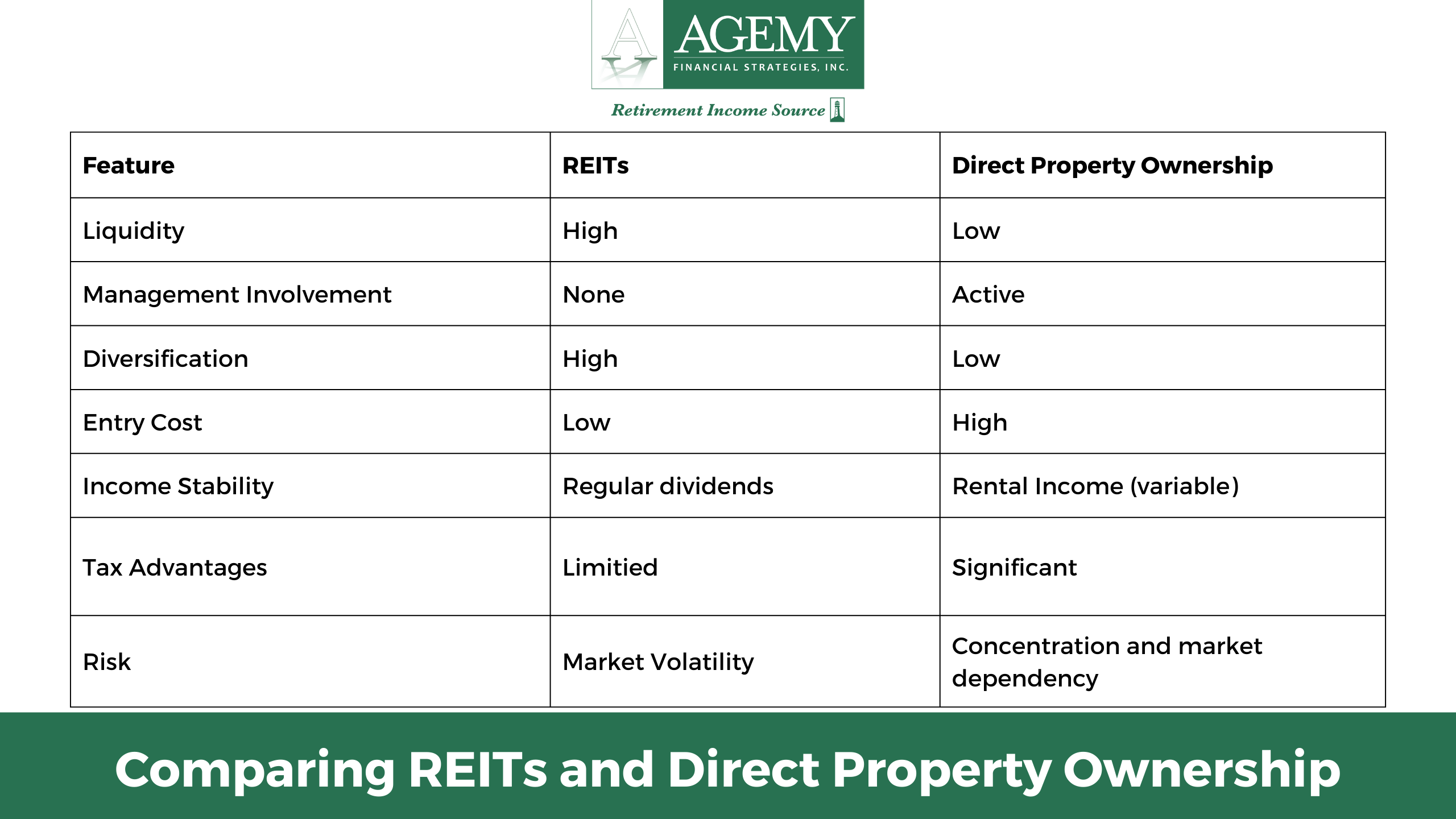
To make this decision easier, we’ve outlined the key differences between REITs and direct property ownership in the table below. Use it as a quick reference to compare their features side by side:

Partner With a Fiduciary Advisor

Investing in real estate during retirement can pose complexities, especially for those managing significant portfolios. If you’re looking for a fiduciary advisor with extensive experience in real estate investments, Agemy Financial Strategies is here to help.

Fiduciary advisors are legally obligated to prioritize your best interests, delivering impartial advice and recommendations aligned with your financial goals. Our seasoned professionals can help you identify opportunities and make well-informed decisions tailored to your unique needs and objectives.

Our advisors are adept at seamlessly integrating your real estate investments into your investment portfolio, helping to ensure they remain balanced and diversified. To explore our full-service offerings, see here.

Final Thoughts

REITs and direct property ownership offer unique advantages, making the right choice dependent on your financial goals, risk tolerance, and time horizon. At Agemy Financial Strategies, we help investors navigate the complexities of real estate investments for their financial portfolios. For over 30 years, our team of fiduciaries has guided clients in exploring opportunities in REITs and other investment vehicles to build resilient, diversified portfolios.

Contact us today to learn how we can help you achieve your financial aspirations and make informed decisions about real estate investments.


Disclaimer: This blog is intended for educational purposes only and should not be considered financial, tax, or legal advice. The information provided is general and may not apply to your financial situation. Investment decisions should always be based on your unique circumstances, goals, and risk tolerance. We recommend consulting a qualified financial advisor, such as our team at Agemy Financial Strategies, for personalized guidance tailored to your needs. Past performance does not indicate future results, and all investments carry inherent risks, including potential loss.

Breaking a leg, needing heart surgery, or suffering from chronic illnesses like diabetes and arthritis: What hurts the most as you age? While all of these medical incidents include extreme suffering, the biggest pain you could face in retirement is covering healthcare costs.

Planning for healthcare in retirement can be daunting, as it often comes with substantial costs that need careful consideration.

Health insurance premiums typically account for most retirees’ yearly healthcare expenses, making up around 70% to 81%. While most premiums can be managed using your monthly retirement income and federal healthcare programs, not being ready for unexpected out-of-pocket expenses can derail your retirement.

To navigate this complex landscape, you need the right strategy in place. Here’s how you can secure a financially stable and healthy retirement.

Assess Your Current Health and Healthcare Needs

The percentage of people in the United States who are 65 years and older has increased noticeably in recent years. And it’s expected to reach 20% of the US population by 2030. Because folks 65 and older typically spend more on healthcare than any other age group, this increase in older Americans will likely increase healthcare costs in the long run.

Assessing your current health and healthcare needs is a crucial initial step when planning for predicted costs in retirement. This process involves taking stock of your current well-being, as well as anticipating potential health issues in the future:

  1. Evaluate Your Current Health Status: Consider factors such as your overall physical fitness, existing medical conditions, family genetic disorders, and general well-being. Are you in good health or do you have any ongoing health concerns? Understanding your health status and potential issues down the road provides a baseline for future planning.
  2. Medical History: Take note of any surgeries, hospitalizations, or significant health events you have experienced. Understanding your medical history can help you anticipate potential health issues or complications that may arise as you age. Take note of any hereditary illnesses or conditions in your family, as these may influence your health outlook and potential healthcare costs.
  3. Chronic Conditions: If you have any chronic health conditions, assess their severity and the ongoing treatment they require. Chronic conditions often demand regular doctor visits, medications, and specialized care, all of which can significantly impact your healthcare expenses in retirement.
  4. Lifestyle Factors: Consider your lifestyle choices, such as diet, exercise, and stress management. As you age, these factors can substantially impact your overall health and healthcare needs.

By thoroughly assessing your past, present, and potential future health and healthcare needs, you’ll be better prepared to make informed decisions about your retirement healthcare budget. This process can also help you explore options for health insurance, long-term care insurance, and other financial strategies to ensure you have adequate resources to cover your healthcare expenses in retirement.

It’s essential to periodically revisit and adjust your healthcare plan as your circumstances change.

Understanding Medicare Coverage

Medicare is a federal health insurance program designed for those aged 65 and older, along with some younger individuals with disabilities. This coverage ranks as the second-largest program in the federal budget. After accounting for offsetting receipts in 2022, its expenditures reached $747 billion, 12 percent of the total federal spending.

As of March 2023, The Centers for Medicare & Medicaid Services (CMS) released the latest enrollment figures. As of March 2023, a noteworthy 65,748,297 individuals have become beneficiaries of Medicare. This number underlines how significant this coverage is, with nearly 100,000 more people enrolling since the previous report in September.

Medicare comprises four distinct parts, labeled A, B, C, and D, each addressing specific aspects of healthcare. Let’s look deeper at the different parts of Medicare to understand what it covers.

  • Medicare Part A: Often referred to as hospital insurance, Part A covers inpatient hospital stays, skilled nursing facility care, hospice care, and some home healthcare services.
  • Medicare Part B: As medical insurance, Part B covers outpatient care, doctor’s visits, preventive services, and medical supplies like durable medical equipment.
  • Medicare Part C (Medicare Advantage): These are private health insurance plans approved by Medicare, offering the same coverage as Parts A and B, often with added benefits such as prescription drug coverage and dental services.
  • Medicare Part D: This is the prescription drug coverage plan, available through private insurance companies, that helps cover the cost of prescription medications.

While Medicare provides substantial coverage, it’s important to know that it doesn’t cover everything. Many retirees opt for supplemental Medigap insurance or Medicare Advantage plans to fill the gaps. But you may need additional coverage beyond these plans.

Exploring Long-Term Care

Effective insurance planning can help preserve your retirement savings while ensuring you’re prepared for this crucial aspect of your healthcare needs. One of the most significant potential healthcare expenses in retirement is long-term care. Someone turning 65 today has almost a 70% chance of needing some type of long-term care services and support in their remaining years.

Planning for this expense is crucial, as Medicare only covers limited long-term care costs under specific conditions. According to a Genworth survey, the median cost for a private room in a nursing home exceeds $100,000 annually, while an in-home health aide could cost $60,000 or more annually.

Some individuals self-fund their long-term care expenses by relying on retirement savings, investments, and other assets. However, this can be risky, as long-term care costs can quickly deplete these resources. Developing a comprehensive retirement plan that accounts for potential long-term care needs is essential.

A long-term care insurance policy helps cover the costs of that care when you have a chronic medical condition, disability or disorder such as Alzheimer’s disease. Most policies will reimburse you for care given in a variety of places, such as:

  • Your home.

  • A nursing home.

  • An assisted living facility.

  • An adult day care center.

Considering long-term care costs is an important part of any long-range financial plan. But don’t wait: you won’t qualify for long-term care insurance if you have a debilitating condition, and long-term care insurance carriers won’t approve most applicants older than 75. Most people with long-term care insurance buy it in their mid-50s to mid-60s.

By taking a detailed approach to healthcare coverage in your retirement plan, individuals can help ensure they have the resources necessary to pay for the care they may require. Given the complexity of long-term care planning, consulting with a financial advisor can be valuable in developing a personalized strategy that addresses your unique needs and circumstances.

Working With a Financial Advisor

Healthcare costs and your health needs can change over time. It’s essential to regularly review and update your retirement healthcare plan to ensure it aligns with your current situation. Working with a Financial Advisor can help you navigate the complex world of healthcare costs and retirement savings strategies.

At Agemy Financial Strategies, our team of Fiduciary Advisors helps individuals navigate the complexities of long-term care planning. We’ll evaluate your current financial and healthcare situation, identify potential risks, and develop a personalized plan to meet your long-term care needs.

By recognizing that healthcare costs can pose a significant threat to your retirement nest egg, we will identify potential risks and costs associated with your health and insurance needs. This includes factors like inflation, potential health changes, and the impact of long-term care expenses on your savings.

Our trusted Financial Advisors will provide you with ongoing support by regularly reviewing your retirement plan and making necessary adjustments so you can enjoy your retirement years without worry.

Final Thoughts

Securing an enjoyable retirement requires careful planning–especially with today’s monumental healthcare expenses. By gaining insights into the healthcare cost landscape, you can proactively prepare yourself for these financial setbacks in your golden years.

If you’re seeking assistance crafting a retirement plan that considers hidden healthcare costs, speak with your dedicated Fiduciary advisors at Agemy Financial Strategies. We can help you decide what insurance plans are the best option for you.

If you’re ready to get started, contact us today and schedule your complimentary strategy session here.


Disclaimer: This content is for educational purposes only and should not be considered financial or investment advice. Please consult with the fiduciary advisors at Agemy Financial Strategies before making any investment decisions.