Posts

For individuals with substantial retirement savings — especially those navigating multi-million-dollar portfolios — Required Minimum Distributions (RMDs) can be one of the most complex and impactful aspects of retirement planning. 

RMDs are mandated by the IRS to help ensure that tax-deferred retirement assets eventually generate taxable income. While the rules can be straightforward for smaller portfolios, when you’re managing significant wealth, RMDs intersect with broader tax planning, estate strategies, income management, investment allocation, and legacy goals.

At Agemy Financial Strategies, we believe that RMDs should not be treated as a compliance exercise; they must be integrated into a thoughtful long-term financial plan. This blog unpacks what RMDs are, how they function in large portfolios, key strategies for management, and how proactive planning can minimize taxes, maximize flexibility, and support your broader financial goals.

1. Understanding RMD Fundamentals

What Are RMDs?

Required Minimum Distributions refer to the minimum amount that individuals must withdraw annually from certain tax-deferred retirement accounts once they reach a specific age. These include:

The purpose of RMDs is to ensure that retirement savings are eventually taxed. The IRS views these assets as tax-deferred, meaning contributions and earnings grow without annual tax until withdrawn.

When Do RMDs Start?

Following recent tax law changes, RMDs generally begin at age 73 for those who reach 72 after December 31, 2022; for those who reached 72 before this date, the prior RMD age still applies. The rules change over time, so periodic review with a financial advisor is critical.

How Are RMDs Calculated?

RMD amounts are based on your account balance as of December 31 of the prior year and your life expectancy factor from IRS tables. For high-net-worth individuals with multi-million-dollar accounts, this calculation often results in substantial distributions that can significantly impact taxable income.

For example, if your IRA balance was $4 million on December 31 and your IRS life expectancy divisor is 25.6 (a hypothetical from IRS tables), your RMD would be approximately:

$4,000,000 ÷ 25.6 = $156,250

This distribution is taxable as ordinary income and must be taken before the RMD deadline (generally December 31).

RMDs

2. RMD Challenges for Multi-Million-Dollar Portfolios

When account balances are significant, RMDs present unique challenges:

Tax Liability Can Increase Dramatically

Large distributions can push you into higher marginal tax brackets, increasing your overall tax burden. Even if you don’t “need” the money for living expenses, the IRS requires you to take these withdrawals and pay taxes on them.

Bracket Creep and the Impact on Cash Flow

“Bracket creep” occurs when RMDs increase your taxable income significantly enough to move you into a higher tax bracket. This shift can also affect how Social Security benefits are taxed, Medicare premiums, and eligibility for certain tax deductions or credits.

Compounding Effects Over Time

Because RMDs are recalculated annually based on the prior year’s balance, poor market performance or strategic rebalancing can increase or decrease future RMDs unpredictably.

3. Strategic Approaches to RMD Management

To stay ahead of RMD issues and optimize outcomes, high-net-worth investors should consider a suite of strategies:

A. Roth Conversions Before RMD Age

One of the most powerful tools in RMD planning is the Roth IRA conversion. Unlike traditional IRAs, Roth IRAs do not have RMDs during the owner’s lifetime.

How it helps:

  • Reduces future RMD amounts because assets moved to a Roth no longer count toward RMD calculations.
  • Grew absolutely tax-free — qualified withdrawals, including earnings, are not taxable.
  • Converts when tax rates are relatively low, potentially saving more in the long run.

Considerations:

  • Roth conversions are taxable events. You’ll owe income tax the year of conversion.
  • Timing matters: converting too much in a single year can spike your tax bracket.
  • A well-timed conversion plan can balance tax liability while reducing future RMDs.

B. Qualified Charitable Distributions (QCDs)

Charitable giving can be both philanthropic and tax-efficient through Qualified Charitable Distributions (QCDs).

What is a QCD?

  • A direct transfer from your IRA to a qualified charity.
  • Only available for individuals age 70½ and older.
  • Up to $100,000 per year can count toward your RMD without being included in taxable income.

Why it matters:

  • QCDs help reduce taxable RMD income.
  • They satisfy your RMD requirement while supporting causes you care about.
  • Especially useful for wealthy retirees with philanthropic goals.

C. Timing and Frequency of RMDs

Although RMDs must be completed by year-end, you have flexibility in when and how often withdrawals occur:

  • Lump sum: simple, but can spike income.
  • Periodic distributions (monthly, quarterly): smooths income and may help with tax planning.
  • Planned timing with cash flow needs: aligns distributions with expenses or investment rebalancing.

D. Tax Diversification: Balance Between Account Types

A diversified retirement portfolio should include:

  • Tax-deferred accounts (Traditional IRA/401k)
  • Tax-free accounts (Roth IRAs)
  • Taxable investment accounts

With these layers, you gain flexibility in withdrawal strategies that can help minimize the tax impact of RMDs. For example:

  • Use taxable accounts to fund spending needs early in retirement.
  • Defer tax-deferred withdrawals until required.
  • Use Roth assets strategically to manage income in high tax years.

E. Strategic Asset Location

This involves placing investments in the accounts where they’re most tax-efficient:

  • High-growth assets (like equities) may be better in tax-free or tax-deferred accounts.
  • Low-yield assets may live in taxable accounts.
  • Municipal bonds often suit taxable accounts because of tax-free interest.

Proper asset location can help reduce taxes over time and affect RMD outcomes.

RMDs

4. RMDs and Estate Planning

For high-net-worth individuals, RMDs intersect strongly with estate planning. The decisions you make now will shape how your assets pass to heirs, how taxes are applied, and how your legacy is preserved.

A. Stretch or Inherited IRAs

Prior to the SECURE Act of 2019, beneficiaries could “stretch” IRA distributions over their lifetime. Today, most non-spouse beneficiaries must distribute accounts within 10 years, accelerating taxable income.

Key impacts:

  • Heirs may face steep tax bills if distributions are large.
  • Strategic planning during your lifetime can mitigate tax shock for beneficiaries.

B. Trusts and Beneficiary Designations

Aligning beneficiary designations and trust structures with your overall estate plan helps ensure that assets flow as intended.

  • Carefully drafted trust language, especially for retirement accounts, can prevent unintended tax consequences.
  • Coordination between your financial advisor and estate attorney is vital.

C. Gifting Strategies

Gifting retirement assets before death can help reduce the size of your RMD base.

  • Lifetime gifts reduce the value of your taxable estate.
  • Some clients use gifts to transfer assets to children or trusts, aligning with legacy plans.

RMDs

5. Navigating RMD Pitfalls and Avoiding Costly Mistakes

Given the complexity of RMD rules, even sophisticated investors can make costly errors. Here are common pitfalls we help clients avoid:

A. Missing the Deadline

The deadline for taking an RMD is usually December 31, with one exception for the first RMD, which can be delayed until April 1 of the year after you reach the required age. However, delaying can lead to two RMDs in one year, doubling taxable income in that tax year.

Penalty for missing an RMD?
The IRS penalty used to be a shocking 50% of the amount not withdrawn. While it has been reduced (to 25% or potentially 10% for corrected distributions), it’s still significant.

B. Miscalculating the Amount

Using incorrect life expectancy tables or outdated IRS rules can lead to under-distribution, exposing you to penalties.

We always verify:

  • Current IRS life expectancy tables
  • Correct account values
  • Proper calculation methods
  • Updated rules after legislative changes

C. Ignoring Market Impact

If market values drop, RMDs based on prior high valuations can force distributions during unfavorable conditions:

Example:
If a portfolio fell 20% after December 31, you may be forced to liquidate assets at a loss to meet your RMD.

Solution?

  • Maintain sufficient liquidity outside of your retirement account.
  • Rebalance regularly to avoid forced selling.

D. Overlooking State Tax Implications

State income taxes vary widely. Some states tax retirement income; others do not. For high-net-worth retirees who split time between states or relocate in retirement, state tax planning is crucial.

6. Modeling RMD Impact: A Hypothetical Case Study

To illustrate the strategic power of RMD planning, let’s consider a hypothetical scenario.

Client Profile

  • Age: 74
  • Traditional IRA: $6,500,000
  • Roth IRA: $1,500,000
  • Taxable Investments: $3,000,000
  • Tax bracket: 32%
  • Charitable goals: $50,000/year

Scenario: No Strategy Applied

  • RMD calculated at $6.5M ÷ 22.0 (hypothetical divisor) = $295,455
  • Total taxable income jump due to RMD
  • No QCDs or Roth conversions
  • Result: higher tax bracket, increased Medicare premiums, reduced flexibility

Tax consequence? Potentially several tens of thousands more in taxes annually.

Strategic Plan Implemented

Year 1:

  • Roth conversion of $500,000
  • QCD of $50,000
  • RMD adjusted with a mix of periodic distributions and QCDs

Result:

  • Smaller future RMD base
  • Reduced taxable income year over year
  • Philanthropic goals met tax-efficiently

Long-term impact:

  • Reduced tax drag over decades
  • More assets left to heirs with favorable tax positioning
  • Greater control over income timing

7. Partnering with Agemy Financial Strategies for RMD Excellence

RMD planning isn’t one-and-done. It’s continuous. Changes in tax rules, market performance, personal goals, and estate priorities all influence the plan. That’s why high-net-worth investors choose a proactive partner.

What We Provide

  • Customized RMD modeling and forecasting
  • Roth conversion strategy tailored to your tax situation
  • Charitable planning using QCDs and donor-advised funds
  • Tax-efficient withdrawal sequencing
  • Coordination with estate and tax professionals
  • Ongoing review as laws and circumstances evolve

RMDs

8. Final Thoughts: RMDs as a Strategic Lever, Not a Mandate

For many retirees, RMDs are viewed with frustration as an unavoidable headache. But for wealthy investors, they are also a strategic lever for:

  • Tax planning
  • Cash flow management
  • Legacy design
  • Charitable impact

With thoughtful planning, RMDs don’t have to be a tax burden; they can be an opportunity to align retirement income with your long-term goals.

At Agemy Financial Strategies, we help our clients see beyond the numbers to the impact those withdrawals have on lifestyle, family, and legacy. If you’re managing a multi-million-dollar portfolio and want to ensure your RMD strategy is optimized for tax efficiency, flexibility, and peace of mind, we’re here to help.

Contact us today at agemy.com. 

Investment advisory services are offered through Agemy Wealth Advisors, LLC, a Registered Investment Advisor and fiduciary to its clients. Agemy Financial Strategies, Inc. is a franchisee of Retirement Income Source®, LLC. Agemy Financial Strategies, Inc. and Agemy Wealth Advisors, LLC are associated entities. Agemy Financial Strategies, Inc. and Agemy Wealth Advisors, LLC entities are not associated with Retirement Income Source®, LLC. The information contained in this e-mail is intended for the exclusive use of the addressee(s) and may contain confidential or privileged information. Any review, reliance or distribution by others or forwarding without the express permission of the sender is strictly prohibited. If you are not the intended recipient, please contact the sender and delete all copies. To the extent permitted by law, Agemy Financial Strategies, Inc and Agemy Wealth Advisors, LLC, and Retirement Income Source, LLC do not accept any liability arising from the use or retransmission of the information in this e-mail.


If you’re planning retirement income for 2026, Required Minimum Distributions (RMDs) remain one of the most important, and sometimes confusing, tax and cash-flow rules to manage. 

Over the last few years, Congress and the IRS have made several changes that affect when RMDs begin, how they’re calculated, and which accounts they apply to. This post breaks down the key updates heading into 2026, explains practical tax and planning implications, and offers clear steps you can take now to help reduce tax surprises and make your retirement income strategy more efficient.

Quick Summary: The Headlines You Must Know

  • The SECURE 2.0 Act permanently raised the RMD starting age to 73 for many taxpayers (and schedules a further increase to age 75 for future cohorts). 
  • The first-year RMD deadline rule still allows a delay until April 1 of the year after you turn the RMD age, but that can create the “two RMDs in one year” tax effect. 
  • The IRS has issued updated worksheets and guidance on life-expectancy tables and calculation methods; some proposed regulation effective dates were delayed, so watch plan-specific rules for 2026. 
  • Several practical rule changes from SECURE 2.0 (including Roth treatment in employer plans and catch-up contribution rules) indirectly affect RMD planning and tax brackets heading into 2026.

What Changed and What’s Staying the Same

RMD Updates for 2026

1. Age to Start RMDs: Still Rising, But Staged

The most material change affecting “when” RMDs start came from the SECURE 2.0 Act. It raised the RMD starting age to 73 (effective January 1, 2023) for people born in certain years, and it includes a scheduled increase to 75 for later cohorts (effective in the early 2030s). That’s why many people who were previously concerned about taking RMDs at 72 now have more flexibility. 

Important nuance: the exact year you must begin RMDs still depends on your birthdate. That means two people close in age could have different first-RMD years. Always check the IRS rules for your specific birth year. 

2. The “First Distribution” Timing and the Two-RMD Year Problem

You may still delay your first RMD until April 1 of the year after you reach the RMD age. But if you do, you’ll typically owe two taxable RMDs in that calendar year: the delayed first distribution (reported in that tax year) plus your regular RMD for that same year (due by Dec. 31). That can push you into a higher bracket unexpectedly, so plan accordingly. 

3. IRS Technical Updates, Worksheets, and Delayed Effective Dates

The IRS has updated worksheets and guidance (including updated life expectancy tables), but some portions of proposed regulations related to plan valuation and certain complex treatments were delayed or had effective dates adjusted. That means plan administrators must follow IRS guidance closely in 2025–2026 for which technical rules apply immediately versus which will come later. 

4. Indirect SECURE 2.0 Effects That Matter for RMD Planning

SECURE 2.0 introduced several changes that don’t alter RMD mechanics directly but affect retirement tax planning: expanded catch-up contribution options for certain ages and Roth conversion/catch-up rules for high earners, elimination of pre-death RMDs from Roth accounts inside employer plans (for distributions before death), and other features. Those provisions change the taxable balances you’ll have at RMD start, and influence strategies like Roth conversions and qualified charitable distributions (QCDs). 

How RMDs Are Calculated in 2026

RMD Updates for 2026

RMD calculation basics haven’t changed: for most accounts, you divide the account balance as of December 31 of the prior year by an IRS life-expectancy factor (from the Uniform Lifetime Table, Joint Life & Last Survivor Table, or the Single Life Table, depending on circumstances). Here’s a practical walk-through:

  1. Find your account balance: Use the fair market value as of December 31 of the previous year (for a 2026 RMD, use the Dec. 31, 2025 balance). 
  2. Choose the correct divisor: If your spouse is the sole beneficiary and more than ten years younger, use the Joint Life & Last Survivor Table; otherwise, use the Uniform Lifetime Table. The IRS provides worksheets to help pick the right factor. 
  3. Divide and report: Divide the account balance by the life expectancy factor. That’s your RMD for the year; you must withdraw that amount by Dec. 31 (or by April 1 only for your first RMD year if you choose to delay). 

Example: If your traditional IRA balance was $500,000 on 12/31/2025 and your life expectancy factor is 24.7 (example number), your 2026 RMD would be $500,000 ÷ 24.7 ≈ $20,243. That amount is taxable as ordinary income in 2026 unless it’s from after-tax contributions.

Tax Consequences and Common Pitfalls for 2026

A. “Two RMDs in One Year” Tax Spike

If you delay your first RMD to April 1, 2026 (because you turned 73 in 2025), you’ll likely need to take another RMD by Dec. 31, 2026, resulting in two taxable distributions in 2026. That can bump you into a higher tax bracket or affect the taxation of Social Security and Medicare IRMAA calculations. Plan for that cash-flow and tax effect if delaying makes sense. 

B. Penalty Risk

Failure to take the full Required Minimum Distribution (RMD) can still trigger a tax penalty, though it’s now less severe than in the past. Under SECURE 2.0, the excise tax for missed RMDs has been reduced from 50% to 25% of the amount not withdrawn. If the mistake is corrected quickly, that penalty may be lowered further—to 10%—provided the distribution is taken and a timely correction is made. Still, don’t count on relief; it’s best to treat RMD deadlines as firm. Learn more from the IRS.

C. Roths, Employer Plans, and Inheritance Complications

While Roth IRAs continue to be exempt from lifetime RMDs for original owners, SECURE 2.0 changed how Roth accounts inside employer plans are treated pre-death (elimination of RMDs before death for plan Roths). Additionally, inherited IRAs (especially post-2019 death rules) have special 10-year distribution windows and different rules for eligible designated beneficiaries. These distinctions can change both timing and tax exposure, and many of these details remain areas where IRS guidance is evolving into 2026, so consult up-to-date guidance. 

Practical Strategies to Manage RMD Impact in 2026

RMD Updates for 2026

Below are commonly used tactics; not all are appropriate for everyone, but they’re worth evaluating with your advisor.

1. Consider Timely Roth Conversions (But Mind the Tax Bracket)

Converting some traditional IRA dollars to a Roth IRA before RMDs begin (or in lower-income years) can permanently remove that money from future RMD calculations, shrinking future RMDs and future taxable income. Be mindful: conversions trigger tax now, so run year-by-year tax projections to avoid unwanted bracket creep.

2. Use Qualified Charitable Distributions (QCDs)

If you’re age-eligible, QCDs allow direct transfers from an IRA to a charity (up to $100,000 per year) that count toward your RMD but are not taxable income. For 2026, confirm eligibility and limits with the latest IRS guidance and your advisor. QCDs can be powerful for retirees with charitable intent and RMD pressure. 

  1. Coordinate Workplace Plan Roth Options and Rollovers

If you have both pretax and Roth balances in an employer plan, SECURE 2.0’s employer-plan Roth rule changes may make conversions or intra-plan Roth rollovers more attractive. Also, confirm whether your plan allows in-service rollovers to IRAs (for example, to convert to a Roth IRA on your timetable).

4. Time Withdrawals and Tax Management Across Years

Avoid taking your first RMD in April if it would cause two very large distributions in the same year that push you into a higher tax bracket (unless you calculated that the bracket impact is acceptable). Likewise, plan taxable income across other sources (Social Security, capital gains) to smooth bracket exposure.

5. Consider Longevity and Cash-Flow

If you expect to need retirement income later rather than sooner, delaying distributions (within the law) can give tax-deferred growth more time, but also increases future RMDs because of larger account balances. Model the tradeoff: tax now vs. potentially higher future RMDs.

Common Questions (FAQ) 

Q: Do I still have to take RMDs in 2026?
A: If you are at or past your applicable RMD starting age (which for many is 73), yes — RMDs are required. For the specific age that applies to your birth year, refer to IRS rules. 

Q: Can I avoid RMDs by keeping money in my 401(k)?
A: Not indefinitely. Employer plans may allow workers still employed to delay RMDs from that employer plan until retirement (if you’re a 5% owner rules don’t apply), but IRAs generally require RMDs when you reach the applicable age. Check plan rules and timing carefully.

Q: Are Roth IRAs subject to RMDs?
A: Roth IRAs owned by the original account owner are not subject to lifetime RMDs. However, Roth accounts inside employer plans have different rules; SECURE 2.0 reduced some pre-death RMD implications for plan Roth. Always confirm which account type you hold. 

Q: If I miss an RMD, can I fix it?
A: The IRS can reduce penalties if you correct the shortfall promptly and show reasonable cause. Historically, the penalty could be severe; always address missed RMDs immediately with your advisor. 

Action Checklist: What to Do Now for 2026

  • Review your birth year and confirm the precise first RMD year that applies to you. Use the IRS RMD page or ask your advisor. 
  • If you may face two RMDs in 2026 (you turned the RMD age in 2025 and delayed to Apr. 1, 2026), run a tax projection to estimate bracket impacts and Medicare IRMAA effects. 
  • Evaluate Roth conversion opportunities in low-income years, modeling tax cost vs. long-term RMD and tax benefits.
  • If charitable giving is planned, calculate QCDs to offset RMDs and reduce taxable income. 
  • Coordinate with your plan sponsors and custodians to help ensure correct worksheets/tables and any plan amendments are applied for 2026 distributions. 
  • Schedule a year-end review with your advisor to confirm you’ll take the correct RMD amounts on time and to address any last-minute plan or tax changes.

Final Thoughts From Agemy Financial Strategies

RMD Updates for 2026

RMDs can feel like an administrative annoyance, but they’re a powerful lever in retirement tax planning, for better or worse. The staged increases in RMD starting age from SECURE 2.0 give many retirees extra flexibility, but they also create complexity: mismatched birth-year rules, delayed IRS technical guidance, and new employer-plan Roth rules all create moving parts for 2026.

Your best defense is proactive planning: calculate projected RMDs, consider Roth conversions or QCDs where appropriate, communicate with plan administrators, and model the tax impact of timing choices like taking the first RMD in April versus December. In many cases, a modest change in distribution timing or a small conversion can save tens of thousands in taxes over a retirement horizon.

Ready to Take Control of Your RMD Strategy?

Navigating new RMD rules can be overwhelming, but you don’t have to do it alone. Agemy Financial Strategies specializes in helping retirees minimize taxes, optimize withdrawals, and build a confident, efficient income plan for every stage of retirement.

Contact Agemy Financial Strategies today to schedule your personalized RMD review and help ensure you’re fully prepared for 2026 and beyond.

Investment advisory services are offered through Agemy Wealth Advisors, LLC, a Registered Investment Advisor and fiduciary to its clients. Agemy Financial Strategies, Inc. is a franchisee of Retirement Income Source®, LLC. Agemy Financial Strategies, Inc. and Agemy Wealth Advisors, LLC are associated entities. Agemy Financial Strategies, Inc. and Agemy Wealth Advisors, LLC entities are not associated with Retirement Income Source®, LLC. The information contained in this e-mail is intended for the exclusive use of the addressee(s) and may contain confidential or privileged information. Any review, reliance or distribution by others or forwarding without the express permission of the sender is strictly prohibited. If you are not the intended recipient, please contact the sender and delete all copies. To the extent permitted by law, Agemy Financial Strategies, Inc and Agemy Wealth Advisors, LLC, and Retirement Income Source, LLC do not accept any liability arising from the use or retransmission of the information in this e-mail.

As we approach the end of 2024, reviewing your retirement goals is a prime opportunity. One essential aspect to consider? Required Minimum Distributions (RMDs).

RMDs are a cornerstone of many retirement strategies, yet their complex rules and tax implications can make them challenging to navigate. Planning ahead can help you stay on track and optimize your retirement withdrawals.

With new RMD regulations set for 2025, understanding these changes can help you optimize your financial plans. In this blog, we’ll break down the fundamentals of RMDs, highlight the upcoming updates, and share practical tips to help you manage your distributions effectively.

Understanding Required Minimum Distributions (RMDs) 

RMDs are mandatory withdrawals from certain retirement accounts once you reach a specific age. These withdrawals, which have grown tax-deferred over time, help retirement funds become taxable income. RMDs apply to the following accounts:

  • Traditional IRAs
  • SEP IRAs
  • SIMPLE IRAs
  • 401(k), 403(b), and 457(b) plans (excluding Roth 401(k)s).

The annual amount you must withdraw is calculated based on your age, life expectancy, and account balance at the end of the previous year. Failing to take the required amount can result in significant tax penalties. Let’s take a look at key changes to look for in 2025.

Key Changes to RMDs for 2025

As retirement planning continues to evolve, the latest updates to RMDs reflect efforts to provide more flexibility and tax advantages for retirees. The SECURE 2.0 Act introduced several new rules that impact how and when retirees must take distributions from certain accounts and adjust penalties. Below are the main changes for 2025 and beyond, designed to give retirees more control over their withdrawals and tax planning:

1. Increased RMD Starting Age: The age at which individuals must begin taking RMDs has been raised. In 2023, the age increased from 72 to 73, and it will further rise to 75 beginning in 2033.

2. Reduced Penalties for Missed RMDs: The penalty for failing to take an RMD has been reduced from 50% to 25% of the missed amount. If the missed RMD is corrected promptly, the penalty can decrease to 10%. Remember that the IRS has waived penalties for failing to take RMDs for certain inherited IRAs. For more information, see here.

3. Elimination of RMDs for Roth 401(k)s: Previously, Roth 401(k) accounts were subject to RMDs. Under the new rules, RMDs are no longer required for Roth 401(k)s, aligning them with Roth IRAs. It’s important to note that post-death minimum distribution rules, which also apply to Roth IRAs, still apply.

4. Annuities and RMDs: The SECURE 2.0 Act introduces provisions to make certain annuities more attractive within retirement plans. It allows certain types of annuity payments and clarifies qualifying longevity annuity contracts (QLACs) rules, including increasing the dollar limit to $200,000 and removing the 25% account balance cap.

5. RMDs for Surviving SpousesSurviving spouses can now elect to be treated as the deceased account owner for RMD purposes, potentially delaying the start of RMDs if the surviving spouse is younger than the deceased. This election is irrevocable and requires notifying the account administrator.

6. Qualified Charitable Distributions (QCDs): The annual limit for QCDs, which count toward RMDs, is now indexed for inflation, starting at $105,000 in 2024. A one-time QCD of up to $50,000 is also allowed through certain charitable remainder trusts or gift annuities.

Why These Changes Matter 

The recent adjustments to RMD rules are more than just technical updates—they bring valuable flexibility that can significantly benefit retirees. Here are some of the primary advantages of these changes:

1. Enhanced Growth Potential for Retirement Savings: Delaying RMDs means retirement accounts can stay invested and grow tax-deferred for longer. This change can be particularly beneficial for retirees who do not immediately need income from their retirement accounts, as it gives their investments more time to compound, potentially increasing their overall retirement nest egg.

2. More Control Over Roth 401(k) Withdrawals: With the removal of RMD requirements for Roth 401(k) accounts, retirees now have the same control as they do with Roth IRAs. This means they can choose when or if they want to withdraw from these accounts, providing a tax-free income source that can be preserved and used strategically within their broader retirement plan.

3. Reduced Penalties for Missed RMDs: The lower penalties for missed RMDs, combined with an opportunity for further reduction if corrected promptly, provide relief for retirees who may inadvertently miss their RMD deadline. This change reduces the financial impact of an honest mistake, making the RMD system more forgiving and manageable.

4. Options for Legacy and Charitable Planning: The increased flexibility around QCDs and the inflation-indexed annual limits make charitable giving a viable strategy for retirees looking to meet their RMD requirements while supporting causes they care about.

How to Calculate Your RMD in 2025

Calculating your Required Minimum Distribution (RMD) in 2025 is straightforward, with a few key steps. The IRS provides tables that determine your life expectancy factor based on your age, which you’ll use to calculate your RMD. Here’s a step-by-step guide:

  1. Determine Your Account Balance: Start with your retirement account balance as of December 31st of the previous year. This amount will serve as the basis for your RMD calculation.
  2. Find Your Life Expectancy Factor: Using the IRS Uniform Lifetime Table, locate the life expectancy factor corresponding to your age. This factor is updated periodically, so make sure you use the latest table for accuracy.
  3. Calculate the RMD: Divide your account balance by the life expectancy factor. The result is the minimum amount you must withdraw from your account for the year.

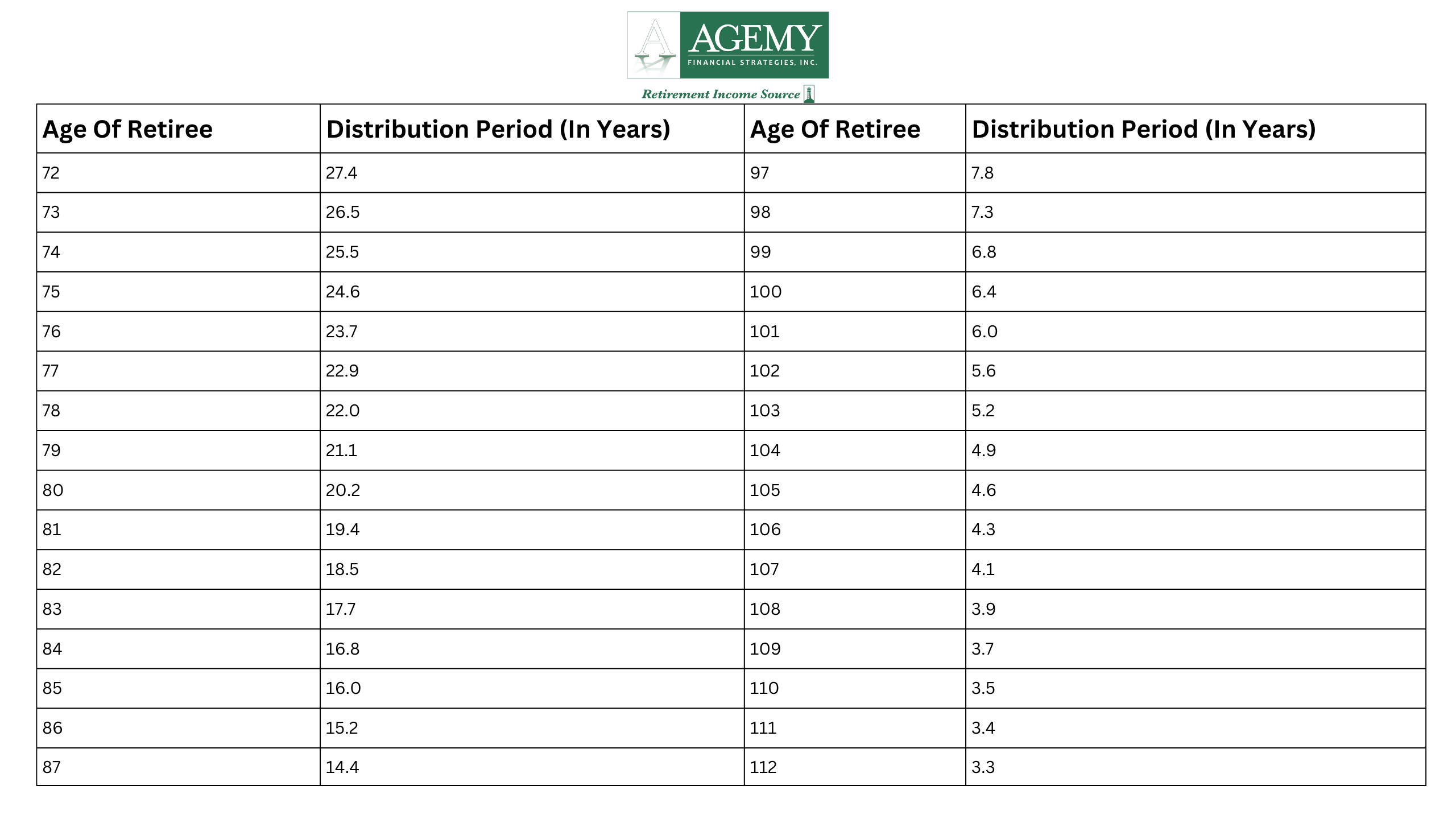
Below is a portion of the IRS Uniform Lifetime Table to illustrate life expectancy factors by age:

Source: Internal Revenue Service (IRS)

Common Mistakes to Avoid

Navigating RMDs can be challenging; even small missteps can have significant financial consequences. Being mindful of some of the most frequent pitfalls can help you protect your retirement savings and maximize the benefits of these withdrawals. Here are three key mistakes to watch out for when planning your RMDs:

  • Missing the Deadline: Missing your RMD deadline can lead to hefty penalties. Know your required distribution date and withdraw the correct amount.
  • Not Planning for Taxes: RMDs can push you into a higher tax bracket. Working with a fiduciary advisor can help you create a strategy to manage these distributions in a tax-efficient manner.
  • Overlooking Beneficiary Designations: Your beneficiaries will have their own RMD requirements based on the inherited RMD rules. Regularly review your designations to align with your estate and financial goals.

Working with a fiduciary can help ensure that your RMDs are managed to align with your financial goals and help you make the most of your retirement savings.

Working With an Advisor 

New tax laws, potential shifts in Medicare premiums, income bracket adjustments, and evolving rules around charitable giving mean that your retirement income strategy may need some fine-tuning. Staying informed is essential for making the most of these adjustments and preparing your RMDs effectively.

At Agemy Financial Strategies, we provide personalized insights into your RMD responsibilities and tax-efficient strategies to help you manage these distributions. Our fiduciary advisors are dedicated to helping you meet your RMD obligations while optimizing your financial situation within IRS guidelines. We’ll work closely with you to assess your income needs in retirement and develop a plan that aligns with your financial goals and adapts to new regulations.

As part of our commitment to supporting your financial well-being, we offer tools like our free online RMD Calculator to help you estimate your required withdrawals. For more details on our services, please see our service offerings page here.

Final Thoughts

Navigating RMDs effectively requires staying informed about changing rules and understanding how these mandatory withdrawals impact your retirement income. Planning, keeping abreast of IRS updates, and consulting with financial advisors can help ensure that RMDs work in your favor while minimizing tax liabilities.

At Agemy Financial Strategies, our team is here to provide personalized guidance and support tailored to your financial needs and goals. Let us help ensure your tax obligations are appropriately managed throughout your retirement.

Preparing for 2025 doesn’t have to be overwhelming—let us help guide you toward a well-planned and prosperous new year. Contact us today to schedule your complimentary consultation.


Disclaimer: The information provided in this blog is for educational purposes only and is not intended as specific financial or investment advice. Each individual’s financial situation is unique, and any changes to your retirement income strategy or RMD planning should be discussed with a qualified financial advisor. We recommend consulting with our team at Agemy Financial Strategies to ensure your decisions align with your financial goals, risk tolerance, and the latest IRS regulations.

The SECURE Act 2.0, enacted in late 2022, changed over 90 rules about IRAs and other qualified retirement plans, including RMDs. Here’s what you need to know about upcoming changes in 2024.

Required Minimum Distribution (RMD) represents the mandatory amount that must be withdrawn from various retirement accounts, including employer-sponsored retirement plans, traditional IRAs, SEPs, or SIMPLE IRAs, by their owners and qualified retirement plan participants once they reach retirement age.

Each account has its RMD calculation, and the distribution must be taken from the respective account unless specific exceptions apply. There’s still time to take your RMD from your retirement accounts (excluding Roth IRAs) before the year’s end—but time is of the essence. Here’s what you need to know for 2024.

Understanding SECURE Act 2.0 Changes

The SECURE 2.0 Act, officially named the Securing a Strong Retirement Act of 2022, ushered in a wave of modifications to the regulations governing when and how individuals must withdraw funds from their retirement accounts to avoid incurring additional taxes and penalties. These alterations were crafted to simplify the retirement landscape for individuals by extending deadlines, eliminating certain requirements, and reducing penalties for errors.

Some of these changes have already taken effect, while others are slated to roll out in the coming years, with the final adjustments set to be fully implemented by 2033. The primary modifications to the Required Minimum Distributions (RMDs) encompass adjustments to the RMD age, exemption of RMDs for Roth accounts, the removal of RMD obstacles for life annuities, and a reduction in excise tax penalties for RMD errors, along with the introduction of a 3-year statute of limitations. Let’s delve into these details and understand what they mean for 2024.

When Do I Need to Take My RMD?

RMDs are mandatory withdrawals from certain tax-advantaged retirement accounts. The first time you take an RMD, you’ll have until April 1 of the year following the year you turn 72 (or age 73 if you turn 72 in 2023 or later) to do so. The IRS sets this age threshold to confirm that retirees begin drawing down their retirement savings and paying taxes on the deferred income.

The deadline for taking your RMD each year is December 31st. Failing to withdraw the required amount by this date can result in steep penalties—a 25% excise tax on the amount you should have withdrawn. If the RMD is missed, you must fill out IRS Form 5329. See Part IX of this form for the section regarding the additional tax on excess contributions.

Which Accounts Require Distributions?

RMDs are primarily associated with traditional Individual Retirement Accounts (IRAs) and employer-sponsored retirement plans such as 401(k)s and 403(b)s. Roth IRAs do not require RMDs during the account owner’s lifetime; they are funded with after-tax dollars. However, beneficiaries of Roth IRAs may have RMD obligations.

You must calculate the RMD for each account separately if you own multiple traditional IRAs. However, you can aggregate the total RMD amount and withdraw it from one or more of your IRAs. This flexibility allows you to choose which account(s) to withdraw from as long as you satisfy the total RMD requirement.

You can use the IRS’s Uniform Lifetime Table to determine the amount you need to withdraw. The RMD amount is calculated based on your account balance and life expectancy to deplete the account over your expected lifetime. If you haven’t yet done so, estimate your personal RMD withdrawals with our free online RMD Calculator here.

What Is The 3-Year Statute Of Limitations?

A statute of limitations is a time frame within which the IRS can take legal action or collect unpaid taxes. It’s a legal restriction that dictates how far back the IRS can reach when assessing penalties, pursuing criminal charges, or initiating other actions related to tax matters. Tax issues have different statutes of limitations, each with specific rules and considerations.

Previously, Form 5329 left the statute of limitations open-ended, allowing penalties and interest to accumulate without a defined limit. Fortunately, Congress addressed this issue, but it’s important to note that there are still some exceptions that retirees should be aware of.

  1. Extended Statute for Excess IRA Contributions: The SECURE 2.0 Act extends the statute of limitations to 6 years for the 6% excess IRA contribution penalty. However, this relief is unavailable if an IRA has acquired property below its fair market value, and the statute of limitations remains indefinite if Form 5329 isn’t filed.
  2. Expansion of IRS Self-Correction Program: SECURE 2.0 broadens the IRS self-correction program, known as the Employee Plans Compliance Resolution System (EPCRS), to include individual retirement account errors, including a waiver for failure to take RMDs. Note that self-correction for IRAs under EPCRS may be available for only a few years, as SECURE 2.0 grants the IRS that timeframe to guide this matter.
  3. Elimination of RMDs for Roth 401(k)s: SECURE 2.0 brings welcome relief by eliminating required minimum distributions (RMDs) for Roth 401(k)s and other employer Roth plans. While Roth IRAs were never subject to lifetime RMDs, Roth 401(k)s were. Starting in 2024, individuals will not need to roll over Roth 401(k) funds to a Roth IRA to avoid RMDs, as these funds will be exempt from RMDs.

Working With a Fiduciary Advisor

Understanding how recent changes impact your IRA is crucial in the ever-evolving landscape of retirement laws. Among the essential topics for IRA owners to grasp is the concept of RMDs. Working with a trusted fiduciary advisor can be a game-changer in effectively managing – and understanding – your RMDs. They can help you fulfill your legal obligations and provide personalized guidance to optimize your financial situation within the bounds of IRS regulations.

You don’t have to tackle the complexities of required minimum distributions alone. At Agemy Financial Strategies, we are here to offer in-depth insights into your specific RMD responsibilities and explore tax-efficient strategies for RMD management. We work with you to assess your retirement income needs and craft a tailored plan aligned with your unique financial goals. Please refer to our service offerings page for a comprehensive list of our services.

Final Thoughts

By staying informed about when RMDs apply, how they’re calculated, and your options for managing them, you can confidently navigate this aspect of retirement planning with confidence. If you’re ready to take the first step to achieving your retirement goals, our team is here to assist you. The better you comprehend your financial strategy, the more effectively you can manage your finances for generations to come!

Set up your complimentary retirement strategy session today. We look forward to helping you on your road to retirement and beyond.


Disclaimer: This content is for educational purposes only and should not be considered financial or investment advice. Please consult with the fiduciary advisors at Agemy Financial Strategies before making any investment decisions.