Posts

From changing Federal Reserve rates to evolving tax brackets, the financial landscape is shifting quickly. As you prepare for the 2026 tax year, now is an ideal time to revisit key retirement planning fundamentals. Notably, the Internal Revenue Service has announced important updates, allowing savers and investors to adjust their strategies and maximize their future security.

These changes impact how much you can set aside, who qualifies for deductions, and how the phase‑outs operate.

Here’s what you need to know. 

What’s Changing? A Snapshot of the 2026 Limits

IRA Limits 2026

The IRS recently released its cost‑of‑living adjustment notice for 2026, and the headline figures are:

  • The annual contribution limit for IRAs (traditional + Roth combined) is increasing from $7,000 to $7,500.
  • The catch‑up contribution (for those age 50 and older) is increasing from $1,000 to $1,100.
  • For traditional IRA deduction eligibility (when you or your spouse are covered by a workplace plan), the income phase‐out ranges are increasing:
    • For single filers covered by a workplace plan: $81,000–$91,000 (up from $79,000–$89,000)
    • For married filing jointly (spouse making the contribution covered by a workplace plan): $129,000–$149,000 (up from $126,000–$146,000)
  • For Roth IRA contribution eligibility, the phase‐out ranges increase to:
    • Singles/Heads of Household: $153,000–$168,000 (up from $150,000–$165,000)
    • Married filing jointly: $242,000–$252,000 (up from $236,000–$246,000)
  • The limit for SIMPLE IRAs also increases (though our focus here is the general IRA).

These adjustments may seem modest, but they reflect meaningful changes, especially when compounded over time, and they can alter your optimal retirement savings strategy.

Why These Changes Matter

1. Increased Contribution Room

By boosting the IRA limit to $7,500 (+$500 over 2025), savers gain additional tax‑advantaged space. While $500 may sound small, over a multi‑decade horizon and combined with investment growth, this extra buffer can meaningfully increase retirement assets.

2. Deductions and Eligibility Shift Upward

Because the income phase‑out thresholds have risen, a greater number of taxpayers can qualify for either the full or partial deductible traditional IRA contribution, or contribute to a Roth IRA when previously limited. That opens up strategic flexibility.

3. Inflation Protection

These annual adjustments reflect inflation and help preserve purchasing power for retirement savings. Without adjustments, over time, the value of tax‑advantaged contributions would erode.

4. Strategic Planning Opportunities

Higher limits and higher thresholds give financial advisors and their clients more flexibility to optimize tax treatment, asset allocation, and timing of contributions (especially for catch‑up contributions for older savers).

Strategic Implications for Different Groups

IRA Limits 2026

Here’s how these changes affect various types of savers, and what to consider.

A. Younger Savers (Under 50)

Key takeaway: You can now contribute up to $7,500 for 2026.

  • If you’re not covered by a retirement plan at work, you may still deduct your traditional IRA contribution fully.
  • If you are covered, check the phase‑out; it begins at $81,000 for singles in 2026.
  • Roth IRAs become more accessible due to higher phase‐out thresholds; consider whether Roth vs. traditional makes more sense based on your tax expectations.
  • Use the extra room ($500) to “max out” earlier in the year rather than waiting until year‑end.

B. Mid‑Career Savers (~50‑59)

Key takeaway: You now have a catch‑up allowance of $1,100 for IRAs on top of the base $7,500 (so, $8,600 total if you do the full catch‑up).

  • If you haven’t yet taken full advantage of retirement‑savings opportunities, now is the time.
  • Consider whether you should split contributions between traditional and Roth IRAs depending on your current vs. future tax rate expectations.
  • If you have a workplace plan with catch‑up capabilities, coordinate between your IRA and your employer plan to help optimize total savings.

C. Approaching Retirement (60‑63)

Key takeaway: While the $7,500 (plus catch‑up) applies for IRAs, for 401(k)/403(b)/457 plans, there is “super catch‑up” potential.

  • This is a time to accelerate savings and help ensure you’re leveraging every tool.
  • It may be wise to revisit your expected retirement income, required distributions (RMDs), tax brackets, and how your IRA vs. 401(k)/Roth allocations will play out.

D. High‑Income Earners & Those with Complex Coverage Scenarios

Key takeaway: With thresholds shifting upward, eligibility is broader—but caveats remain.

  • If your income exceeds the new phase‑out thresholds for deduction or Roth eligibility, you may need to consider “backdoor” strategies (e.g., nondeductible traditional IRAs rolled into a Roth), but also be aware of the tax and legislative risks of such moves.
  • Check whether your spouse is covered by a workplace plan that affects the deduction phase‑out for you.
  • For those with multiple retirement accounts and significant assets, this is a great year to revisit how you allocate contributions, manage tax diversification (pre‑tax vs. Roth), and integrate with estate‑planning goals.

Practical Planning Steps for 2026

IRA Limits 2026

To help maximize the benefit of these IRA limit changes, here are practical steps you can consider taking: 

  1. Mark Your Calendar and Update Savings Plan
    • Adjust your payroll or brokerage auto‑contribution settings for 2026 to reflect the $7,500 limit (or $8,600 if age 50+).
    • Consider splitting contributions (January vs. monthly installments) to help reduce the risk of missing contributions later.
  2. Revisit Your Traditional vs. Roth IRA Strategy
    • A traditional IRA offers an immediate deduction (subject to income/coverage rules).
    • Roth IRA offers tax‑free growth and withdrawals (in many cases).
    • With higher phase‑outs, more people may now qualify for a Roth or partial deductibility of a traditional IRA.
    • Ask: “What do I expect my tax rate to be in retirement vs now?” If you anticipate higher taxes later, Roth may be more appropriate; if you’re in a higher tax bracket now and expect to be lower later, traditional might win out.
  3. Review Income Phase‑Outs Early
    • If your modified adjusted gross income (MAGI) is near or above the phase‑out ranges, plan accordingly. For example:
      • Single & covered by a workplace plan: $81,000–$91,000.
      • Married filing jointly & contributor covered by a workplace plan: $129,000–$149,000.
    • If you’re outside eligibility for deduction or Roth, consider alternative strategies (e.g., nondeductible IRA + Roth conversion).
    • Keep an eye on contributions and income as the year progresses; you may need to adjust withholdings or timing of income/unrealized gains to stay within thresholds.
  4. Coordinate With Employer Plans
    • While this blog focuses on IRAs, don’t forget employer‑sponsored plans (401(k), 403(b)). The base contribution limit for 2026 is $24,500.
    • The interplay between your employer plan and IRA can determine your optimal tax‑advantaged savings strategy. For example, if you’re maxing out your 401(k) and still have capacity, then the IRA becomes another layer.
  5. Catch‑Up Contributions for Older Savers
    • If you’re age 50 or older, you now have $1,100 additional room in IRAs.
    • If you’re also using catch‑ups in your employer plan or in a SIMPLE plan, map out how all of your catch‑ups work together.
    • Consider your “tax brackets,” estate‑planning implications (RMDs), and whether Roth conversions make sense now vs. later.
  6. Monitor Legislative and Regulatory Risk
    • Rules can change (e.g., treatment of Roth conversions, taxation of high‑income earners, required minimum distributions).
    • It’s wise to revisit your retirement plan annually (or more often) and adjust for regulatory shifts, not just inflation‑indexed changes.
  7. Focus on Investment Growth & Tax Efficiency
    • Contribution limits matter, but arguably more important is what happens after the contribution. Regularly review your investment mix, fees, rebalancing, and tax efficiency within and outside of tax‑advantaged accounts.
    • Especially for IRA accounts (traditional or Roth), consider your long‑term withdrawal strategy, tax diversification, and how these accounts integrate with taxable and tax‑free buckets.

Why You Should Act Now (Even Though It’s for 2026)

  • Advance Planning Matters: Setting up your contribution strategy now (including payroll elections or brokerage automatic settings) puts you ahead of the game rather than scrambling later.
  • Benefit of Early Contributions: The earlier you contribute, the longer your money can potentially grow tax‑advantaged.
  • Year‑End Income Management: Because eligibility (deduction or Roth) depends on income, you may want to manage income, bonuses, or capital gains timing in 2026 to stay within favourable ranges.
  • Coordination Across Accounts: If you have multiple accounts (401(k), IRA, HSA, taxable brokerage), then building an integrated strategy now helps you avoid surprises.
  • Leverage the Extra Room: Given the ceilings are rising, every dollar of tax‑advantaged savings matters; take full advantage.

Common Questions About Roth IRAs

Q: “Can I contribute $7,500 to a Roth IRA and another $7,500 to a traditional IRA in 2026?”
A: No, the $7,500 (plus the $1,100 catch‑up if applicable) is the total contribution limit across all IRAs (traditional + Roth) for the tax year. That means you must allocate it between the two types. Strategically, we’ll help you decide the split that makes sense given your tax bracket, expected future tax, and income eligibility.

Q: “I’m covered by a workplace retirement plan; can I still deduct my traditional IRA contribution?”
A: Possibly, it depends on your filing status and MAGI. For 2026, if you’re single and covered by a workplace plan, the deduction is phased out between $81,000–$91,000. Above $91,000, your deduction is eliminated. We’ll review your projected income to determine whether a deduction applies, whether a Roth makes more sense, or whether a nondeductible IRA + conversion strategy is appropriate.

Q: “I earn too much for a Roth IRA. Now what?”
A: The 2026 phase‑out for Roth contributions (single: $153,000–$168,000; married filing jointly: $242,000–$252,000) gives more leeway. If your income still exceeds those levels, you may consider a backdoor Roth approach: contribute nondeductible to a traditional IRA, then convert to Roth. But there are nuances (tax on existing traditional IRA balances, timing, legislative risk). We’ll walk you through whether that strategy works for you.

Q: “Does the new limit mean I should increase my contribution from $7,000 to $7,500?”
A: If you’re in a position to do so, yes. Increasing your contribution gives you extra tax‑advantaged savings. But contributing the max isn’t always the correct move for everyone. We’ll assess your cash flow, emergency reserves, employer match (if applicable), debt management, and overall financial picture to decide whether prioritizing IRA max contributes to your strategy.

Q: “How do these changes affect my employer‑sponsored plan (like a 401(k))?”
A: While this blog focuses on IRAs, the 2026 401(k) limit is rising to $24,500 (from $23,500), and catch‑up for those 50+ becomes $8,000 (from $7,500). We’ll look at both IRA and employer plan contributions in tandem. Often, the optimal strategy is to first capture any employer match, then maximize tax‑advantaged contributions across all vehicles.

How Agemy Financial Strategies Can Help

IRA Limits 2026

At Agemy Financial Strategies, we’re highly experienced in tailored retirement and wealth‑planning solutions. Here’s how we bring value to this update:

  • Personalized Contribution Planning: We’ll run projections for your tax bracket now and in retirement, factoring in the new 2026 limits, to determine the optimal mix of traditional vs. Roth contributions.
  • Income & Tax Phase‑out Modeling: We’ll analyze your income trajectory to determine whether you fall into phase‑out zones for deduction or Roth eligibility, and help you stay within favourable thresholds when possible.
  • Integrated Account Strategy: We look across IRAs, 401(k)s, HSAs, taxable accounts, and brokerage accounts to build a holistic savings and withdrawal strategy. We’ll also consider RMDs, legacy goals, and tax‑efficient withdrawals.
  • Year‑End and Mid‑Year Reviews: We’ll monitor for the rest of 2025 and 2026 to verify that your contribution elections, withholding, investment allocations, and income management stay aligned with your goals and the shifting regulatory environment.
  • Ongoing Oversight and Adjustment: Retirement planning is not “set it and forget it.” We’ll regularly revisit accounts, investment performance, tax law changes, and market dynamics to help keep your strategy optimized.

Final Thoughts: Seize the Opportunity

The 2026 IRA contribution limit increase is modest but meaningful, especially when combined with higher income thresholds and broader access to Roth opportunities. For many clients of Agemy Financial Strategies, this is a chance to boost savings, refine tax strategies, and align contributions more closely with long‑term goals.

Whether you’re just beginning your savings journey, accelerating toward retirement, or somewhere in between, now is the time to update your plan:

  • Evaluate whether you can increase your IRA contribution to $7,500 (or $8,600 if you’re age 50+).
  • Reassess your traditional vs. Roth IRA allocation given the new phase‑out ranges.
  • Coordinate your contributions across IRAs and employer plans.
  • Discuss with your advisor the case for backdoor Roth conversions, catch‑up strategies, and tax‑efficient retirement withdrawal planning.

At Agemy Financial Strategies, we’re committed to helping you navigate these changes, optimize what you can control, and keep your retirement strategy resilient in a changing environment. 

If you’d like to review your 2026 retirement‑savings plan, contribution elections, or tax‑efficient strategies, let’s schedule a time to connect at agemy.com. 


Investment advisory services are offered through Agemy Wealth Advisors, LLC, a Registered Investment Advisor and fiduciary to its clients. Agemy Financial Strategies, Inc. is a franchisee of Retirement Income Source®, LLC. Agemy Financial Strategies, Inc. and Agemy Wealth Advisors, LLC are associated entities. Agemy Financial Strategies, Inc. and Agemy Wealth Advisors, LLC entities are not associated with Retirement Income Source®, LLC. The information contained in this e-mail is intended for the exclusive use of the addressee(s) and may contain confidential or privileged information. Any review, reliance or distribution by others or forwarding without the express permission of the sender is strictly prohibited. If you are not the intended recipient, please contact the sender and delete all copies. To the extent permitted by law, Agemy Financial Strategies, Inc and Agemy Wealth Advisors, LLC, and Retirement Income Source, LLC do not accept any liability arising from the use or retransmission of the information in this e-mail.

But navigating the complexities of charitable giving can be challenging. That’s where asking an experienced fiduciary advisor can make all the difference. A knowledgeable advisor can help you develop a giving strategy tailored to your unique financial situation, helping your contributions effectively support the causes you care about while complementing your overall retirement plan.

In this blog, we’ll provide insights for HNW retirees looking to enhance their year-end giving strategies. Here’s what you need to know to make the most of your charitable contributions.

Why Charitable Giving Matters

Charitable giving is more than just a financial transaction; it’s a powerful way to make a meaningful and lasting impact on the causes you care about. Beyond the immediate benefit to the organizations and communities you support, it helps align your values with your financial plans. This creates a dual benefit of doing good while managing your wealth strategically.

With ongoing economic shifts and changes in tax laws, understanding the best ways to give can help you maximize your philanthropic contributions and financial position. Choosing the right methods and timing for your donations can help reduce your taxable income, minimize capital gains, and potentially lower your estate taxes. Let’s take a look at some of the best strategies you can use for your charitable giving efforts.

1. Leverage Donor-Advised Funds (DAFs)

A Donor-Advised Fund (DAF) is one of the most popular and flexible strategies for charitable giving. It allows you to contribute assets—such as cash, stocks, or real estate—to a tax-advantaged fund, which can then distribute grants to multiple charities over time. DAFs offer several benefits, including potential tax deductions, centralized giving, and investment growth opportunities. Here’s a closer look at the advantages:

  • Tax Benefits: Donors can receive an immediate tax deduction for a DAF contribution, which is especially beneficial in high-income years. For 2024, the deduction limit for gifts to donor-advised funds is up to 30% of adjusted gross income (AGI) for non-cash assets held for more than one year and up to 60% of AGI for cash donations.
  • Flexibility: DAFs can distribute funds to multiple charities over time, allowing donors to choose the timing and recipients of their donations according to their philanthropic goals.
  • Investment Growth: While the assets are held in the DAF, they can be invested, potentially growing the value of the charitable gift over time. This growth can result in even more significant support for the charities of your choice.

2. Utilize Qualified Charitable Distributions (QCDs)

A Qualified Charitable Distribution (QCD) allows you to transfer funds directly from your IRA to a qualified charity, helping to lower your taxable income. This strategy is particularly beneficial for those taking Required Minimum Distributions (RMDs), as it allows you to satisfy the RMD requirement without increasing your taxable income while supporting a cause you care about.

  • How It Works: If you are an IRA owner aged 70½ or older, you can exclude up to $100,000 of QCDs from your annual gross income. For married couples, each spouse aged 70½ or older with their own IRA can exclude up to $100,000, for a combined total of up to $200,000 annually.
  • Tax Benefits: QCDs are excluded from your taxable income, providing a tax benefit even if you do not itemize deductions. This makes them especially valuable for those who typically take the standard deduction.
  • Eligibility: QCDs can only be made from IRAs, not 401(k)s or other retirement accounts. As always, it’s important to consult with a fiduciary advisor to determine eligibility and whether this strategy is right for you.

3. Bunching Charitable Contributions

For many taxpayers, itemizing deductions can be challenging due to high standard deduction thresholds. In 2024, the standard deduction amounts are $14,600 for Single or Married Filing Separately, $29,200 for Married Filing Jointly or Qualifying Surviving Spouse, and $21,900 for Head of Household. To exceed these thresholds and benefit from itemizing, “bunching” charitable contributions into a single tax year can be an effective strategy.

  • How It Works: Instead of spreading donations evenly over several years, you “bunch” two or more years’ contributions into one year. This allows you to itemize deductions in the year of the large donation, potentially maximizing your tax benefits while taking the standard deduction in other years.
  • Who Benefits: This approach is particularly advantageous for high-net-worth individuals with fluctuating incomes or those anticipating a high-income year when maximizing deductions would be most beneficial.

4. Consider Charitable Remainder Trusts (CRTs)

A Charitable Remainder Trust (CRT) is a powerful tool for individuals seeking income streams while making a meaningful charitable contribution.

  • How It Works: You contribute assets to the CRT, providing you (or other beneficiaries) an income stream for a set period or lifetime. At the end of the trust term, the remaining assets are donated to your chosen charity.
  • Tax Benefits: The donor receives an immediate charitable deduction based on the present value of the remainder interest that will eventually go to charity. Appreciated assets can be sold within the CRT without incurring immediate capital gains taxes.
  • New IRS Guidance: In 2024, the IRS has issued new guidance on calculating CRT payouts, making it crucial to consult with a fiduciary advisor to ensure compliance and maximize benefits.

5. Incorporating Charitable Giving into Estate Planning

Estate planning and charitable giving often go hand in hand for HNWIs. Incorporating charitable strategies into your estate plan can help meet your philanthropic goals while minimizing estate taxes.

  • How It Works: One of the simplest ways to include charitable giving in your estate plan is by making properly structured gifts and donations. You can remove assets from your estate before the total is tallied and taxed.
  • Tax Benefits: For 2024, the annual exclusion from the gift tax—the amount you can gift annually to individuals without incurring tax consequences—has increased from $17,000 to $18,000 per recipient. The lifetime exclusion amount, the total amount you can transfer without incurring federal gift or estate taxes, is currently $13.61 million per individual. Staying informed about these limits is essential, as they can change periodically.
  • Review and Update: Given the potential for changes in tax laws, it’s crucial to review and update your estate plan regularly to help ensure it aligns with current regulations and your personal and financial goals. Working with a fiduciary advisor can help you navigate the complexities of gifting and estate planning, helping align your financial decisions with your long-term objectives.

Partner with a Fiduciary Advisor: A Strategic Approach to Giving

Charitable giving can be complex, and the rules and regulations change frequently. This is where working with a fiduciary advisor can be beneficial. At Agemy Financial Strategies, we understand the unique needs of HNWIs in Connecticut, Colorado, and beyond and offer personalized strategies to help you maximize your charitable impact while aligning with your financial goals.

  • Risk Management: We meticulously vet and evaluate potential beneficiaries to help ensure your contributions to reputable and financially stable organizations. This thorough due diligence minimizes the risk of misappropriating or misusing your funds.
  • Customized Strategies: We understand that each giver has unique financial circumstances and philanthropic goals. Our team works closely with you to develop a personalized giving strategy that aligns with your values, maximizes the impact of your contributions, and optimizes your tax benefits.
  • Legacy Planning: If you aspire to create a lasting philanthropic legacy, our fiduciaries can help guide you. We assist in setting up trusts, endowments, or foundations that perpetuate your giving beyond your lifetime.
  • Compliance and Reporting: Agemy Financial Strategies is well-versed in the complex regulations and reporting requirements associated with charitable giving. We handle all compliance matters so that your donations adhere to legal guidelines and that you receive the full range of tax benefits.

Make Your Impact Count in 2024

At Agemy Financial Strategies, we are committed to providing our clients guidance on charitable giving as they plan for retirement. We recognize your generosity’s profound impact on your community and financial well-being.

Our team of experienced fiduciaries is here to support you every step of the way, helping your retirement years be both fulfilling and financially sound. With our help, you can create a lasting legacy that reflects your values while potentially maximizing your tax benefits.
Contact us today to set up a complimentary strategy session and discover how we can help you achieve your philanthropic and financial goals.


Disclaimer: This content is for educational purposes only and should not be considered financial or investment advice. Please consult with the fiduciary advisors at Agemy Financial Strategies before making any investment decisions.

If you’re approaching retirement, you might be familiar with Required Minimum Distributions (RMDs). However, the rules surrounding RMDs are changing, and without proper planning, you could risk IRS-enforced collections. Here’s what you need to know. 

The SECURE 2.0 Act of 2022, enacted Dec. 29, includes almost 100 new retirement plan provisions, many of which aren’t effective yet. But some big changes involving required minimum distributions and related penalty relief are already in effect

Before we delve into the 3-year statute of limitations, let’s briefly recap what RMDs are and why they matter.

What are RMDs?

required minimum distribution (RMD) is the amount of money that must be withdrawn from employer-sponsored retirement plans by owners and qualified retirement plan participants of retirement age.

In 2023, the age at which you must begin taking RMDs changed to 73 years. Account holders must, therefore, start withdrawing from a retirement account by April 1, following the year they reach age 73. The exact age may vary depending on your retirement plan and when you were born.

The IRS uses a specific formula to calculate your RMD, considering your account balance and factors related to life expectancy. In 2023, the RMD table is based on the IRS’s widely-used Uniform Lifetime Table. It’s worth noting that the IRS has additional tables for account holders and beneficiaries whose spouses are considerably younger.

SECURE 2.0 Shakes Things Up for RMDs

The Securing a Strong Retirement Act of 2022, known as SECURE 2.0 Act, made some changes to the rules about when and how people need to take out money from their retirement plans to avoid being hit with extra taxes.

These changes were designed to make things easier for retirees by giving them more time to file, removing certain requirements, and lowering penalties if they make a mistake. Some of these updates are already in place, and others will start in the coming years, with the last ones kicking in by 2033. The main changes to RMDs include:

1. Changes to the Participant’s RMD Age (Effective in 2023)

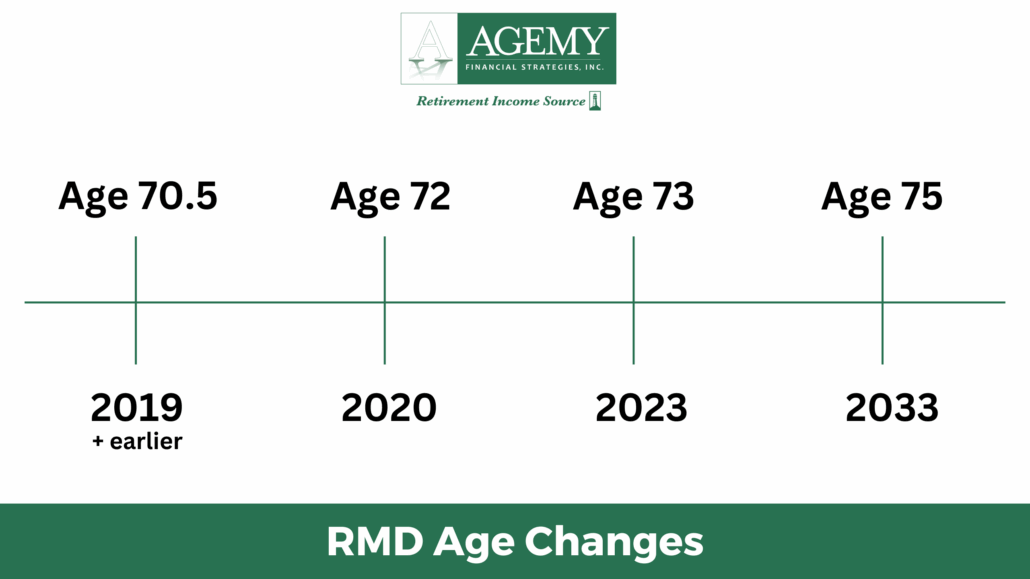
Under the SECURE Act of 2019, the RMD age for a terminated participant increased from 70½ to 72 effective in 2020. SECURE 2.0 again changes the RMD age to 73 in 2023, and ultimately to age 75. The chart below highlights the changes to the RMD age at relevant points in time.

Required Minimum Distributions (RMDs)

2. No RMDs Required from Roth Accounts (Effective in 2024)

For 2024 and later years, RMDs are no longer required from designated Roth accounts. You must still take RMDs from designated Roth accounts for 2023, including those with a required beginning date of April 1, 2024. You can withdraw more than the minimum required amount.

3. Removing RMD Barriers to Life Annuities

The rules for Required Minimum Distributions are designed to prevent individuals from deferring taxes for too long, and one way they achieve this is by limiting annuity contracts from providing small initial payments that grow excessively over time. However, in practice, these rules can sometimes restrict even minor increases in benefits. But now, Congress is working to make annuity contracts in defined contribution plans more appealing.

Section 201 of the Act allows commercial annuities purchased under 401(k) and other defined contribution plans, as well as IRAs, to offer the following:

  1. Increases in payments of up to 5% per year.
  2. The option to receive certain lump sums that replace future distribution payments.
  3. The ability to accelerate up to 12 months’ worth of payments.
  4. Reasonable dividend payments.
  5. Death benefits that are equal to the cost of the annuity, reduced by previous payments.

4. Reduction in Excise Tax for RMD Errors

Despite regularly appearing on the list of priorities for tax-exempt and government entities’ compliance, it’s not unusual for people to make mistakes when it comes to Required Minimum Distributions (RMDs).

Up to now, one of the largest penalties in the Tax Code was the 50% penalty for not taking an RMD. It was based on the RMD amount that should have been taken but wasn’t.

SECURE 2.0 lowers this penalty to 25%, and then to 10% if the missed RMD is timely made up.

What is the Statue of Limitations?

The statute of limitations is the time limit for the IRS to file charges or collect back taxes. In general, a statute of limitations is a law (statute) that limits how far back you can go when assessing a penalty, charging someone with a crime, or taking other actions. There are different statutes of limitations for different types of tax issues.

RMDs and the 3-Year Statute of Limitations

There is now a three-year statute of limitations associated with the failure to take a required minimum distribution (RMD) from a retirement account. Overlooked when the SECURE Act 2.0 was enacted was Section 313 of the Act, which added a 3-year statute of limitation for the failure to take an RMD. If an RMD is missed, the 25% penalty is only applicable for the next three years. So what happens after those three years have passed?

The statutes of limitations not only limits the IRS in assessing additional tax on returns filed, but it also limits the amount of time you have to claim a refund or credit due. If the three-year deadline for filing has passed, the IRS, by law, cannot issue your refund.

IRS Form 5329 is a tax form used for reporting retirement plan penalties and requesting a waiver of the RMD penalty. As mentioned above, in the past, not filling out this form for penalty relief meant that the three-year statute of limitations wouldn’t start, resulting in a hefty 50% excise tax. However, thanks to the SECURE 2.0 Act, this tax has been reduced to 25%, and it could drop to 10% if you take action to withdraw the missed RMD within two years.

To solve this problem, the SECURE 2.0 Act introduced a statute of limitations tied to when individual files their federal income tax return, Form 1040. If no federal income tax return is required, the statute period begins on what would have been the tax filing deadline. This new statute of limitations covers missed RMDs for three years and excess IRA contributions for six years but doesn’t apply to early distributions.

Form 5329 left the statute of limitations open indefinitely, allowing penalties and interest to accumulate unnoticed. A positive outcome happened once Congress addressed the issue. However, even with these changes, there are still exceptions retirees should make note of.

Exceptions to the Rule

While the 3-year statute of limitations relieves many retirees, it’s essential to be aware of exceptions. Not all missed RMDs qualify for this extended correction period. Here are some important exceptions:

  1. Extended Statute for Excess IRA Contributions: The SECURE 2.0 Act extends the statute of limitations to 6 years for the 6% excess IRA contribution penalty. However, this relief is unavailable if an IRA has acquired property below its fair market value, and the statute of limitations remains indefinite if Form 5329 isn’t filed.
  2. Expansion of IRS Self-Correction Program: SECURE 2.0 broadens the IRS self-correction program, known as the Employee Plans Compliance Resolution System (EPCRS), to include inadvertent individual retirement account errors, including a waiver for failure to take RMDs. Note that self-correction for IRAs under EPCRS may not be available for two years, as SECURE 2.0 grants the IRS that timeframe to guide this matter.
  3. Elimination of RMDs for Roth 401(k)s: SECURE 2.0 brings welcome relief by eliminating required minimum distributions (RMDs) for Roth 401(k)s and other employer Roth plans. While Roth IRAs were never subject to lifetime RMDs, Roth 401(k)s were. Starting in 2024, individuals will not need to roll over Roth 401(k) funds to a Roth IRA to avoid RMDs, as these funds will be exempt from RMDs.

Working With a Fiduciary Advisor

It’s important to understand how the recent law changes affect your IRA. One of the more relevant topics IRA owners should be aware of is a Required Minimum Distribution (RMD). Partnering with a trusted Fiduciary Advisor can play a crucial role in helping you manage your RMDs effectively so you meet your legal obligations while optimizing your financial situation. They can also offer tailored guidance to help maximize your retirement savings while following IRS rules.

You don’t have to battle the confusing regulations for certain required minimum distributions alone. From advice on understanding your specific RMD obligations, to helping you explore tax-efficient ways to manage your RMDs, Agemy Financial Strategies works alongside you to assess your retirement income needs and create a plan for your unique needs and goals.

Final Thoughts

This 3-year statute of limitations provision is yet one more reason why we anxiously await proposed Regulations from the IRS with respect to how the SECURE Act 2.0 will be interpreted. There are several other provisions in the Act that need a lot of clarification. A solid understanding of Required Minimum Distributions is essential for anyone with tax-advantaged retirement accounts. Failing to comply with RMD rules can result in costly penalties, potentially derailing your retirement plans.

By staying informed about when RMDs apply, how they’re calculated, and your options for managing them, you can confidently navigate this aspect of retirement planning. If you’re ready to take the first step to achieving your retirement goals, our team is here to assist you. The better you comprehend your financial strategy, the more effectively you can manage your finances.

For a detailed list of our service offerings, see here.

Set up your complimentary retirement strategy session today.


Disclaimer: This content is for educational purposes only and should not be considered financial or investment advice. Please consult with the fiduciary advisors at Agemy Financial Strategies before making any investment decisions.

Are you making the most of your 401(k)? A well-managed 401(k) is the cornerstone of a secure retirement, yet many people miss out on maximizing its potential. A recent survey reveals that while 57% of workers contribute to a 401(k) or company-sponsored savings plan, a staggering 41% are leaving money—and peace of mind—on the table.

In this blog, we’ll break down essential strategies to help ensure your 401(k) works harder for you. We will cover everything from smart asset allocation to minimizing fees. Here’s what you need to know to help protect your future and avoid common retirement pitfalls.

Understanding Your 401(k): The Basics

A 401(k) is a retirement plan employers offer that lets you save and invest part of your paycheck before taxes are taken out. One of its biggest benefits is tax-deferred growth, which allows your savings to grow over time without being taxed until you withdraw them in retirement. Here’s a breakdown of the key features of a 401(k):

  • Tax Advantages: Your 401(k) contributions are made pre-tax, lowering your annual taxable income. For 2024, you can contribute up to $23,000 as an employee or $69,000 when combining employee and employer contributions. If you’re 50 or older, you can add an extra $7,500 as a catch-up contribution, raising your limit to $30,500.
  • Employer Matching: Many companies will match a portion of what you contribute to your 401(k), which is essentially free money. However, about 25% of workers don’t contribute enough to get their full match. Ensure you’re contributing enough to get the full match and take advantage of this opportunity.
  • Investment OptionsMost 401(k) plans offer a variety of investment choices, such as stocks, bonds, and mutual funds. Selecting a mix that fits your risk tolerance and long-term retirement goals is key.

Diversify Your Investments

Diversification is a fundamental principle of investing that involves spreading your money across different asset classes, such as stocks, bonds, and cash, to help minimize risk. For 401(k) holders, diversification can provide a potential cushion against market volatility and help reduce the impact of a downturn in any single investment.

A well-diversified portfolio might include a mix of:

  • Equities (Stocks): These offer the potential for higher returns but come with increased risk. Consider allocating a percentage of your portfolio to stocks depending on your age and risk tolerance.
  • Bonds: These are generally considered safer investments, providing steady income with lower risk. As you near retirement, increasing your allocation to bonds can help protect your portfolio from market fluctuations.
  • Cash or Cash Equivalents: These provide stability and liquidity but usually offer lower returns. It’s advisable to keep a small portion of your portfolio in cash or cash equivalents for emergencies.

Consider Roth 401(k) Contributions

While traditional 401(k) contributions are made pre-tax, some employers offer a Roth 401(k) option, where contributions are made after-tax. This means you pay taxes now, but qualified withdrawals in retirement are tax-free. This strategy can be effective for high-net-worth individuals, especially if you anticipate a higher retirement tax bracket. To determine whether Roth contributions are right for you, consider the following:

  • Current vs. Future Tax Rates: If you expect your retirement tax rate to be higher, Roth contributions might be more beneficial.
  • Diversification of Tax Treatment: By having both traditional and Roth savings, you can have more flexibility to manage your tax liability in retirement.
  • Required Minimum Distributions (RMDs): Traditional 401(k)s require you to begin taking required minimum distributions (RMDs) once you reach age 73, which can push you into a higher tax bracket if you’re forced to withdraw more than you’d like. On the other hand, Roth 401(k)s don’t have RMDs during your lifetime, allowing your money to continue growing tax-free for as long as you want.

Ultimately, deciding between traditional and Roth 401(k) contributions—or a combination of both—depends on your financial situation and long-term retirement goals. Consulting a fiduciary advisor can help tailor a strategy that maximizes your tax savings and helps ensure you’re on track for a successful retirement.

Consider Rolling Over to an IRA

Effectively managing your retirement accounts, such as 401(k)s and Roth IRAs, requires a strategic approach that maximizes tax benefits. Many individuals choose to roll their 401(k) into an Individual Retirement Account (IRA) upon retirement. This move can offer several key benefits:

  • Increased Contribution Limits: In 2024, more Americans will qualify for Roth IRA contributions, with the adjusted gross income (AGI) limits rising. For single filers, the AGI range will increase to $146,000–$161,000, up from $138,000–$153,000 in 2023. For married couples filing jointly, the range will rise to $230,000–$240,000, up from $218,000–$228,000.
  • Wider Range of Investment Options: IRAs typically provide more investment choices than 401(k) plans, offering the potential for greater diversification flexibility.
  • Consolidation: If you have multiple 401(k) accounts from different employers, rolling them into a single IRA can simplify account management.

However, be mindful of potential downsides, such as losing certain creditor protections unique to 401(k) plans. Consult a fiduciary advisor to help weigh the pros and cons based on your specific situation.

Regularly Review and Adjust Your Plan

Over time, market movements can cause your retirement portfolio to stray from its intended asset allocation. Rebalancing is the process of selling assets that have performed well and buying those that have underperformed to help restore your portfolio to its original target allocation. This practice helps maintain your preferred risk level so that your 401(k) remains aligned with your retirement goals.

Regular reviews of your 401(k) and similar accounts are essential to keeping your plan on track. It’s a good idea to set a schedule to review your account at least once a year, making adjustments as necessary based on:

  • Life Changes: Significant events like marriage, divorce, or the birth of a child may require you to rethink your financial strategy.
  • Retirement Goals: As your goals evolve, you may need to adjust your contributions, asset allocation, or even your retirement timeline.
  • Market Conditions: Shifts in the economic environment can prompt necessary changes to your investment strategy.

Working with a fiduciary advisor can help you navigate timely adjustments that will help ensure your 401(k) stays on course as your circumstances and the market evolve.

Seek Professional Guidance

Properly managing a 401(k) requires knowledge and ongoing attention. Consulting with a fiduciary advisor can help you make informed decisions tailored to your unique circumstances. At Agemy Financial Strategies, our team of fiduciary advisors is here to walk you through the process of achieving renewable wealth so that your money can work hard for you and you can reap the benefits of a comfortable retirement.

Here are just some of the many ways we can help our clients:

  • Goal Setting: We will help you establish clear and attainable retirement goals, crafting a personalized financial blueprint to realize your retirement lifestyle aspirations.
  • Risk Assessment: Identifying potential financial risks is the cornerstone of our approach. 401(k) plans come with specific rules and regulations that must be followed to maintain their tax-advantaged status. A fiduciary can help ensure that your plan complies with ever-changing tax laws and regulations, reducing the risk of penalties and setbacks.
  • Portfolio Management: We’re highly experienced in implementing and managing a diversified investment portfolio meticulously aligned with your long-term objectives and risk tolerance.
  • Regular Reviews: Beyond managing your 401(k), a fiduciary can help you develop a comprehensive financial plan encompassing your entire financial picture. This includes tax management, estate planning, and other critical components contributing to your financial well-being.

Last Thoughts

In the quest for financial independence, your 401(k) stands out as a promising tool for a secure financial future. Its high contribution limits and tax advantages can significantly boost your retirement savings. However, partnering with a fiduciary is valuable in navigating the complexities for long-term success.

At Agemy Financial Strategies, you can rest assured knowing that your financial affairs are in capable hands. Our priority is helping you take care of yourself and your family. We want to learn more about your situation, identify your dreams and goals, and provide you with the highest level of service.

If you want to learn more about how we can help you manage your wealth, schedule a complimentary strategy session here today.


Disclaimer: This content is for educational purposes only and should not be considered financial or investment advice. Please consult with the fiduciary advisors at Agemy Financial Strategies before making any investment decisions.