Posts

Understanding the Difference Can Make or Break Your Retirement

You’ve worked hard to build a nest egg. Maybe you’ve recently retired or are planning to. You have savings, a 401(k), maybe even a buyout offer or pension lump sum, and now you’re asking the million-dollar question:

How should I invest this money to last the rest of my life?

Too many retirees fall into a trap: they think they’re investing when they’re really speculating, and that mistake can lead to stress, losses, and the fear of running out of money.

At Agemy Financial Strategies, we’ve spent over 30 years helping people retire and stay retired. One of the most important conversations we have with new clients is this: Are you a speculator or an investor? Understanding this distinction isn’t just financial jargon; it’s critical to helping protect your retirement lifestyle.

What’s the Real Difference?

Let’s get clear on what these terms actually mean. The financial world uses them loosely, but at Agemy, we define them in a simple, meaningful way:

✅ Investor:

An investor puts money into assets that produce consistent, predictable income, regardless of short-term price movements. Think dividends, interest, rental income, or fixed-income strategies. You don’t have to “hope” for gains; your money is working for you now.

❌ Speculator:

A speculator puts money into assets hoping they’ll go up in value. There’s no guaranteed return. Speculators often chase “hot stocks,” time the market, or follow media hype, trying to buy low and sell high.

A Tale of Two Retirees: George and Betty

Imagine George. He’s just taken an early retirement package and received a sizeable lump sum. Excited but unsure, he turns on a financial news network. A panel of TV “experts” enthusiastically recommends a trending tech stock. George jumps online and buys it.

Six months later, the stock has tanked.

George is confused. He thought he was investing. But what he really did was speculate. He acted on a tip, without understanding the fundamentals of the company or having an income strategy in place.

Meanwhile, his friend Betty took the same buyout but worked with a fiduciary. Her retirement portfolio pays her $70,000 a year in steady income through interest, dividends, and other reliable sources. Her plan isn’t flashy, but it’s dependable.

George is hoping.

Betty is planning.

Why This Matters More in Retirement

Before retirement, time is on your side. You can ride out volatility, recover from losses, and afford to take risks. But in retirement, the rules change. You’re no longer adding to your portfolio; you’re drawing from it. And that makes every decision matter.

Here’s what happens when retirees continue to speculate instead of invest:

  • They may see their portfolio grow during good years, only to suffer big losses during market downturns.
  • If those losses occur early in retirement, they can permanently reduce the income their portfolio can generate (this is called sequence-of-returns risk).
  • They start withdrawing principal, not income, which can drain their savings faster than expected.

The Biggest Retirement Fear Is Real

According to a study by the Employee Benefit Research Institute, more than 40% of retirees fear outliving their money. That fear is justified, especially when portfolios are overly reliant on market growth instead of income.

At Agemy Financial Strategies, we believe retirement should not be a gamble. It should be a strategy.

TR = I + G: The Formula for Retirement Success

One concept we teach frequently is simple but powerful:

Total Return = Income + Growth (TR = I + G)

Too many people focus only on growth. But if your account grows without producing income, you’re relying on hope.

A Strong Retirement Strategy Includes:

  • I (Income): Regular, predictable payments from interest, dividends, rental income, annuities, or structured notes.
  • G (Growth): Moderate, stable growth to keep pace with inflation and allow for future flexibility.

You need both, but income becomes the priority in retirement. After all, you can’t spend percentage points or stock charts; you spend cash.

How Financial Media Leads You Astray

TV finance programs, online blogs, and social media influencers often blur the lines between investing and speculating. They present tips, trends, and trade ideas under the guise of “investment advice,” when really, they’re offering entertainment.

These media outlets don’t know your goals, your risk tolerance, or your timeline. And many of the “experts” already own the stocks they’re hyping. They profit when you jump in after them, providing liquidity for their exit.

The result? People like George buy high, sell low, and repeat the cycle.

Are You Aligned With Your Goals?

One of the most common disconnects we see is between what people say they want and how their portfolios are actually structured.

  • A client says, “I’m conservative,” but 85% of their portfolio is in high-risk mutual funds.
  • Another says, “I want income,” but everything they own requires capital appreciation to pay off.

This is what we call incongruence. And it’s dangerous.

When markets drop and fear kicks in, people realize their portfolios don’t match their comfort zone. They sell at the wrong time, miss the recovery, and lock in losses.

That’s why clarity and congruence are essential to retirement planning.

Self-Assessment: Are You a Speculator or an Investor?

Take a few minutes to ask yourself these five key questions:

  1. What is your primary investment goal?
    a. Generate steady income
    b. Grow wealth slowly
    c. Make quick profits through market timing

  2. How often do you check your investments?
    a. Once a quarter
    b. Monthly
    c. Daily or with every market swing

  3. What is your typical holding period for an investment?
    a. Several years
    b. One to two years
    c. A few weeks or months

  4. How do you respond to market volatility?
    a. Stay calm and stick to the plan
    b. Get anxious, but try to wait it out
    c. Panic and sell quickly

  5. What’s more important to you in retirement?
    a. Income that covers your lifestyle
    b. Higher returns
    c. Beating the market

If most of your answers were A, you’re likely an investor. If they were mostly C, you’re likely a speculator, even if you didn’t realize it. And if most of your answers were B, you fall into what we might call the “Hybrid Investor” category. You’re not fully speculative, but you’re also not fully income-focused.

You Can Have a Play Account, Just Keep It Small

At Agemy Financial Strategies, we don’t believe speculation is inherently bad. In fact, some of our clients have small “fun money” accounts they use to buy individual stocks or chase growth ideas.

But we always separate that from their core retirement portfolio. That portfolio must:

  • Provide income
  • Protect principal
  • Last as long as they do

Speculation can be entertainment. Your retirement strategy should be your lifeline.

Why Working With a Fiduciary Matters

We’ve seen countless examples where people unknowingly received guidance from advisors who don’t differentiate between speculation and investing. Or worse, they sell products based on commissions, not client outcomes.

At Agemy Financial Strategies, our advisors are fiduciaries. That means we are legally and ethically bound to act in your best interest, not ours.

We view our role as your CFO, while you remain the CEO of your finances. We bring clarity, structure, and strategies designed around your goals, risk tolerance, and timeline.

You’ve worked hard for your money. It’s time your money worked just as hard for you.

The Path Forward: Income, Clarity, Confidence

Your retirement years should be full of freedom, not fear. And they certainly shouldn’t depend on guessing what the market will do next.

If you’re within 5–10 years of retirement, or already there, now is the time to pivot toward:

Let us help you align your money with your mission and build a plan that pays you to live the retirement you deserve.

Final Thoughts: Build a Retirement Strategy That Works for You

Whether you’re a steady income investor, a hopeful speculator, or somewhere in between, the key to a successful retirement isn’t luck; it’s alignment. Your investment strategy should reflect your goals, your lifestyle, and your need for reliable, long-term income.

At Agemy Financial Strategies, we believe retirement should be about freedom, not financial uncertainty. That’s why we focus on educating and empowering our clients to understand where they stand—so they can take control of where they’re going.

Speculation has its place, but your core retirement plan should be grounded in confidence, not hope.

Let our team help you answer the question: Are you a speculator or an investor, and is your money working the way it should?

Visitwww.agemy.com to schedule your complimentary retirement review.

We’ll help you build a personalized strategy that prioritizes what matters most: security, income, and peace of mind.

Retire with purpose. Stay retired with confidence. That’s the Agemy way.


FAQs: Understanding Speculation vs. Investing in Retirement

1. What’s the main risk of speculating in retirement?
Speculation involves putting your money into assets that may or may not increase in value, often without generating income. In retirement, this strategy can be especially risky because losses can derail your income plan, and you may not have time to recover. If the market drops early in retirement, you could be forced to withdraw from a declining portfolio, increasing the risk of outliving your money.

2. Is it okay to have a portion of my portfolio in speculative assets?
Yes, but with caution. Some retirees choose to allocate a small percentage of their portfolio (often called a “play account”) for speculative opportunities. The key is to ensure your core retirement strategy is built around income, safety, and consistency. Speculation should never be the foundation of your retirement plan.

3. How can I tell if I’m investing or speculating?
Ask yourself: Does this asset pay me regularly? If not, you’re likely speculating. True investments, such as dividend-paying stocks, bonds, or income-generating real estate, provide predictable returns. If your portfolio relies solely on asset growth and market timing, you’re taking a speculative approach, even if unintentionally.

4. Can income-based investing still offer growth potential?
Absolutely. At Agemy Financial Strategies, we help clients design income-first portfolios that also include moderate, sustainable growth. The goal isn’t to eliminate growth, but to prioritize reliable income, then layer in growth for flexibility and inflation protection.

5. Why is working with a fiduciary so important for retirees?
A fiduciary is legally obligated to act in your best interest. Many financial salespeople push speculative products for commissions, not because they align with your retirement goals. At Agemy, we’re fiduciaries who focus on educating and guiding clients toward investment strategies that prioritize income, risk management, and long-term retirement success.


Disclaimer: This content is for educational purposes only and should not be considered financial or investment advice. Please consult with the fiduciary advisors at Agemy Financial Strategies before making any investment decisions.


Real estate has long been a cornerstone of wealth-building, offering opportunities for steady income, diversification, and long-term growth. For those approaching retirement, it’s not just about whether to include real estate in your portfolio—it’s about choosing the right approach to suit your goals and lifestyle.

Deciding what to do with yourself in the period between Christmas and the New Year can feel confusing for us all. More unsettling? The daunting decision between Real Estate Investment Trusts (REITs) and direct property ownership! While the festivities take a quick break, use your time off to research each option, as each has its own benefits and challenges, making it essential to understand how they align with your financial plans.

This blog dives into the pros and cons of both strategies, helping you make informed decisions and position your real estate investments for success in retirement.

What Are REITs? 

Real Estate Investment Trusts (REITs) own, operate, or finance income-generating real estate. They pool funds from multiple investors, allowing shareholders to own a portion of large-scale properties without directly managing them. REITs are traded on public stock exchanges, making them an accessible and liquid investment vehicle.

More than 45% of American households own REITs, nearly double the estimate from two decades ago. They can be a good fit if you want the diversification benefits of real estate without the commitment and responsibilities of directly owning property. To better understand how REITs work, let’s explore the three main types available to investors, each with unique features and benefits:

  1. Equity REITs: These REITs focus on owning and managing properties. Some examples include apartment complexes, office buildings, and shopping malls. Investors have the potential to earn income through rental revenue.
  2. Mortgage REITs: Investing in mortgages and mortgage-backed securities has the potential to generate income from interest payments.
  3. Hybrid REITs: These combine the strategies of equity and mortgage REITs, offering potential income from rent and interest.

Now that we know more about what REITs entail let’s look at the pros and cons.

Pros of REITs

  1. Liquidity

One of the most significant benefits of REITs is their high liquidity. Since REIT shares are traded on stock exchanges, investors can quickly buy or sell them, unlike physical real estate transactions, which can take weeks or months. This liquidity is particularly advantageous for investors needing immediate access to funds without being locked into long-term real estate ownership.

  1. Diversification

REITs allow investors to spread their exposure across various properties, sectors, and geographies. For example, a single REIT may include assets like shopping malls, apartment complexes, healthcare facilities, and industrial warehouses. This built-in diversification can help reduce the risk of potential loss that could occur if an individual property or sector underperforms. It’s an efficient way to participate in the real estate market without the concentration risk of owning one or two properties.

  1. Accessibility

REITs offer a low barrier to entry compared to direct property ownership. Instead of needing tens or hundreds of thousands of dollars for a down payment on a property, investors can gain exposure to real estate markets with the cost of a single REIT share. This accessibility can make REITs a practical choice for small-scale investors or those just starting to diversify their portfolios into real estate.

Cons of REITs

  1. Market Volatility

Since REITs are traded on stock exchanges, they are subject to the same market volatility as other publicly traded securities. Their values can fluctuate based on economic conditions, interest rates, or changes in investor sentiment, regardless of the underlying real estate performance. This volatility can be challenging for investors seeking stability or those uncomfortable with the stock market’s swings.

  1. Limited Control

Investing in REITs means relinquishing decision-making power to the REIT’s management team. Investors cannot control which properties the REIT buys, sells, or develops. This lack of control can be a drawback for those who prefer a hands-on approach to managing their investments or want to focus on specific property types or locations.

  1. Tax Implications

While REITs often pay attractive dividends, these payouts are typically taxed as ordinary income rather than benefiting from the lower tax rates associated with qualified dividends or long-term capital gains. This can result in a higher tax burden for investors, particularly those in higher tax brackets. For tax efficiency, REITs may be better suited for tax-advantaged accounts like IRAs or 401(k)s.

What Is Direct Property Ownership? 

Direct property ownership involves purchasing and owning physical real estate, such as residential properties, commercial spaces, or undeveloped land. Investors earn income by leasing the property or profiting from its appreciation over time. This approach requires hands-on involvement or the hiring of property management services.

Unlike REITs, direct ownership gives investors full control over property management and decision-making. However, it comes with responsibilities like tenant management, property upkeep, and navigating real estate market fluctuations.

Let’s look deeper at the pros and cons of direct property ownership.

Pros of Direct Property Ownership

  1. Building Equity

One of the primary benefits of direct property ownership is the ability to build equity over time. As you pay down the mortgage, your ownership stake in the property increases. This creates a valuable asset that can be leveraged for future investments or financial needs. Unlike other investments, real estate allows you to combine equity growth with income generation, such as rental payments, making it a powerful wealth-building tool.

  1. Potential for Appreciation

Real estate has a historical tendency to appreciate over time, offering investors the potential for substantial capital gains. Investors can benefit from increasing property values by holding long-term property long-term, particularly in growing markets or areas with rising demand. This potential for growth makes real estate a valuable component of a long-term investment strategy.

  1. Inflation Hedge

Real estate is often considered a natural hedge against inflation because property values and rental income typically rise over time, outpacing it. This ability to preserve and potentially increase purchasing power during inflationary periods makes real estate a reliable store of value. This characteristic makes direct property ownership particularly attractive for investors seeking long-term stability.

Cons of Direct Property Ownership

  1. Illiquidity

One of the most significant drawbacks of owning physical property is its lack of liquidity. Unlike REITs or stocks, selling a property can take several months and involves high transaction costs, including real estate agent commissions, closing fees, and potential repairs or upgrades to prepare the property for sale. This lack of liquidity can be a drawback for retirees who need quick access to funds.

  1. Management Burden

Direct property ownership requires active involvement, making it far from a passive investment. Owners are responsible for property maintenance, tenant relations, and compliance with local laws and regulations. Even when hiring a property manager, the owner is ultimately accountable for decisions and outcomes, which can still demand time and effort.

  1. Market Dependency

The value and income real estate generates are heavily influenced by local market conditions, economic trends, and interest rate fluctuations. For instance, an economic downturn or oversupply of rental properties in a specific area can lead to declining property values and rental income. Similarly, rising interest rates can make mortgages more expensive, reducing affordability and demand. These factors can create unpredictable fluctuations in income and value, requiring property owners to carefully research and monitor market conditions to mitigate risks.

Key Considerations for Investors

Choosing between REITs and direct property ownership depends on your financial goals, time horizon, risk tolerance, and tax strategy. Each option has unique strengths and potential drawbacks; understanding these factors can help you make an informed decision.

  1. Financial Goals: If you’re seeking consistent income with minimal effort, REITs may be the better choice as they provide potential dividends and require no active management. On the other hand, direct property ownership may be ideal for those prioritizing control over their investment and potential long-term property appreciation.
  2. Time Horizon: REITs’ liquidity and ease of access can benefit investors nearing retirement. In contrast, younger investors with a longer time horizon may benefit from the potential appreciation and equity growth associated with owning property directly. Because every investor’s journey is different, consulting a fiduciary advisor is crucial to help your decisions align with your financial goals.
  3. Risk Tolerance: REITs inherently offer diversification, spreading risk across multiple properties or sectors, helping reduce the impact of underperformance in any single asset. Direct property ownership, however, concentrates risk into fewer assets, which could be advantageous for investors willing to take on more responsibility for higher potential returns.
  4. Tax Strategy: Tax advantages can vary significantly between the two options. REITs may have limited tax benefits compared to direct ownership, which can offer depreciation and other deductions. Consulting an advisor or tax professional can be essential to help optimize your investment strategy based on your tax situation.

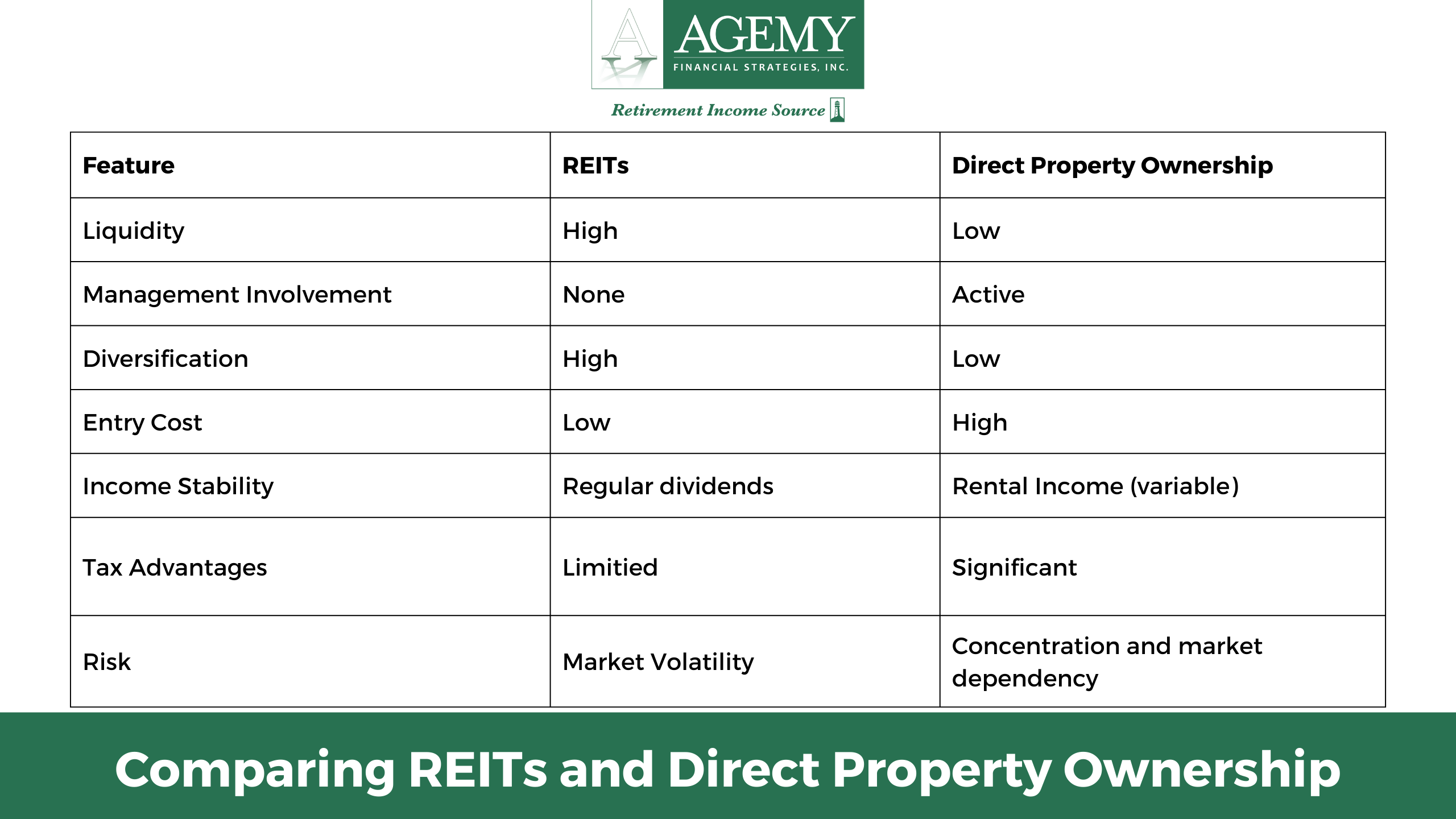
To make this decision easier, we’ve outlined the key differences between REITs and direct property ownership in the table below. Use it as a quick reference to compare their features side by side:

Partner With a Fiduciary Advisor

Investing in real estate during retirement can pose complexities, especially for those managing significant portfolios. If you’re looking for a fiduciary advisor with extensive experience in real estate investments, Agemy Financial Strategies is here to help.

Fiduciary advisors are legally obligated to prioritize your best interests, delivering impartial advice and recommendations aligned with your financial goals. Our seasoned professionals can help you identify opportunities and make well-informed decisions tailored to your unique needs and objectives.

Our advisors are adept at seamlessly integrating your real estate investments into your investment portfolio, helping to ensure they remain balanced and diversified. To explore our full-service offerings, see here.

Final Thoughts

REITs and direct property ownership offer unique advantages, making the right choice dependent on your financial goals, risk tolerance, and time horizon. At Agemy Financial Strategies, we help investors navigate the complexities of real estate investments for their financial portfolios. For over 30 years, our team of fiduciaries has guided clients in exploring opportunities in REITs and other investment vehicles to build resilient, diversified portfolios.

Contact us today to learn how we can help you achieve your financial aspirations and make informed decisions about real estate investments.


Disclaimer: This blog is intended for educational purposes only and should not be considered financial, tax, or legal advice. The information provided is general and may not apply to your financial situation. Investment decisions should always be based on your unique circumstances, goals, and risk tolerance. We recommend consulting a qualified financial advisor, such as our team at Agemy Financial Strategies, for personalized guidance tailored to your needs. Past performance does not indicate future results, and all investments carry inherent risks, including potential loss.

Financial independence often takes center stage in retirement planning for high-net-worth individuals (HNWIs), with 80% prioritizing it as their top personal finance goal. Building a portfolio that generates reliable income while preserving wealth is essential to achieving that independence.

In this blog, we’ll explore key strategies to help you maximize income from your investments and help a steady cash flow. We’ll also discuss how to strike the right balance between growth and income and how our fiduciary advisors can help tailor a plan that aligns with your unique financial needs and retirement goals. Here’s what you need to know.

What is Cash Flow Investment? 

Cash flow investing is a strategy focused on generating a steady and reliable income stream from various assets. Unlike growth-oriented investments, which aim primarily at capital appreciation, cash-flow investments help prioritize regular income through dividends, interest payments, or rental income.

Typical cash flow investments include dividend-paying stocks, bonds, real estate, and certain types of annuities. For HNWI approaching retirement, cash flow investments are essential for helping maintain a consistent income and meet living expenses without selling off assets. This strategy helps promote liquidity while preserving long-term financial security.

When selecting cash flow investments, HNWIs should carefully evaluate factors like:

  • Return on investment.
  • Payment frequency.
  • Tax efficiency.
  • Principal growth potential.
  • Risk management.

Let’s take a closer look at some of the best cash flow investments for HNWIs. Five options to discuss with your advisor include:

1. Real Estate Investments

Real estate investments, whether through direct ownership or Real Estate Investment Trusts (REITs), offer the potential for passive income and long-term growth. Rental properties, for example, can provide a steady monthly cash flow, while REITs give investors access to the real estate market without needing hands-on management.

Here’s why many investors choose to include real estate in their portfolios:

  • Steady Cash Flow: Investing in rental properties or certain real estate funds can generate consistent income through tenant payments.
  • Diversification: If your portfolio already includes stocks or bonds, adding real estate introduces diversification. Real estate tends to move independently from other asset classes, offering a different risk and return profile.
  • Tax Benefits: Owning rental property comes with tax advantages. For instance, depreciation on the property can reduce your taxable income. In some cases, property losses can be used to offset other taxes.
  • Tangible Asset: Unlike some investments that exist only on paper, real estate is a tangible asset. Even if property values fluctuate, it remains useful and can continue to generate income through rent.

Before investing in REITs, it’s essential to consult with an investment professional, such as a fiduciary advisor. They can help you evaluate potential risks and ascertain whether REITs align with your financial objectives and overall investment strategy.

2. Dividend-Paying Stocks

Dividend-paying stocks offer a combination of income and growth potential. These stocks represent shares of companies that regularly distribute a portion of their profits to shareholders in the form of dividends. For HNWIs, dividend stocks can provide a steady stream of income while still allowing for capital appreciation over time.

One of the greatest benefits of dividend-paying stocks is that they have historically outperformed their non-dividend-paying counterparts during market volatility. A report by Hartford Funds showed that from 1940 to 2023, dividend income contributed an average of 34% to the total return of the broader market. This makes them an appealing choice for retirees who want to protect their wealth in unpredictable markets.

While dividend-paying stocks can be valuable to a retirement income strategy, they are not without risk. Consulting with an advisor can help determine whether this investment aligns with your financial goals.

3. Bonds and Fixed-Income Securities 

Bonds are a reliable choice for generating a steady income. Government, corporate, and municipal bonds offer regular interest payments, providing predictable cash flow. With interest rates stabilizing in 2024, bonds remain viable for income-seeking investors. Beyond bonds, other fixed-income options include:

  • Certificates of Deposit (CDs): CDs are low-risk time deposits from banks and credit unions, offering fixed interest over a set term. While less flexible than bonds, they’re FDIC-insured up to $250,000, making them a safe investment.
  • Preferred Stocks: Preferred stocks are hybrids offering fixed dividends like bonds and potential capital appreciation. While they can provide higher yields, they come with more risk since dividends aren’t guaranteed.
  • Bond Funds: These offer diversification by investing in a mix of bonds (government, corporate, municipal). Bond funds provide a diversified income stream but may come with management fees and interest rate risk.

Collaborating with a fiduciary adds another layer of benefits and security. At Agemy Financial Strategies, our fiduciaries can assist you in carefully evaluating each investment opportunity and optimizing your financial strategy for retirement.

4. Consider Annuities for Guaranteed Income

Certain annuities can be a valuable addition to a portfolio for HNWIs looking for guaranteed income. An annuity is a contract with an insurance company that guarantees current or future payments in exchange for a premium or series of premiums.

Fixed Annuities offer guaranteed interest rates and predictable income payments, providing stability that isn’t influenced by market fluctuations. They are ideal for conservative investors who want a reliable cash flow throughout retirement without worrying about market volatility.

5. Dollar-Cost Averaging

Dollar-cost averaging requires the investor to invest the same amount of money in the same stock on a regular basis over time, regardless of the share price. The number of shares purchased each month will vary depending on the share price of the investment at the time of the purchase. The idea being when the share value rises, your money will buy fewer shares per dollar invested. When the share price is down, your money will get you more shares. Over time, the average cost per share you spend should compare quite favorably with the price you would have paid if you had tried to time it.

Partnering with an advisor can provide valuable guidance in making the right choice.

Having a Tax-Efficient Strategy

Maximizing income from your investments isn’t just about how much you earn but also how much you keep. Tax-efficient investing is vital in maintaining steady cash flow, especially for HNWIs who may be subject to higher tax brackets.

  • Utilizing Tax-Advantaged Accounts: Contributing to tax-advantaged accounts such as IRAs, 401(k)s, or Roth IRAs can help minimize the tax impact on your investment income. While traditional IRAs and 401(k)s allow for tax-deferred growth, Roth IRAs offer tax-free withdrawals in retirement, making them an excellent option for generating tax-efficient income later in life.
  • Tax-Loss Harvesting: This strategy can help reduce the taxes you owe on your investment gains. This involves selling underperforming investments at a loss to offset capital gains from other assets. By strategically harvesting losses, you can lower your overall tax bill and retain more investment income.

Creating a Withdrawal Strategy

Maintaining income without prematurely depleting your investment portfolio is key for HNWIs looking to develop a sustainable withdrawal strategy. Your approach will depend on your retirement goals and risk tolerance. A dynamic withdrawal strategy offers flexibility by adjusting withdrawals based on portfolio performance and market conditions.

When markets are strong, you can increase withdrawals slightly; reducing withdrawals helps preserve capital during downturns. Working with a fiduciary advisor can help you implement a dynamic strategy that balances your immediate income needs with the long-term health of your portfolio.

Work with a Fiduciary to Tailor Your Investment Strategy 

Each investor’s financial situation, risk tolerance, and retirement goals are unique. At Agemy Financial Strategies, we pride ourselves on providing personalized, fiduciary-based advice that prioritizes your best interests. Here are some of the areas we can help you with:

  • Investment Management: Our fiduciaries perform extensive research and analysis of financial instruments and market trends to make well-informed investment decisions. We craft and implement tailored strategies, allocate assets effectively, and manage risk to help optimize your portfolio.
  • Financial Planning: We offer financial services that consider your entire financial picture. This includes assessing your income needs and developing a strategy to generate steady cash flow while preserving your wealth for future generations.
  • Risk Management: As you approach retirement, managing risk becomes even more critical. Your advisor can help you optimize your asset allocation to meet your income needs while minimizing the risk of portfolio depletion.
  • Ongoing Portfolio Monitoring: Maximizing income from your investments requires ongoing portfolio monitoring and adjustments. We continuously review your investments to ensure they align with your financial goals, market conditions, and evolving retirement needs.

Final Thoughts

Maximizing income from your investments is essential for ensuring a successful and financially secure retirement, especially for high-net-worth individuals approaching this important life stage. At Agemy Financial Strategies, we craft tailored plans to meet your unique investment goals, helping provide stability and growth. Our team of dedicated fiduciary advisors is committed to guiding you through the complexities of investment management with advice and ongoing support.

Take the next step toward a secure financial future—contact us today to schedule your complimentary consultation.


Disclaimer: The information provided in this blog is for educational purposes only and should not be considered as specific investment advice. While we aim to provide valuable insights, every individual’s financial situation is unique, and changes to your investment portfolio or financial strategies should only be made after consulting with a qualified financial advisor. We encourage you to contact our team before making any investment decisions to help ensure they align with your personal goals and risk tolerance.

Federal fund rates currently sit at 4.75% to 5%, and the implications of this rate cut will affect everything from borrowing costs to investment strategies. Understanding how this shift affects their financial strategy is essential for investors nearing retirement. Let’s explore the Fed’s rate cut for investors preparing for retirement, from how it might affect your investment portfolio to its influence on key financial decisions and long-term retirement planning. Here’s what you need to know.

Understanding The Fed’s Rate Cut 

On September 18, 2024, the Federal Reserve cut its benchmark interest rate by half a percentage point. This marked the end of its longest cycle of rate hikes in over a decade. According to Joe Brusuelas, chief economist at RSM US, the Fed’s pivot signifies a return to a more normalized economic environment. “We had three years of extremely aggressive policy out of the Fed. We’re now pivoting toward normalizing rates in the post-pandemic economy,” Brusuelas said.

From a fiduciary standpoint, the Fed’s decision could have immediate and long-term implications for those nearing retirement. Michael Madowitz, a principal economist at the Roosevelt Institute, notes that the rate cut underscores the Fed’s confidence in controlling inflation and signals that the economy has recovered enough to support sustainable growth. But what does this mean for your retirement strategy? Let’s break down the areas most affected by the rate cut.

Mortgage Rates and Housing: Opportunities and Challenges

For many Americans, especially those approaching retirement, the housing market is a key part of their financial plans. Whether you’re considering downsizing, buying a second home, or refinancing your current mortgage, the Fed’s recent rate cut could lower borrowing costs. Typically, when interest rates drop, mortgage rates follow, making it easier to lock in favorable terms on home loans.

This could create opportunities for investors nearing retirement. Lower mortgage rates might make it more appealing to invest in real estate, such as purchasing a smaller home or a vacation property. However, it’s important to understand that the effects of the Fed’s rate cut may take some time to fully materialize. Working alongside a financial advisor can help you capitalize on the benefits of lower interest rates while helping your investments align with your financial strategy.

Savings and Investments: Adapting to a New Landscape


Interest rates on savings accounts and certificates of deposit (CDs) are a key consideration for those nearing retirement. Historically, high rates have benefited savers, offering a safe way to grow wealth without market risk. However, those yields will likely decrease with the Fed’s rate cut.

While lower interest rates may reduce the return on savings accounts, this also presents opportunities for more strategic investment. As rates fall, Americans will likely shift money fromsavings accounts into the stock market. The prospect of better returns in equities may drive this shift, particularly for HNWIs with a higher risk tolerance.

As fiduciaries, we help clients navigate these changes thoughtfully. Exploring alternative strategies for retirees relying on interest income can help provide income and growth. Our goal is to help your investment portfolio align with your long-term objectives, even as the interest rate environment changes.

The Stock Market: Potential Gains and Increased Volatility

Historically, lower interest rates have been positive for the stock market, reducing business borrowing costs and encouraging investment. However, the current rate cut comes when the market is already volatile. There is no consistent pattern in how markets respond after significant rate-hiking cycles, and some analysts believe the Fed’s decision may already be priced in.

While lower rates may support higher stock prices, market volatility remains a significant concern. Investors nearing retirement should approach the market cautiously, balancing the potential for gains with the need for stability in their portfolios. Here are some investment strategies that can help you manage volatility:

  • Diversification: Maintaining a diverse portfolio that includes a mix of asset classes (stocks, bonds, real estate) helps manage risk and reduce exposure to market volatility.
  • Dividend-Paying Stocks: These stocks provide income through dividends, offering more stability than growth stocks during volatile times.
  • Bonds: Bonds, especially government or high-quality corporate bonds, tend to be less volatile than stocks and can offer steady returns, making them a safer option during uncertain periods.

With the potential for increased volatility, it’s essential to regularly review your investment strategy to ensure it aligns with your risk tolerance and long-term retirement goals. Working with a fiduciary can provide valuable guidance and help you make informed decisions in your best interest.

Keeping an Eye on Inflation 

One of the primary goals of the Federal Reserve’s previous rate hikes was to curb inflation. The current annual inflation rate is 2.5%, the lowest since February 2021. While the risk of inflation seems to have subsided for now, certain goods and services may continue to rise in cost due to factors outside of the Fed’s control.

For retirees, managing these escalating costs is crucial. Rising healthcare expenses, unpredictable insurance premiums, and fluctuating housing costs can impact your financial stability during retirement. A comprehensive retirement strategy can help account for these potential increases to help ensure long-term security.

Here are some key areas to consider when planning for inflationary impacts:

  • Healthcare & LTC costs: Medical expenses tend to rise faster than general inflation, making planning for long-term care and health-related expenses essential.
  • Housing costs: Whether you own or rent, housing costs can fluctuate, especially with supply shortages and high demand in certain areas.
  • Insurance premiums: As climate-related risks grow, premiums for homeowners’ insurance and other policies could increase, requiring careful coverage review.

As fiduciaries, we emphasize the importance of creating a retirement plan that accounts for rising costs in critical areas such as healthcare. Ensuring adequate savings and insurance coverage is essential for financial security in retirement.

The Importance of Fiduciary Guidance

At Agemy Financial Strategies, we recognize that the Federal Reserve’s decisions can have significant implications for those approaching retirement. As fiduciaries, we aim to provide personalized, unbiased advice that puts your best interests first. The recent rate cut presents opportunities and challenges, making careful planning essential to protect your financial future. Here are a few ways our financial team can help you:

  • Personalized Retirement Planning: We take the time to understand your unique financial situation, retirement goals,and risk tolerance. Whether you’re considering adjusting your investment portfolio or reevaluating your income streams, we craft a tailored plan to meet your long-term objectives.
  • Investment Strategy Adjustments: We’ll help you determine the right investment mix to balance risk and reward and help your portfolio stay resilient through market fluctuations.
  • Planning for Care Costs: We’ll work with you to develop a custom plan for long-term healthcare expenses, including potential insurance needs, helping you secure your financial well-being.
  • Tax-Efficient Strategies: Tax-efficient planning becomes even more important with changing interest rates. We’ll help you navigate the tax implications of your financial decisions, from withdrawals to capital gains, optimizing your tax strategy to preserve wealth over the long term.

Final Thoughts

The Federal Reserve’s rate cut marks a significant shift in the U.S. economic landscape, and it’s essential for those preparing for retirement to understand how this change impacts their financial strategy. At Agemy Financial Strategies, we are committed to helping you make informed decisions that align with your long-term goals. In this evolving economic environment, now is the time to review your retirement plan and ensure you are well-positioned for future growth.

Contact us to learn how we can support your financial goals and help you navigate this evolving environment.

For every investor, the world has become a hard place. But for those reaching retirement, pressure is significantly mounting. Here’s how to cope with a roller-coaster market on the lead up to your golden years. 

When you think of retirement, many Americans imagine a fun and relaxing lifestyle. However, preparing for retirement is no easy task– especially with volatility and rising interest rates. This past year has been especially challenging to plan for retirement. The economy has been turbulent and many are having a hard time keeping up with the cost of living.

It’s estimated that 1.5 million retirees have re-entered the U.S. labor market over the past year due to such factors as more flexible work arrangements, rising costs, and the inability to keep up while on a fixed income (according to an analysis of Labor Department data by Nick Bunker, an economist at Indeed). Additionally, 25% of Americans feel they have to delay their retirement plans because of disrupted savings resulting from increased prices and market instability.

During such an uncertain time many are second guessing their road to retirement. However, a down market should not deter you from reaping the benefits of a fruitful retirement. Here are a few tips to help you prepare for your golden years in a volatile market.

Evaluate Risk Tolerance

When it comes to risk tolerance, having a diversified portfolio will help minimize the impact of risk and total loss in a volatile market. The right mix of investments for you will depend on your unique circumstances, including your age, investment goals, and risk tolerance.

The key is to find the right balance of risk and reward for you.

Investing Without Emotions

It can be hard not to invest with emotions. After all, it’s your hard-earned cash you’re watching rise and fall. Market volatility is a stressful environment for anyone with money in the stock market. Investing with emotions can lead to significant losses.

It can be difficult to impulse buy or sell stocks when the market is experiencing a hiccup. In the end, it’s hard to predict market behavior—so try not to make any risky or permanent decisions regarding your portfolio when it’s likely that current market conditions are temporary. Stick to your investment plan and build on these important building blocks:

  • A retirement date. Figure out how long you’ll have to save.
  • Your major life goals. Plan for small and big events in the future.
  • Your tolerance for risk. Find your comfort zone.

Your plan is like a safety belt when the market starts seesawing. Stay on track by sticking to it during market swings.

Having a Plan in Place

When it comes to planning for retirement, having a long-term plan can help ease stress and keep you on track for the long-run. Market volatility can tempt you to want to ditch your plan, but it’s important to think long-term. If you’re nearing retirement it may be an appropriate time to make some small changes in order to reduce the chances of major risk. Make sure to rebalance your investment plan on a regular basis — quarterly, semiannually or once a year. Why? Because volatile markets can change the proportion of your funds in different asset classes. Therefore, rebalancing resets your portfolio to your desired investment mix.

Note: It’s important not to make any significant changes without consulting your financial advisor. A trusted advisor is crucial to your success when preparing for retirement during a volatile market.

Final Thoughts

Don’t let market volatility derail your retirement savings plan. With the market’s current conditions, it may not be as smooth of sailing as you’d hope for–but market downturns don’t last forever.

The investment professionals at Agemy Financial Strategies can help you make sure your investments and assets are mixed to create a balanced plan for your unique retirement goals. Regardless of a volatile market, we can help strategize asset allocations to help stomach inflation, or revise your current plan to make helpful amendments.

If you’re looking for more ways to prepare for retirement with inflation, connect with the team at Agemy Financial Strategies here to help you get started on your portfolio diversification journey today.