Tax laws are shifting, and for individuals committed to preserving their wealth, staying ahead of these changes is more important than ever. 

With new adjustments to estate, gift, and generation-skipping transfer (GST) tax exemptions on the horizon, your decisions could have a lasting impact on your financial legacy. For high-net-worth individuals (HNWIs), understanding these updates isn’t just beneficial—it provides a decisive strategic advantage.

In this blog, we’ll break down the key changes and explore how Agemy Financial Strategies can assist you in navigating the complexities of these taxes, turning challenges into opportunities to help secure your future.

What Are Estate, Gift, and Generation-Skipping Transfer Taxes? 

The federal government employs estate, gift, and generation-skipping transfer (GST) taxes to help ensure wealth transfers are subject to taxation. In turn, this limits the accumulation of untaxed wealth across individuals and generations. Understanding how these taxes operate and interact is essential for crafting a comprehensive wealth preservation strategy. Let’s explore each tax in detail:

1. Estate Tax

The estate tax is a levy imposed on the total value of an individual’s estate that exceeds the federal exemption threshold at the time of their death. This tax applies to assets such as real estate, investments, cash, and other valuables included in the estate. The federal estate tax doesn’t apply unless you hit a certain exemption amount.

  • The exemption amount for people who pass away in 2025 is $13.99 million (up from $13.6 million last year).
  • Married couples can expect their exemption to be $27.98 million (up from $27.22 million last year).

Proper estate planning can help mitigate this tax burden, allowing more wealth to be passed on to your heirs.

2. Gift Tax

The gift tax applies to transferring money or assets during your lifetime that exceeds the annual or lifetime exemption limits. The annual gift tax exclusion sets the amount you can give each recipient without impacting your lifetime exemption. The IRS has announced an increase in the annual gift tax exclusion for 2025:

Maximizing annual gift exclusions helps reduce your taxable estate while providing financial support to loved ones. However, exceeding these limits without careful planning can lead to unnecessary tax liabilities. Working alongside a fiduciary can help you integrate gifting strategies into your broader estate plan.

3. Generation-Skipping Transfer (GST) Tax

The Generation-Skipping Transfer (GST) tax is designed to prevent individuals from avoiding taxation by skipping over a generation and transferring wealth directly to beneficiaries who are at least two generations younger. It is an additional tax on top of the federal gift or estate tax. For the tax year 2025, the GST tax exemption amount is set at $13.99 million per individual.

Transfers to these younger-generation beneficiaries are only tax-free up to the GST tax exemption limit. Any amount exceeding this exemption is subject to the GST tax, which, like the estate tax, has a top rate of 40%. This tax most commonly affects:

  1. Direct Transfers: Gifts or inheritances given directly to grandchildren or other younger-generation individuals.
  2. TrustsTrusts established for the benefit of grandchildren or great-grandchildren, especially when structured to avoid intermediate taxation on the parent generation.

A fiduciary can help you by providing tailored advice for your estate plan accounts. With proactive planning and guidance, you can better protect your financial legacy and help ensure it benefits your family for years.

Why Understanding These Taxes Matters 

Proper planning for estate, gift, and GST taxes is essential to help protect your financial legacy. Failing to account for these taxes can result in significant financial losses for your heirs and complicate wealth transfer strategies. For example:

  • Overlooking Gift Tax Exclusions: Missing annual or lifetime gift tax exclusions can unintentionally trigger higher tax liabilities.
  • Missing the Current Exemptions: Failing to take advantage of the higher exemptions before they are reduced in 2026 could expose your estate to substantial federal taxes.
  • Mismanaging GST Tax Liabilities: Poor planning could undermine the long-term benefits of trusts and other wealth transfer strategies to skip generations.

Working with a fiduciary can help you have the guidance needed to navigate the nuances of these taxes. A trusted fiduciary can help you maximize available exemptions and create a plan to help preserve your wealth for future generations.

Key Changes to Tax Exemptions for 2025

The Tax Cuts and Jobs Act (TCJA) of 2017 significantly increased the exemptions for estate, gift, and GST tax. However, these enhancements are set to sunset at the end of 2025, potentially altering how wealth can be transferred tax-efficiently. Here’s what to expect:

Post-2025 Adjustments

  • The lifetime estate and gift tax exemptions are scheduled to be cut in half after 2025 to approximately $7 million per individual (adjusted for inflation).
  • Without action, gifts or estate transfers exceeding these reduced limits could face federal taxes at rates as high as 40%.

If you have a large estate, taking advantage of the higher exemptions in 2025 can help reduce your tax liabilities and preserve wealth for future generations. Early planning is essential to avoid the financial burden of potential reductions.

State Estate Taxes: Another Layer to Consider

In addition to federal estate taxes, many states impose their own estate or inheritance taxes, often with lower exemption thresholds. For residents of states like Connecticut, where state-level estate taxes can be significant, careful planning is crucial to help avoid unexpected tax liabilities. 

The current Connecticut estate tax exemption is $13.61, and the flat tax rate is 12%. Any taxable gifts or estates exceeding this exemption amount will be subject to a 12% tax. Thus, it is vital for Connecticut residents to integrate state tax considerations into their overall estate planning strategy.

The absence of a state estate tax offers a significant advantage for Colorado residents. Without an additional layer of taxation, residents can pass on their wealth to loved ones without incurring state-level estate taxes. This benefit particularly appeals to retirees seeking to preserve their legacy and help maximize the financial resources available to their families.

With dedicated offices in Connecticut and Colorado, Agemy Financial Strategies has extensive experience helping residents navigate these state-specific tax laws. Whether navigating Connecticut’s estate tax thresholds or taking advantage of Colorado’s tax benefits, our team helps protect your financial legacy for future generations.

How Agemy Financial Strategies Can Help 

The upcoming changes to estate, gift, and GST tax exemptions present a valuable opportunity to help optimize your financial legacy and minimize future tax burdens for your heirs. However, navigating these complex tax structures requires skilled guidance and thoughtful planning. At Agemy Financial Strategies, we help simplify financial complexities, equipping you with the tools and knowledge to make confident, informed decisions about your wealth. Here’s how we can help:

  1. Tailored Estate Planning: We can design personalized estate plans that align with your unique goals, helping ensure your wealth transitions smoothly and tax-efficiently.
  2. Proactive Gifting StrategiesOur team will guide you in leveraging exemptions, avoiding common pitfalls, and making tax-savvy decisions.
  3. Trust Design and Management: Whether you’re setting up a trust or optimizing an existing one, we provide solutions to help maximize benefits for you and your heirs.
  4. Holistic Financial Advice: Estate planning works best when integrated with your broader financial goals. We offer comprehensive advice to help ensure all aspects of your financial life are aligned.
  5. Staying Ahead of Legislative Changes: Tax laws change frequently, and we keep you informed, adapting strategies as needed.

Preparing for the Future: Start Today

The adjustments to estate, gift, and generation-skipping tax exemptions represent a pivotal moment for estate planning. With potential tax savings at stake, proactive planning in 2025 and beyond is more important than ever.

Whether you’re seeking to preserve wealth for future generations or minimize tax liabilities, the key is working with a knowledgeable advisor who understands your needs. Agemy Financial Strategies is here to assist you in navigating these changes and helping secure your financial legacy.

Contact us today to learn how we can help you make the most of this critical tax planning period.


Frequently Asked Questions (FAQs)

How will these exemptions change in 2026?

Unless new legislation is passed, the exemptions will revert to $5 million per individual (indexed for inflation) on January 1, 2026, which is expected to be approximately $7 million per individual.

What Happens If You Exceed the Annual Limit?

Gifts exceeding the annual exclusion are deducted from your lifetime gift and estate tax exemption. If your total lifetime gifts surpass the federal exemption threshold, the remaining amount may be subject to federal gift taxes, which are taxed at a maximum rate of 40%.

How can I take advantage of the current exemptions?

The higher exemptions in 2025 can be used to make large lifetime gifts, establish trusts, or utilize other tax-efficient wealth transfer strategies. Consulting a fiduciary advisor can help ensure your plan is effective and compliant.

What is a Spousal Lifetime Access Trust (SLAT)?

SLAT is an irrevocable trust that allows one spouse to gift assets to the other while retaining indirect access to the assets. It is a popular tool for utilizing the higher gift exemptions before they are reduced.

How do state-level estate taxes affect my plan?

Some states impose their own estate or inheritance taxes, with exemption thresholds often lower than federal limits. A comprehensive estate plan should account for both federal and state tax implications.

How does Agemy Financial Strategies help with these taxes?

Agemy Financial Strategies provides personalized estate planning services, including wealth analysis, trust creation, and tax-efficient gifting strategies. We help clients navigate complex tax laws and align their plans with long-term goals.

How do I get started with estate planning?

Start by scheduling a consultation with Agemy Financial Strategies. We’ll help you by reviewing your financial situation, discussing your goals, and designing a tailored estate plan to meet your needs. Visit us today to get started.


Disclaimer: The information provided in this blog is for educational purposes only and should not be considered specific investment, tax, legal, or financial advice. Agemy Financial Strategies does not guarantee results, and past performance does not indicate future results. Tax laws are subject to change, and any strategies discussed should be reviewed in the context of current legislation and individual circumstances.


As Bitcoin and other cryptocurrencies continue to gain mainstream attention, more Americans are considering the role of digital assets in their retirement portfolios.

The volatile nature of cryptocurrencies, combined with their potential for substantial gains, has piqued the interest of investors seeking alternative ways to secure their financial future. In this blog, we’ll explore the intersection of Bitcoin and retirement and discuss how a financial advisor can be a valuable resource in helping you make informed decisions. Here’s what you should know.

What is Cryptocurrency?

Cryptocurrency is a digital or virtual currency that relies on cryptography for security. During the first half of 2023, Bitcoin (BTC) and various other cryptocurrencies have rebounded following significant losses experienced in 2022. Nevertheless, the prolonged “crypto winter” (which some experts say is now over) has revealed vulnerabilities within the digital currency landscape, such as excessive risk-taking, the promotion of illegal securities, and even fraudulent activities.

Unlike traditional currencies issued and regulated by governments*, cryptocurrencies operate on blockchain decentralized technology. This technology helps provide transparency and immutability of transactions. (*The sale of cryptocurrency is generally only regulated if the sale (i) constitutes the sale of a security under state or federal law, or (ii) is considered money transmission under state law or conduct otherwise making the person a money services business (“MSB”) under federal law.)

One of the most well-known cryptocurrencies is Bitcoin, but thousands of others have unique features and use cases. Investors can use cryptocurrencies for various purposes, including online purchases and investment, and to transfer value across borders quickly and with lower transaction fees than traditional financial systems.

Close to 44% of U.S. adults who’ve started saving for retirement say they have invested part of their retirement savings in cryptocurrency. Nearly half of these people indicated they had invested a “big” part of their retirement funds in crypto. It’s essential to recognize that cryptocurrencies also come with volatility and regulatory considerations that users must be aware of.

Why is Crypto an Appealing Investment for Retirees

Since its inception in 2009, the pioneering cryptocurrency, Bitcoin, has exhibited extraordinary growth. Starting from virtually nothing, it surged to reach peaks exceeding $60,000 per Bitcoin in 2023, attracting the attention of both individual and institutional investors. The idea of using Bitcoin as a potential retirement asset has gained traction for several reasons:

  1. Diversification: Traditional retirement portfolios often include stocks, bonds, and real estate. Adding Bitcoin to the mix can provide diversification, as cryptocurrencies tend to have a low correlation with traditional assets, which has the potential to reduce portfolio risk.
  2. Hedge Against Inflation: Many investors view Bitcoin as a hedge against inflation, similar to gold. With central banks worldwide injecting stimulus money into economies, concerns about the devaluation of fiat currencies have grown. Bitcoin’s fixed supply (limited to 21 million coins) can protect your wealth from currency devaluation.
  3. Potential for High Returns: Bitcoin’s price history has been marked by significant volatility but has also seen substantial long-term gains.

Some investors hope to capitalize on this growth potential to boost their retirement savings. However, it’s important to use caution as digital assets can be risky investments. Consult with a financial advisor experienced in Crypto to help you align cryptocurrency investments with your unique retirement goals and risk tolerance.

Risk vs. Reward

Cryptocurrency has generated a lot of buzz in recent years, with some investors reaping substantial profits. However, it’s crucial to understand that investing in crypto is not without its risks, and it may not be the right choice for everyone.

One of the most significant concerns with cryptocurrency is its extreme price volatility. Prices can skyrocket one day and plummet the next. Its volatility is often driven by factors like market sentiment, regulatory developments, or technological advancements. This can lead to significant gains but also substantial losses.

Since the cryptocurrency market is relatively new, it lacks the comprehensive regulation seen in traditional financial markets. This means that investors have fewer protections. In fact, hackers stole $400 million of crypto in the first three months of 2023. Security professionals celebrated that number because it’s 70% less than what was stolen in the first three months of 2022.

Assessing your risk tolerance is a pivotal step when considering cryptocurrency investments, especially during retirement. Making ill-informed decisions in the crypto market could potentially jeopardize your hard-earned nest egg. However, working with the right financial advisor can help you understand your risk tolerance and explore the best investments based on your unique needs and financial goals.

How a Financial Advisor Can Help

While Bitcoin may have its appeal, it’s important to remember that it is a highly speculative and risky asset. But with great risk comes the potential for great returns.

“If you invest 2% of your savings and lose it, those savings can eventually be replaced. But if you invest 2% with a 10X return, it’s a game changer for your golden years…” said Daniel J. Agemy, CPM®, RFC®,  Chief Investment Officer at Agemy Financial Strategies. With over a decade of portfolio management under his belt, Daniel is well-versed in the alternative ways of helping retirees and pre-retirees generate income streams that last throughout their retirement years.

Daniel continues, “As a fiduciary, I believe that seeking guidance for investment advice is essential because it means we are not just committed to your financial success; we are legally bound to always put your interests first, providing you with personalized and trustworthy support on your financial journey.”

For more valuable insights from the investing world, including cryptocurrency investing, Daniel and his father, Andrew A. Agemy, MRFC®, Founder and CEO
Investment Advisor at Agemy co-hosts the wildly popular radio show and YouTube podcast Financial Strategies, which airs every weekend in Connecticut and Colorado and is available wherever you listen to your favorite podcasts.

Advice You Can Trust

At Agemy Financial Strategies, we want you to know that we are committed to helping you achieve your retirement goals.

Here’s a breakdown of how our experienced advisors can play a crucial role in helping you integrate Bitcoin into your retirement plan:

  • Risk Assessment: We can evaluate your risk tolerance and financial situation to help determine whether Bitcoin is a suitable addition to your retirement portfolio. We will help you understand the potential risks and rewards in your investment choices.
  • Asset Allocation: Our fiduciaries will assist you in determining the appropriate allocation of Bitcoin within your overall retirement portfolio; helping you maintain a balanced, diversified approach that aligns with your financial goals.
  • Tax Implications: Cryptocurrency taxation can be complex, and tax laws can vary from one jurisdiction to another. Agemy Financial Strategies can help you navigate the tax implications of buying, holding, and selling Bitcoin in the context of your retirement plan.
  • Long-Term Strategy: Crafting a long-term strategy for your retirement is essential. Our dedicated team of fiduciary advisors can help you set realistic goals, review your plan periodically, and make necessary adjustments to your financial well-being in retirement.

The path to wealth accumulation is marked by a commitment to slow and steady progress, and the realm of cryptocurrency remains shrouded in uncertainty. Could cryptocurrency emerge as a more mainstream investment option in the future? That possibility exists. However, having a skilled financial advisor by your side can help ensure that you navigate this dynamic landscape with levelheadedness.

Final Thoughts

Bitcoin’s potential as a retirement asset is a growing interest, but it’s important to approach it with caution and careful planning. At Agemy Financial Strategies, we are dedicated to helping clients navigate the intricacies of planning for retirement to help ensure you never outlive your savings. Our fiduciary advisors can be a valuable resource in helping you navigate the cryptocurrency landscape, assess the risks, and integrate Bitcoin into your retirement strategy to align with your financial goals and risk tolerance.

If you’re ready to explore the world of cryptocurrency investing, contact us today to set up your complimentary consultation here.


Disclaimer: This content is for educational purposes only and should not be considered financial or investment advice. Please consult with the fiduciary advisors at Agemy Financial Strategies before making any investment decisions.

Real estate has long been a cornerstone of wealth-building, offering opportunities for steady income, diversification, and long-term growth. For those approaching retirement, it’s not just about whether to include real estate in your portfolio—it’s about choosing the right approach to suit your goals and lifestyle.

Deciding what to do with yourself in the period between Christmas and the New Year can feel confusing for us all. More unsettling? The daunting decision between Real Estate Investment Trusts (REITs) and direct property ownership! While the festivities take a quick break, use your time off to research each option, as each has its own benefits and challenges, making it essential to understand how they align with your financial plans.

This blog dives into the pros and cons of both strategies, helping you make informed decisions and position your real estate investments for success in retirement.

What Are REITs? 

Real Estate Investment Trusts (REITs) own, operate, or finance income-generating real estate. They pool funds from multiple investors, allowing shareholders to own a portion of large-scale properties without directly managing them. REITs are traded on public stock exchanges, making them an accessible and liquid investment vehicle.

More than 45% of American households own REITs, nearly double the estimate from two decades ago. They can be a good fit if you want the diversification benefits of real estate without the commitment and responsibilities of directly owning property. To better understand how REITs work, let’s explore the three main types available to investors, each with unique features and benefits:

  1. Equity REITs: These REITs focus on owning and managing properties. Some examples include apartment complexes, office buildings, and shopping malls. Investors have the potential to earn income through rental revenue.
  2. Mortgage REITs: Investing in mortgages and mortgage-backed securities has the potential to generate income from interest payments.
  3. Hybrid REITs: These combine the strategies of equity and mortgage REITs, offering potential income from rent and interest.

Now that we know more about what REITs entail let’s look at the pros and cons.

Pros of REITs

  1. Liquidity

One of the most significant benefits of REITs is their high liquidity. Since REIT shares are traded on stock exchanges, investors can quickly buy or sell them, unlike physical real estate transactions, which can take weeks or months. This liquidity is particularly advantageous for investors needing immediate access to funds without being locked into long-term real estate ownership.

  1. Diversification

REITs allow investors to spread their exposure across various properties, sectors, and geographies. For example, a single REIT may include assets like shopping malls, apartment complexes, healthcare facilities, and industrial warehouses. This built-in diversification can help reduce the risk of potential loss that could occur if an individual property or sector underperforms. It’s an efficient way to participate in the real estate market without the concentration risk of owning one or two properties.

  1. Accessibility

REITs offer a low barrier to entry compared to direct property ownership. Instead of needing tens or hundreds of thousands of dollars for a down payment on a property, investors can gain exposure to real estate markets with the cost of a single REIT share. This accessibility can make REITs a practical choice for small-scale investors or those just starting to diversify their portfolios into real estate.

Cons of REITs

  1. Market Volatility

Since REITs are traded on stock exchanges, they are subject to the same market volatility as other publicly traded securities. Their values can fluctuate based on economic conditions, interest rates, or changes in investor sentiment, regardless of the underlying real estate performance. This volatility can be challenging for investors seeking stability or those uncomfortable with the stock market’s swings.

  1. Limited Control

Investing in REITs means relinquishing decision-making power to the REIT’s management team. Investors cannot control which properties the REIT buys, sells, or develops. This lack of control can be a drawback for those who prefer a hands-on approach to managing their investments or want to focus on specific property types or locations.

  1. Tax Implications

While REITs often pay attractive dividends, these payouts are typically taxed as ordinary income rather than benefiting from the lower tax rates associated with qualified dividends or long-term capital gains. This can result in a higher tax burden for investors, particularly those in higher tax brackets. For tax efficiency, REITs may be better suited for tax-advantaged accounts like IRAs or 401(k)s.

What Is Direct Property Ownership? 

Direct property ownership involves purchasing and owning physical real estate, such as residential properties, commercial spaces, or undeveloped land. Investors earn income by leasing the property or profiting from its appreciation over time. This approach requires hands-on involvement or the hiring of property management services.

Unlike REITs, direct ownership gives investors full control over property management and decision-making. However, it comes with responsibilities like tenant management, property upkeep, and navigating real estate market fluctuations.

Let’s look deeper at the pros and cons of direct property ownership.

Pros of Direct Property Ownership

  1. Building Equity

One of the primary benefits of direct property ownership is the ability to build equity over time. As you pay down the mortgage, your ownership stake in the property increases. This creates a valuable asset that can be leveraged for future investments or financial needs. Unlike other investments, real estate allows you to combine equity growth with income generation, such as rental payments, making it a powerful wealth-building tool.

  1. Potential for Appreciation

Real estate has a historical tendency to appreciate over time, offering investors the potential for substantial capital gains. Investors can benefit from increasing property values by holding long-term property long-term, particularly in growing markets or areas with rising demand. This potential for growth makes real estate a valuable component of a long-term investment strategy.

  1. Inflation Hedge

Real estate is often considered a natural hedge against inflation because property values and rental income typically rise over time, outpacing it. This ability to preserve and potentially increase purchasing power during inflationary periods makes real estate a reliable store of value. This characteristic makes direct property ownership particularly attractive for investors seeking long-term stability.

Cons of Direct Property Ownership

  1. Illiquidity

One of the most significant drawbacks of owning physical property is its lack of liquidity. Unlike REITs or stocks, selling a property can take several months and involves high transaction costs, including real estate agent commissions, closing fees, and potential repairs or upgrades to prepare the property for sale. This lack of liquidity can be a drawback for retirees who need quick access to funds.

  1. Management Burden

Direct property ownership requires active involvement, making it far from a passive investment. Owners are responsible for property maintenance, tenant relations, and compliance with local laws and regulations. Even when hiring a property manager, the owner is ultimately accountable for decisions and outcomes, which can still demand time and effort.

  1. Market Dependency

The value and income real estate generates are heavily influenced by local market conditions, economic trends, and interest rate fluctuations. For instance, an economic downturn or oversupply of rental properties in a specific area can lead to declining property values and rental income. Similarly, rising interest rates can make mortgages more expensive, reducing affordability and demand. These factors can create unpredictable fluctuations in income and value, requiring property owners to carefully research and monitor market conditions to mitigate risks.

Key Considerations for Investors

Choosing between REITs and direct property ownership depends on your financial goals, time horizon, risk tolerance, and tax strategy. Each option has unique strengths and potential drawbacks; understanding these factors can help you make an informed decision.

  1. Financial Goals: If you’re seeking consistent income with minimal effort, REITs may be the better choice as they provide potential dividends and require no active management. On the other hand, direct property ownership may be ideal for those prioritizing control over their investment and potential long-term property appreciation.
  2. Time Horizon: REITs’ liquidity and ease of access can benefit investors nearing retirement. In contrast, younger investors with a longer time horizon may benefit from the potential appreciation and equity growth associated with owning property directly. Because every investor’s journey is different, consulting a fiduciary advisor is crucial to help your decisions align with your financial goals.
  3. Risk Tolerance: REITs inherently offer diversification, spreading risk across multiple properties or sectors, helping reduce the impact of underperformance in any single asset. Direct property ownership, however, concentrates risk into fewer assets, which could be advantageous for investors willing to take on more responsibility for higher potential returns.
  4. Tax Strategy: Tax advantages can vary significantly between the two options. REITs may have limited tax benefits compared to direct ownership, which can offer depreciation and other deductions. Consulting an advisor or tax professional can be essential to help optimize your investment strategy based on your tax situation.

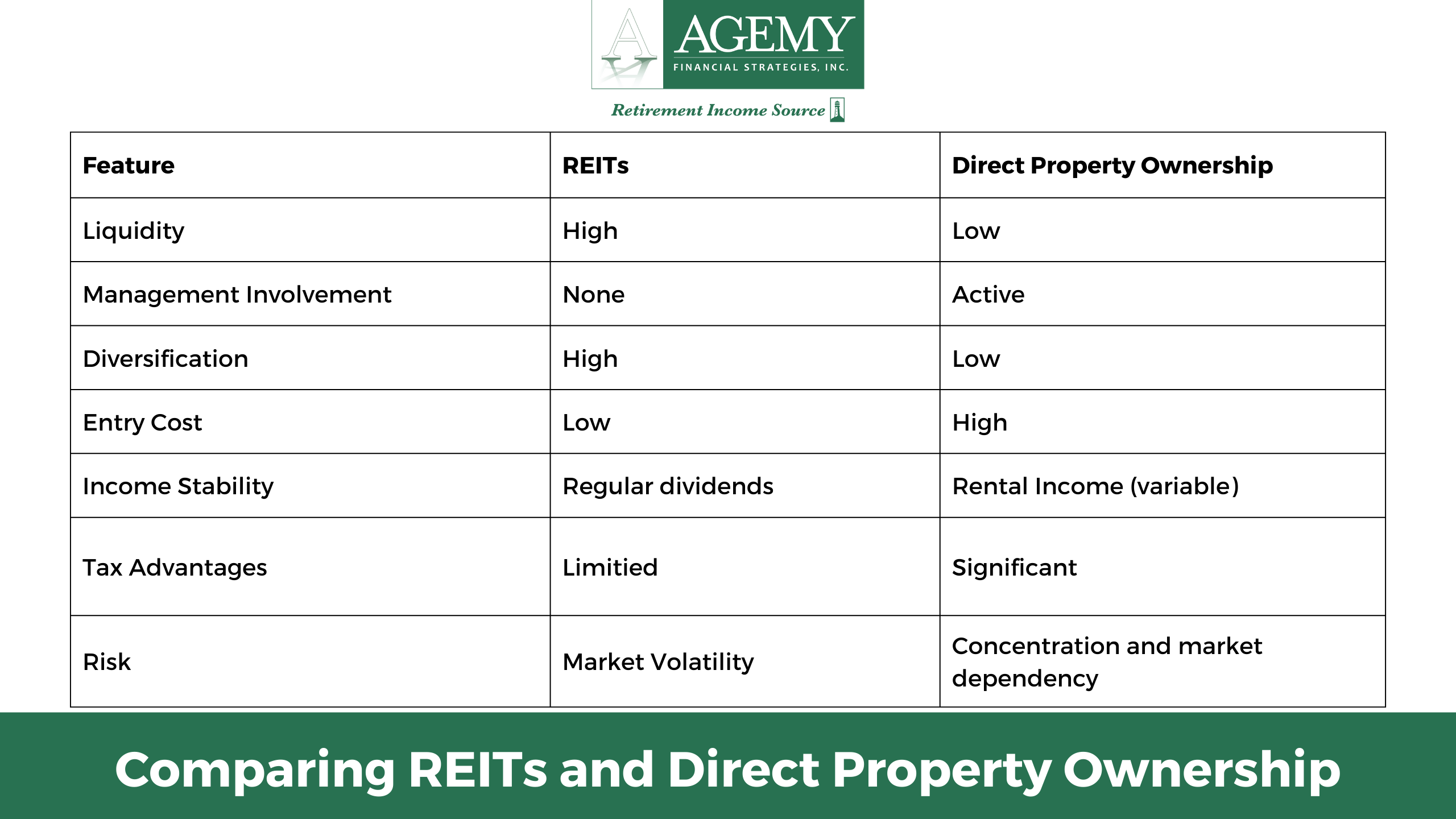
To make this decision easier, we’ve outlined the key differences between REITs and direct property ownership in the table below. Use it as a quick reference to compare their features side by side:

Partner With a Fiduciary Advisor

Investing in real estate during retirement can pose complexities, especially for those managing significant portfolios. If you’re looking for a fiduciary advisor with extensive experience in real estate investments, Agemy Financial Strategies is here to help.

Fiduciary advisors are legally obligated to prioritize your best interests, delivering impartial advice and recommendations aligned with your financial goals. Our seasoned professionals can help you identify opportunities and make well-informed decisions tailored to your unique needs and objectives.

Our advisors are adept at seamlessly integrating your real estate investments into your investment portfolio, helping to ensure they remain balanced and diversified. To explore our full-service offerings, see here.

Final Thoughts

REITs and direct property ownership offer unique advantages, making the right choice dependent on your financial goals, risk tolerance, and time horizon. At Agemy Financial Strategies, we help investors navigate the complexities of real estate investments for their financial portfolios. For over 30 years, our team of fiduciaries has guided clients in exploring opportunities in REITs and other investment vehicles to build resilient, diversified portfolios.

Contact us today to learn how we can help you achieve your financial aspirations and make informed decisions about real estate investments.


Disclaimer: This blog is intended for educational purposes only and should not be considered financial, tax, or legal advice. The information provided is general and may not apply to your financial situation. Investment decisions should always be based on your unique circumstances, goals, and risk tolerance. We recommend consulting a qualified financial advisor, such as our team at Agemy Financial Strategies, for personalized guidance tailored to your needs. Past performance does not indicate future results, and all investments carry inherent risks, including potential loss.

If you have substantial wealth, the need for estate planning becomes even more significant due to the complexity of your financial situation. But when should you start estate planning if you fall into the HNWI category?

Estate planning is crucial for managing your wealth and protecting your assets so that they are distributed according to your wishes after your passing.  In this blog, we will explore the importance of early estate planning for high-net-worth individuals and the key considerations to remember. Here’s what you need to know…

The Importance of Early Estate Planning

Estate planning is a solid guide on how you wish your assets to be distributed after passing. Whether your goal is to establish a lasting legacy or secure the financial well-being of your loved ones, starting estate planning early helps to ensure that your intentions are documented and legally binding.

A recent survey showed 73% of respondents had no estate plan. What’s even more surprising is that among respondents aged 75 and older, 72% were found to be without an estate plan. While it can be an uncomfortable topic to think about and discuss, postponing estate planning for too long can lead to potential complications and difficulties.

Let’s look deeper at some of the benefits of estate planning for high-net-worth individuals.

The Benefits of Establishing A Trust

As a HNWI, establishing a trust can be a powerful tool for achieving various financial goals and protecting your assets. Trusts offer flexibility, control, and numerous benefits, making them popular among individuals with substantial wealth.

There are various types of trusts, each designed to serve different purposes. Common types include revocable living trusts, irrevocable trusts, charitable trusts, and special needs trusts. Trusts can help shield your assets from creditors, lawsuits, and other threats. High-net-worth individuals can benefit from using irrevocable trusts for asset protection and estate tax planning.

Some trusts allow you to serve as the trustee, maintaining control while enjoying the benefits of asset protection and tax planning. The federal estate tax ranges from 18% to 40% and generally only applies to assets over $12.92 million in 2023 or $13.61 million in 2024. It’s important to consult with a financial advisor who can help you navigate the complexities of trusts to preserve, protect, and distribute your wealth according to your wishes.

Selecting Trustees and Beneficiaries

Estate planning transcends the mere allocation of assets; it involves pivotal decisions regarding the inheritors of your wealth. For high-net-worth individuals, the meticulous selection of trustees and beneficiaries is paramount in crafting a robust estate plan.

Beneficiaries, slated to inherit your assets upon your passing, can encompass a range of individuals or entities, from beloved family members and friends to charitable organizations close to your heart.

Trustees, on the other hand, assume the pivotal role of overseeing and executing the distribution of assets in alignment with your meticulously outlined estate plan. Their role is instrumental in ensuring the proper management of your wealth.

By thoughtfully handpicking both beneficiaries and trustees, you lay the foundation for effectively realizing your estate plan’s objectives. Furthermore, this strategic selection significantly reduces the likelihood of conflicts and delays, assuring you that your assets will be disbursed precisely as you intended.

Minimizing Tax Liabilities

Reducing taxes on what you leave behind is a common estate-planning goal. Estate planning is about protecting your loved ones from potential IRS tax burdens. Essential to estate planning is transferring assets to heirs to create the smallest possible tax burden. Here are some key points to consider:

  • Asset Distribution: An estate plan allows you to specify how you want your assets, including property, investments, and personal belongings, to be distributed among your beneficiaries. Without a clear plan, your assets might be subject to intestate laws, which can lead to unintended outcomes.
  • Business Succession Planning: If you own a business, an estate plan can outline how it will be managed or transferred to successors, providing its continuity and your family’s financial future.

Life is constantly changing, and so should your estate plan. Changes in your family structure, financial situation, or legal regulations might necessitate updates to your plan to guarantee it remains aligned with your goals. A fiduciary advisor can help you with any changes that life may bring and help you adapt your plan accordingly.

Regularly Review and Update Your Plan

Estate planning can be challenging — especially for those with a high net worth. You want to protect your family, assets, and business and gain peace of mind knowing you’re prepared and in control. Therefore, it’s essential to regularly review and update your estate plan to confirm it remains aligned with your goals and takes advantage of any new tax-saving opportunities.

An experienced fiduciary advisor can provide valuable advice and guidance regarding estate planning. At Agemy Financial Strategies, our team of skilled fiduciaries excels in assisting clients with creating robust estate plans. We are committed to providing our clients with the highest level of service, and we will work with you every step of the way to confirm that your estate plan needs are taken care of.

Last Thoughts

Estate planning is not just about wealth preservation; it’s about leaving a lasting legacy that reflects your values and priorities. Working with professionals to establish trust is essential to help guarantee your wishes are met, and your assets are protected.

At Agemy Financial Strategies, you can rest assured knowing that your financial affairs are in capable hands. If you want to learn more about how trusts can benefit your estate planning needs, schedule a complimentary strategy session with us today.


Disclaimer: This content is for educational purposes only and should not be considered financial or investment advice. Please consult with the fiduciary advisors at Agemy Financial Strategies before making any investment decisions.

Planning for retirement is a complex journey, with numerous factors influencing your financial security. While a single issue may not derail your plans, a combination of common yet often overlooked risks can significantly impact your retirement outlook.

A recent study found that nearly half of American households could run out of money in retirement if they cease working at 65. Understanding these hidden threats and taking proactive steps to mitigate them can mean the difference between a secure, fulfilling retirement and one filled with financial stress.

In this blog, we’ll uncover five major risks to your retirement that you won’t want to ignore. We will share how tips for strategic planning can help you navigate these challenges, allowing you to retire on your terms with more confidence and peace of mind.

1. Poor Asset Allocation: Finding the Right Balance 

Improper asset allocation is one of the biggest risks to retirement savings. Many assume retirement demands a dramatic shift to conservative investments like bonds or cash equivalents. While reducing risk is wise, going too conservative can also hinder your savings growth, leaving you vulnerable to inflation. 

A recent study was conducted to gain insight into investors’ alternative investments in workplace retirement savings plans. The study revealed solid interest in private assets despite a significant knowledge gap. Among those who expressed interest in private investments, most would take a measured approach with their retirement plan allocations (Schroders):

  • 52% would allocate less than 10% to private assets.
  • 34% would commit between 10-15%.
  • 8% would invest more than 15%.
  • 6% are unsure how much they would allocate to private assets.

The ideal asset mix depends on individual goals, time horizon, and risk tolerance. Partnering with a fiduciary advisor can help you find the optimal balance and craft a plan that adapts to market conditions and personal changes. This approach can help keep your portfolio resilient and aligned with long-term goals.

2. Running Into Unexpected Expenses

When unexpected expenses arise, they can significantly affect your long-term financial health, particularly in retirement. These unplanned costs can quickly deplete your retirement savings, whether it’s a medical emergency, family support, or sudden home repairs. Nearly 6 in 10 (59%) U.S. adults feel unprepared for financial emergencies, indicating a widespread need for better financial planning.

This highlights the importance of a well-structured emergency fund. An emergency fund acts as a financial buffer, allowing you to manage surprise expenses without jeopardizing your retirement accounts. Building and maintaining this fund requires careful planning. With professional support, you can establish a cushion that shields your retirement savings from unplanned withdrawals, helping ensure your long-term financial security stays intact.

3. Being Part of the Sandwich Generation


The “Sandwich Generation” refers to adults simultaneously supporting aging parents and children, a responsibility that can strain financial resources and delay retirement goals. Juggling these family obligations often means taking on additional healthcare, education, and living expenses, leaving less room for retirement savings. 

In fact, 90% of Sandwich Generation adults report making a lifestyle change or financial decision because of caregiving responsibilities. Setting boundaries and establishing a structured financial plan is essential for those in this position. Prioritizing retirement savings while supporting family members can help safeguard long-term financial security.

A fiduciary advisor can provide valuable support by developing a balanced plan tailored to your situation. This personalized guidance can make a significant difference in helping maintain financial stability for both your loved ones and your future.

4. Long-Term Care Expenses: Protecting Against Rising Healthcare Costs

Long-term care remains a significant concern for retirees, with the U.S. Department of Health and Human Services estimating that 70% of people turning 65 will need some form of long-term care in their lifetime. Unfortunately, Medicare provides limited coverage for these services, and long-term care insurance can be costly. Planning for these potential expenses is crucial to helping safeguard your retirement savings.

The 2024 American Association for Long-Term Care Insurance (AALTCI) annual Price Index survey shows that the average annual premium for a $165,000 benefit policy without inflation protection is $950 for a single 55-year-old male and $1,500 for a single 55-year-old female. For a 55-year-old couple, the average combined annual premium reaches $2,080. These figures highlight the financial impact of securing long-term care coverage and the importance of including these costs in retirement planning.

A fiduciary advisor can help you navigate various funding options for long-term care, such as health savings accounts (HSAs), hybrid insurance policies, and setting aside dedicated assets within your retirement plan. With a fiduciary’s guidance, you’ll have access to strategies designed in your best interest, helping ensure these costs won’t drain your retirement funds and that you’re better prepared for the future.

5. Ignoring the Impact of Inflation 

One of the most common yet underestimated threats to retirement savings is inflation. Over time, inflation erodes the purchasing power of your money, meaning that the same dollar buys less and less each year. For example, if inflation averages just 3% annually, in 20 years, you’ll need nearly twice as much money to maintain the same standard of living. For retirees, this steady cost increase can severely strain savings, particularly when living on a fixed income.

Ignoring inflation’s impact on retirement planning can lead to a financial shortfall when it matters most. Understanding the long-term impact and incorporating strategies to help protect your purchasing power is essential. Working alongside a fiduciary can help you build a portfolio that includes inflation-resistant assets aimed at outpacing inflation over time. By planning and adjusting your portfolio as needed, you can retain the ability to meet rising costs without compromising your financial security in retirement.

Planning for a Secure Retirement with Agemy Financial Strategies


A secure retirement doesn’t happen by chance; it requires proactive planning and a clear understanding of the risks that lie ahead. Andrew Agemy, Owner and CEO of Agemy Financial Strategies, emphasizes the importance of a client-focused approach. “Our focus is on serving our clients with an educational process and listening with our hearts, not just our ears. This empowers our clients to make and realize their own solid financial decisions and allows them to remain in control.”

Here is how our team can help you navigate these challenges with confidence:

  • Customized Plans: Every individual has unique retirement goals and concerns. We work closely with you to develop a plan tailored to your financial situation.
  • Comprehensive Risk Management: From asset allocation to healthcare costs, we address each aspect of retirement to help ensure you’re prepared for potential risks.
  • Ongoing SupportRetirement planning is an evolving journey. As market conditions and personal circumstances change, we adjust your strategy to align with your goals.

With Agemy Financial Strategies by your side, you can build a retirement plan designed to empower you and support a financially secure future.

Final Thoughts

Understanding and addressing these five critical retirement risks can make a significant difference in securing a comfortable, worry-free future. By taking proactive steps to help protect your savings and working with a knowledgeable fiduciary advisor, you can be better prepared to navigate unexpected challenges and achieve your retirement goals.

At Agemy Financial Strategies, we’re committed to helping you build a retirement plan that aligns with your vision and financial needs. With our personalized approach, you can plan confidently, knowing you’re well-prepared for the future.

Contact us today to start planning a retirement that fulfills your dreams and provides peace of mind.

Frequently Asked Questions

Q: How can I be sure my retirement plan is on track?
A: Regularly reviewing your retirement plan is essential to staying on course. At Agemy Financial Strategies, we offer ongoing support and periodic reviews to help your plan adapt to changes in market conditions, tax laws, and your personal financial situation. These reviews help you stay aligned with your long-term goals.

Q: What if I don’t know how much I’ll need for retirement?
A: Determining your retirement income needs is a common challenge. Our team at Agemy Financial Strategies helps you estimate these needs by examining your current expenses, desired lifestyle, and potential future costs like healthcare and long-term care. This process gives you a clearer picture of the savings required to maintain your lifestyle.

Q: How do you approach healthcare and long-term care costs?

A: Healthcare and long-term care expenses can be significant in retirement. We explore various options with you, including health savings accounts (HSAs), long-term care insurance, and retirement assets earmarked for medical needs. Planning for these costs in advance helps reduce their impact on your savings.

Q: How does Agemy Financial Strategies help manage inflation risks?

A: Inflation can erode the purchasing power of your savings over time. To combat this, we build inflation-resistant elements into your portfolio, such as stocks, bonds, and other investments that aim to outpace inflation. This approach helps protect your wealth and maintain your standard of living in retirement.

Q: What is the advantage of working with a fiduciary advisor?

A: As fiduciary advisors, we are legally and ethically committed to putting your best interests first. This means that all our recommendations are based solely on what’s best for you, with no conflicts of interest. Our goal is to provide transparent, objective guidance to help you achieve a secure and fulfilling retirement.


Disclaimer: The information provided in this blog is for educational purposes only and should not be taken as specific retirement or investment advice. Retirement and investment strategies should be tailored to each individual’s financial situation, goals, and risk tolerance. Before making any changes to your retirement investments, consult our qualified advisors to ensure these decisions align with your personal retirement objectives.

As we approach the end of 2024, reviewing your retirement goals is a prime opportunity. One essential aspect to consider? Required Minimum Distributions (RMDs).

RMDs are a cornerstone of many retirement strategies, yet their complex rules and tax implications can make them challenging to navigate. Planning ahead can help you stay on track and optimize your retirement withdrawals.

With new RMD regulations set for 2025, understanding these changes can help you optimize your financial plans. In this blog, we’ll break down the fundamentals of RMDs, highlight the upcoming updates, and share practical tips to help you manage your distributions effectively.

Understanding Required Minimum Distributions (RMDs) 

RMDs are mandatory withdrawals from certain retirement accounts once you reach a specific age. These withdrawals, which have grown tax-deferred over time, help retirement funds become taxable income. RMDs apply to the following accounts:

  • Traditional IRAs
  • SEP IRAs
  • SIMPLE IRAs
  • 401(k), 403(b), and 457(b) plans (excluding Roth 401(k)s).

The annual amount you must withdraw is calculated based on your age, life expectancy, and account balance at the end of the previous year. Failing to take the required amount can result in significant tax penalties. Let’s take a look at key changes to look for in 2025.

Key Changes to RMDs for 2025

As retirement planning continues to evolve, the latest updates to RMDs reflect efforts to provide more flexibility and tax advantages for retirees. The SECURE 2.0 Act introduced several new rules that impact how and when retirees must take distributions from certain accounts and adjust penalties. Below are the main changes for 2025 and beyond, designed to give retirees more control over their withdrawals and tax planning:

1. Increased RMD Starting Age: The age at which individuals must begin taking RMDs has been raised. In 2023, the age increased from 72 to 73, and it will further rise to 75 beginning in 2033.

2. Reduced Penalties for Missed RMDs: The penalty for failing to take an RMD has been reduced from 50% to 25% of the missed amount. If the missed RMD is corrected promptly, the penalty can decrease to 10%. Remember that the IRS has waived penalties for failing to take RMDs for certain inherited IRAs. For more information, see here.

3. Elimination of RMDs for Roth 401(k)s: Previously, Roth 401(k) accounts were subject to RMDs. Under the new rules, RMDs are no longer required for Roth 401(k)s, aligning them with Roth IRAs. It’s important to note that post-death minimum distribution rules, which also apply to Roth IRAs, still apply.

4. Annuities and RMDs: The SECURE 2.0 Act introduces provisions to make certain annuities more attractive within retirement plans. It allows certain types of annuity payments and clarifies qualifying longevity annuity contracts (QLACs) rules, including increasing the dollar limit to $200,000 and removing the 25% account balance cap.

5. RMDs for Surviving SpousesSurviving spouses can now elect to be treated as the deceased account owner for RMD purposes, potentially delaying the start of RMDs if the surviving spouse is younger than the deceased. This election is irrevocable and requires notifying the account administrator.

6. Qualified Charitable Distributions (QCDs): The annual limit for QCDs, which count toward RMDs, is now indexed for inflation, starting at $105,000 in 2024. A one-time QCD of up to $50,000 is also allowed through certain charitable remainder trusts or gift annuities.

Why These Changes Matter 

The recent adjustments to RMD rules are more than just technical updates—they bring valuable flexibility that can significantly benefit retirees. Here are some of the primary advantages of these changes:

1. Enhanced Growth Potential for Retirement Savings: Delaying RMDs means retirement accounts can stay invested and grow tax-deferred for longer. This change can be particularly beneficial for retirees who do not immediately need income from their retirement accounts, as it gives their investments more time to compound, potentially increasing their overall retirement nest egg.

2. More Control Over Roth 401(k) Withdrawals: With the removal of RMD requirements for Roth 401(k) accounts, retirees now have the same control as they do with Roth IRAs. This means they can choose when or if they want to withdraw from these accounts, providing a tax-free income source that can be preserved and used strategically within their broader retirement plan.

3. Reduced Penalties for Missed RMDs: The lower penalties for missed RMDs, combined with an opportunity for further reduction if corrected promptly, provide relief for retirees who may inadvertently miss their RMD deadline. This change reduces the financial impact of an honest mistake, making the RMD system more forgiving and manageable.

4. Options for Legacy and Charitable Planning: The increased flexibility around QCDs and the inflation-indexed annual limits make charitable giving a viable strategy for retirees looking to meet their RMD requirements while supporting causes they care about.

How to Calculate Your RMD in 2025

Calculating your Required Minimum Distribution (RMD) in 2025 is straightforward, with a few key steps. The IRS provides tables that determine your life expectancy factor based on your age, which you’ll use to calculate your RMD. Here’s a step-by-step guide:

  1. Determine Your Account Balance: Start with your retirement account balance as of December 31st of the previous year. This amount will serve as the basis for your RMD calculation.
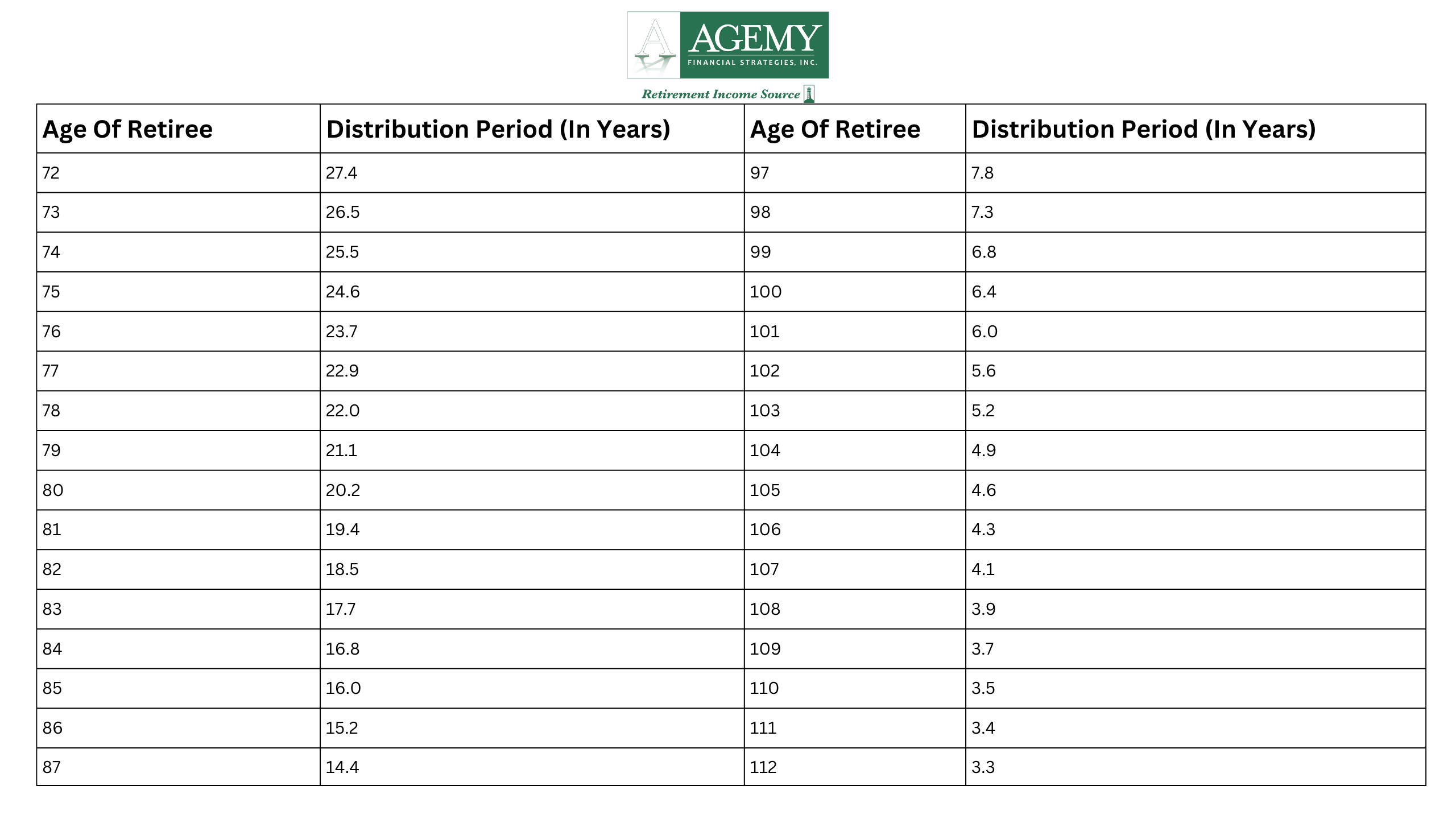
  2. Find Your Life Expectancy Factor: Using the IRS Uniform Lifetime Table, locate the life expectancy factor corresponding to your age. This factor is updated periodically, so make sure you use the latest table for accuracy.
  3. Calculate the RMD: Divide your account balance by the life expectancy factor. The result is the minimum amount you must withdraw from your account for the year.

Below is a portion of the IRS Uniform Lifetime Table to illustrate life expectancy factors by age:

Source: Internal Revenue Service (IRS)

Common Mistakes to Avoid

Navigating RMDs can be challenging; even small missteps can have significant financial consequences. Being mindful of some of the most frequent pitfalls can help you protect your retirement savings and maximize the benefits of these withdrawals. Here are three key mistakes to watch out for when planning your RMDs:

  • Missing the Deadline: Missing your RMD deadline can lead to hefty penalties. Know your required distribution date and withdraw the correct amount.
  • Not Planning for Taxes: RMDs can push you into a higher tax bracket. Working with a fiduciary advisor can help you create a strategy to manage these distributions in a tax-efficient manner.
  • Overlooking Beneficiary Designations: Your beneficiaries will have their own RMD requirements based on the inherited RMD rules. Regularly review your designations to align with your estate and financial goals.

Working with a fiduciary can help ensure that your RMDs are managed to align with your financial goals and help you make the most of your retirement savings.

Working With an Advisor 

New tax laws, potential shifts in Medicare premiums, income bracket adjustments, and evolving rules around charitable giving mean that your retirement income strategy may need some fine-tuning. Staying informed is essential for making the most of these adjustments and preparing your RMDs effectively.

At Agemy Financial Strategies, we provide personalized insights into your RMD responsibilities and tax-efficient strategies to help you manage these distributions. Our fiduciary advisors are dedicated to helping you meet your RMD obligations while optimizing your financial situation within IRS guidelines. We’ll work closely with you to assess your income needs in retirement and develop a plan that aligns with your financial goals and adapts to new regulations.

As part of our commitment to supporting your financial well-being, we offer tools like our free online RMD Calculator to help you estimate your required withdrawals. For more details on our services, please see our service offerings page here.

Final Thoughts

Navigating RMDs effectively requires staying informed about changing rules and understanding how these mandatory withdrawals impact your retirement income. Planning, keeping abreast of IRS updates, and consulting with financial advisors can help ensure that RMDs work in your favor while minimizing tax liabilities.

At Agemy Financial Strategies, our team is here to provide personalized guidance and support tailored to your financial needs and goals. Let us help ensure your tax obligations are appropriately managed throughout your retirement.

Preparing for 2025 doesn’t have to be overwhelming—let us help guide you toward a well-planned and prosperous new year. Contact us today to schedule your complimentary consultation.


Disclaimer: The information provided in this blog is for educational purposes only and is not intended as specific financial or investment advice. Each individual’s financial situation is unique, and any changes to your retirement income strategy or RMD planning should be discussed with a qualified financial advisor. We recommend consulting with our team at Agemy Financial Strategies to ensure your decisions align with your financial goals, risk tolerance, and the latest IRS regulations.

Given the volatile year we’ve encountered, checking in on your retirement plan may make a lot of sense this December. 

As we approach the end of the year, it’s the perfect time for retirees to conduct a comprehensive financial checkup. December is not just a month for holiday cheer; it’s also an opportune moment to ensure your financial health is in excellent shape for the year ahead. In this article, we’ll explore the importance of a December financial checkup and provide valuable insights from the team here at Agemy Financial Strategies to help you navigate this crucial process.

Review Your Retirement Goals

Before diving into the nitty-gritty of your finances, take a step back and review your retirement goals. Are you on track to achieve what you set out to accomplish? Have there been any significant life changes that require adjustments to your financial plan? Whether it’s traveling more, supporting grandchildren, or simply enjoying a comfortable retirement, ensure your goals align with your current circumstances.

Sometimes, a few changes to your plan now can help you cross the finish line, even if market conditions are less than fully cooperative. Are you doing even better than anticipated? Maybe now is a good time to reduce your risk exposure to lock in that progress and protect against future market volatility.

Agemy Tip: Use our free online retirement goal calculators and other retirement resources here to evaluate your progress and make necessary adjustments.

Assess Your Investment Portfolio

A key component of any financial checkup is assessing your investment portfolio. Review your asset allocation to ensure it aligns with your risk tolerance and retirement timeline. December is an excellent time to rebalance your portfolio if necessary, as it can help you stay on track to meet your long-term financial objectives.

Agemy Tip: Our fiduciary advisors offer educated investment advice to help you analyze your investment portfolio’s performance and make informed decisions.

Tax Planning

December is your last chance to make tax-efficient moves for the year. Explore opportunities to minimize your tax liability by considering strategies such as tax-loss harvesting, maximizing contributions to tax-advantaged accounts, and reviewing potential deductions or credits.

Agemy Tip: These strategies can be complex; our team is well-versed in tax planning and can help you implement them.

Social Security and Medicare

Retirees must also consider Social Security and Medicare in their financial checkup. Are you eligible for Social Security benefits, and have you maximized your claiming strategy? Review your Medicare coverage to ensure it meets your healthcare needs. And don’t forget to cover Long-Term Care in your retirement plan.

Agemy Tip: If you need assistance navigating the complexities of Social Security, Medicare, or Long-Term Care planning, see here.

Emergency Fund and Insurance

As you head into retirement, having an adequate emergency fund and appropriate insurance coverage becomes paramount. Ensure you have enough cash reserves to cover unexpected expenses and review your insurance policies to make sure they adequately protect your assets and loved ones.

Agemy Tip: Explore our guide on building an emergency fund here and choosing the right insurance coverage here.

Estate Planning

Preparing for life after retirement involves much more than financial considerations. An estate plan ensures that your assets are protected and distributed according to your wishes, minimizing the burden on your loved ones and leaving a lasting legacy. Review your will, trusts, and beneficiary designations to ensure they align with your wishes. Consider consulting with Agemy’s estate planning professionals to make any necessary updates.

Agemy Tip: Agemy Financial Strategies offers valuable insights into estate planning; for more information on estate planning for the new year, see here.

Set Up an Annual Review

An annual financial review gives you a chance to evaluate your financial position. Many changes can affect your investments during the course of a year. It’s important to monitor your retirement and investment accounts regularly and make adjustments annually to stay on track.

You can schedule an appointment with a fiduciary advisor at any time of the year, but if it’s been a while since you last spoke with one (or have never spoken with one), you may be due for an end-of-year review. You should consider chatting with a fiduciary, especially if you have major life changes coming up in the new year — like a move to a new state, a home purchase, or even need changes to beneficiaries in your estate plan — so they can help you create a solid financial plan for those events.

Agemy Tip: We understand that annual reviews are an important part of anyone’s retirement plan. We strive to provide comprehensive advice and guidance so that you can make informed decisions about your investments, estate plans, and other financial strategies. Let us help you chart the path to a secure financial future with a complimentary strategy session here.

Conclusion

A December financial checkup is a vital step in maintaining your financial wellness. By reviewing your retirement goals, assessing your investment portfolio, planning for taxes, optimizing Social Security and Medicare, and addressing other financial aspects, you can set the stage for a financially secure and worry-free retirement. Agemy Financial Strategies’ resources and tools can be invaluable in this process, providing you with the guidance you need to make informed decisions and secure your financial future.

Checking in on your retirement plan doesn’t just entail making sure you are saving enough money. It also means helping ensure the savings you’ve worked so hard to accumulate will be there when you need it. Remember, it’s never too late to take control of your finances and make adjustments as needed. Start your December financial checkup today, and may you enjoy a prosperous and stress-free retirement in the coming year.


Disclaimer: This content is for educational purposes only and should not be considered financial or investment advice. Please consult with the fiduciary advisors at Agemy Financial Strategies before making any investment decisions.

Longevity is rewriting the retirement rulebook. With Americans reaching age 65 now expecting to live an additional 20 years on average, and nearly one in seven making it past 95, the need for a reliable, long-lasting income has never been more critical. 

Building wealth and creating a steady income stream to support you through the decades ahead becomes essential as retirement approaches. In this blog, we will explore effective income strategies and provide valuable insights for those looking to create a financial foundation that endures the test of time. Here’s what you need to know.

Why Income-Generating Investments Are Crucial for a Long Retirement

As life expectancy rises, retirement planning must adapt to ensure financial resources endure. Traditional savings alone may fall short of keeping up with inflation and unexpected expenses, making it crucial to incorporate income-generating investments. Designed to provide regular cash flow rather than solely relying on appreciation, these investments play a vital role in maintaining financial stability.

By including income-generating assets, investors nearing retirement can sustain their lifestyle and cover ongoing expenses without eroding their principal savings. Here are some common investment vehicles that can help generate steady income:

  • Bonds and Bond Funds
  • Dividend-Paying Stocks
  • Real Estate Investments
  • Certain Annuities

Building a sustainable portfolio designed for consistent income can help you gain peace of mind, knowing you have the financial support to handle a longer retirement and the unexpected costs that may come with it. Working with an advisor can help you select the right investment based on your unique financial situation.

Building a Diversified Portfolio for Stability

Diversification is key to helping reduce risk while generating income from investments. By spreading investments across different asset classes—such as stocks, bonds, real estate, and alternative assets—investors can help protect themselves from market volatility and enhance the potential for steady income. Here’s a look at some advantages of a diversified portfolio:

  • Risk Reduction: Each asset class performs differently depending on market conditions. By diversifying, investors can help reduce their risk exposure when one asset class experiences a downturn.
  • Income Consistency: Different asset classes generate income at various intervals. Combining them can lead to more consistent income, as one investment’s income may offset another’s downturn.
  • Adaptability: As market conditions change, a diversified portfolio allows investors to rebalance and adjust their holdings to help maintain income levels and financial goals.

Evaluating Fixed-Income Securities for Reliable Cash Flow


Fixed-income securities, such as bonds and bond funds, are often the cornerstone of income-focused portfolios for retirees. They offer regular interest payments that can help provide a predictable income stream, particularly appealing to those nearing or in retirement. Fixed-income securities can vary significantly regarding risk and yield, so understanding their distinctions is essential.

Types of Fixed-Income Securities

  • U.S. Treasury Bonds: Considered one of the safest investments, U.S. Treasury bonds are backed by the government. They offer lower yields than corporate bonds but can provide stability and a steady income stream.
  • Corporate Bonds: These bonds typically offer higher yields than government bonds, as they carry higher risk. Selecting bonds from highly rated companies can help mitigate this risk.
  • Municipal Bonds: Issued by state and local governments, municipal bonds are often tax-exempt at the federal level, making them attractive for HNWIs in higher tax brackets.
  • Bond Funds: Bond funds pool money from multiple investors to invest in a diversified range of bonds. They provide instant diversification, but the income and principal value may fluctuate with interest rate changes.

Income from Real Estate: A Tangible Asset with Growth Potential

For investors interested in physical assets, real estate offers a compelling opportunity to generate income through rental payments and benefit from potential property appreciation. Many investors choose real estate for its income potential and its ability to diversify their portfolios. Here are some key benefits of real estate investments:

  • Cash Flow through Rental Income: Rental properties provide monthly income, which can be reinvested or used to cover living expenses. The steady nature of rental payments makes real estate a popular option for retirees.
  • Potential Tax AdvantagesReal estate investors can benefit from potential tax deductions related to mortgage interest, property taxes, and property depreciation.
  • Hedge Against InflationReal estate generally appreciates over time, offering a potential hedge against inflation. Rental income may also increase with inflation, helping to maintain purchasing power.

Working with a fiduciary advisor can help enhance your real estate investment strategy. They can offer tailored guidance to help manage risks and protect income, helping your investments align with your financial goals.

Dividends as a Source of Passive Income

Dividend stocks provide a way to earn income without selling investments. Companies in sectors like utilities, consumer goods, and healthcare often have stable dividend-paying stocks. Dividend-focused funds are another way to diversify income sources, as they pool stocks from multiple companies that pay dividends.

Evaluating Dividend-Paying Stocks

  • Dividend Yield: The dividend yield represents the annual dividend payment as a percentage of the stock price. A higher yield can offer potential income, but it’s essential to consider the sustainability of the dividend payout.
  • Dividend Growth Rate: Companies that regularly increase their dividend payouts demonstrate financial health and commitment to returning value to shareholders, attracting retirees looking to offset inflation.
  • Dividend Aristocrats: Stocks in the S&P 500 that have increased their dividends for at least 25 consecutive years are known as Dividend Aristocrats. These companies offer a combination of reliability and growth potential.

The Importance of Tax-Efficiency in Income Generation

Taxes can significantly impact the net income received from investments, so structuring your investment portfolio to help minimize tax liability becomes crucial. A well-planned, tax-efficient strategy can help enhance the longevity of your assets and allow you to keep more of your hard-earned income.

  • Municipal Bonds: Interest income from municipal bonds is often exempt from federal taxes and, in some cases, state taxes, making them a great potential tax-efficient option for high-net-worth individuals.
  • Qualified Dividends: Qualified dividends are taxed at a lower rate than ordinary income, which can help reduce the potential tax burden on dividend-producing assets.
  • Tax-Deferred Accounts: Placing income-generating investments in tax-deferred accounts, such as IRAs, allows income to grow tax-free until withdrawal, offering potential tax benefits over the long term.

Working with a fiduciary can be invaluable when building a tax-efficient income strategy. They can help you structure an income-focused portfolio that helps minimize taxes while meeting your financial needs.

Managing Risk to Protect Income

Generating income from investments involves balancing income potential with effective risk management. For retirees and those nearing retirement, protecting your principal is crucial. Here are some strategies to help mitigate risk while prioritizing income generation:

  • Invest in High-Quality Bonds: Selecting investment-grade bonds can provide a potential income stream with reduced risk, making them an option for income-focused portfolios.
  • Limit Equity Exposure in Volatile Markets: While dividend-paying stocks are appealing for income, limiting exposure to high-volatility stocks is essential, which can cause potentially unpredictable returns.
  • Adjust Asset Allocation: Regularly reviewing and rebalancing your asset allocation can help ensure alignment with current market conditions, personal risk tolerance, and income needs.

Working with a fiduciary advisor can further support effective risk management, helping you tailor your portfolio to protect your income and financial security.

Working with an Advisor for Personalized Income Strategies

Crafting a personalized investment strategy to generate steady income can be complex, especially as retirement approaches. A knowledgeable advisor provides essential guidance, helping to create a tailored plan that meets income needs without compromising financial security. At Agemy Financial Strategies, our team of fiduciaries is here to guide you through the process, helping ensure that your money works efficiently to support a comfortable retirement.

Benefits of Professional Guidance

  • Portfolio Customization: Our advisors design portfolios aligned with your specific income goals, time horizon, and risk tolerance, optimizing investments to help deliver steady income.
  • Access to Unique Investment Opportunities: We offer access to a broader range of investments, including alternative options and private market offerings not typically available to individual investors.
  • Tax Efficiency: We help maximize after-tax income by structuring investments to minimize tax liabilities, supporting financial longevity in retirement.

Our team is committed to providing the insights and resources you need to make confident decisions about your financial future. To learn more about our full range of personalized services, see here.

Creating a Sustainable Income Plan With Agemy

Building a reliable income stream from investments is essential to helping you achieve financial stability throughout retirement. The objective is to craft a diversified portfolio that not only generates steady income but also preserves capital for the long term. At Agemy Financial Strategies, we’re here to help you create an income-focused portfolio tailored to your unique financial goals and needs.

Contact us today to learn more about how our team can support your journey toward a sustainable and more secure retirement income plan.


Disclaimer: The information provided in this blog is for educational purposes only and should not be considered as specific investment advice. While we aim to provide valuable insights, every individual’s financial situation is unique, and changes to your investment portfolio or financial strategies should only be made after consulting with a qualified financial advisor. We encourage you to reach out to our team before making any investment decisions to ensure they align with your personal goals and risk tolerance.

The world of retirement planning is changing in 2024, including a nationwide crackdown on “Junk Fees.” Here’s what you need to know.

The landscape of financial advising is abuzz with new insights and strategies as we approach the upcoming year. Most recently, President Biden has announced that the Department of Labor will propose a new rule — the Retirement Security Rule — to extend fiduciary standards and close loopholes to protect people saving for retirement against conflicted advice.

Between shifting retirement account contribution limits and fresh investment opportunities, it’s important to understand all the latest developments that can significantly impact your financial future. Here’s what you need to know to navigate the upcoming year. Let’s begin with the year’s contribution changes.

2024 Retirement Account Contribution Limits

One of the key aspects of retirement planning is understanding the contribution limits for retirement accounts such as 401(k)s and IRAs. These limits determine how much you can contribute to these accounts each year, helping you build a robust nest egg for retirement. Let’s take a look at the expected contribution limits for 2024:

  • 401(k) Plans: The contribution limit for 401(k) plans is projected to increase to $23,000 in 2024, up from $22,500 in 2023. For those aged 50 and older, an additional catch-up contribution of $7,500 will remain the same. It’s important to note that these new amounts apply to 403(b) and most 457 plans.
  • IRA Contribution Limits: Individual Retirement Accounts (IRAs) are another popular retirement savings option. The contribution limits are to remain relatively stable for IRAs. For 2024, individuals under 50 can contribute up to $7,000, up from $6,500 in 2023. Catch-up contributions for adults 50 and older will remain at $1,000.
  • Roth IRA Contribution Limits: Beginning in 2024, more Americans will qualify for Roth IRA contributions, with the AGI range rising between $146,000-$161,000 for single filers, up from $138,000-$153,000 in 2023. The Roth IRA contribution phaseout for married couples filing together will rise to between $230,000 and $240,000 in 2024, up from between $218,000 and $228,000.

It’s essential to consult with a financial advisor or check the latest IRS guidelines to confirm these limits for 2024 and adjust your retirement savings strategy accordingly.

Income Limits for Roth Eligibility

The IRS has introduced income limits for Roth IRA contributions, making it less accessible for high-income individuals. For the 2024 tax year, the limit for single filers is $146,000; for joint filers, it’s $161,000. These limits have seen a significant reduction from the 2023 tax year, which was $153,000 for single filers and $228,000 for married couples who filed jointly.

Now, you might be wondering, “What are my alternatives?” That is where a financial advisor can be valuable. They have the experience to tailor a retirement strategy that aligns with your unique financial situation, helping you make the most of your wealth and plan for a comfortable retirement.

A financial advisor can explore alternative retirement savings options that can help you maintain or even enhance your current standard of living in retirement. By working together, you can strategize around tax-efficient investment choices, explore advanced retirement planning strategies, and ensure that your wealth continues to work for you in your golden years.

The Retirement Security Rule – Strengthening Protections for Americans Saving for Retirement

A new retirement security rule proposed by the Department of Labor is set to expand the definition of fiduciary advice and redefine which advisors fall underneath it.

The proposed rule will now cover things like fixed index annuities, advice to employers and plan fiduciaries, and one-time advice for transactions like 401(k) rollovers, the Whitehouse said in a statement. The proposed rule, which is open for public comment, could have far-reaching consequences for advisors, brokers, plan sponsors, and insurance agents.

The rule will also cut so-called junk fees in retirement products, which the Whitehouse said will potentially provide billions more in savings for those preparing for retirement.

“Today’s proposed Retirement Security rule by the Biden Administration expands protections for retirement savers, ensures sounder financial advice, lowers investment junk fees, and gives every American saving for retirement greater peace of mind about their portfolios,” the Whitehouse said.

The proposed rule aims to address a known fiduciary gap to the Employee Retirement Security Income Security Act, also known as ERISA, the federal law governing retirement plans. Under the current rule, financial advisors must put their client’s interests above their own commissions when recommending the purchase of securities like stocks and mutual funds.

At Agemy Financial Strategies, we strongly support the proposal for transparency and encourage those seeking advice to always look for a fiduciary advisor for your retirement income planning needs. Because financial planners aren’t licensed, look for one who has been certified as a CFP® professional by the Certified Financial Planner Board of Standards (CFP Board). These financial planners earn their certifications by being experienced financial professionals who have passed a rigorous financial planning examination. They also agree to uphold the highest standards of integrity, accountability, and client service.

Cracking Down on Junk Fees in Retirement Accounts

One area of focus of the proposed plan has been eliminating junk fees. Junk fees are unnecessary charges that can significantly affect your retirement savings over time, potentially reducing your nest egg.

The Department of Labor (DOL) has been working to develop rules and regulations to increase transparency and reduce retirement account fees. These initiatives help to ensure that financial institutions and retirement plan providers act in the best interests of their clients and disclose all associated fees.

The recent regulation aims to support guidance on transferring assets from employer-sponsored plans like 401(k)s, a decision affecting approximately 5 million individuals annually. In 2022, Americans shifted approximately $779 billion from their 401(k)s to IRAs. This rule is set to help protect investors from bad advice and help ensure that information is presented in a manner that prioritizes your best interests.

As an investor, staying informed about these regulatory changes is crucial, and monitoring your retirement account statements for any fees eroding your savings is crucial. Working with a Fiduciary can help you navigate these complex financial waters, as they are legally obligated to act in your best interests and provide advice that minimizes fees.

The Importance of Working with a Fiduciary

A fiduciary is a financial professional legally bound to prioritize your best interests when providing investment advice or managing your retirement accounts. Unlike some financial advisors with conflicts of interest, fiduciaries are legally bound to act in your best interests.

They are committed to helping you achieve your financial goals without being influenced by commissions or fees tied to specific financial products. Choosing to work with a Fiduciary can be a game-changer for your retirement planning for several reasons:

  • Reducing Risk: Fiduciaries help you make informed investment decisions that align with your risk tolerance and long-term objectives. They can design a diversified portfolio tailored to your unique circumstances, which can be crucial for managing risk in retirement.
  • Staying Informed: The financial landscape continually evolves, with new regulations and investment options emerging regularly. Fiduciaries stay current with these changes, ensuring your retirement strategy aligns with current best practices.
  • Peace of Mind: Working with a Fiduciary can provide peace of mind, knowing that your financial future is in capable hands. You can trust that your advisor is always working in your best interests.

Working With Agemy Financial Strategies

If you are worried about your road to retirement in 2024, working with a qualified fiduciary advisor like the team at Agemy can help provide valuable guidance and transparency regarding retirement planning. Our fiduciary advisors, Andrew A. Agemy, MRFC®, and son Daniel J. Agemy, CPM®, RFC®, can help you develop a personalized retirement plan, optimize your investment strategy, and stay on track to achieve your goals.

At Agemy Financial Strategies, we are committed to educating our clients on various financial matters, including retirement planningwealth managementtax planning, and more. With over 30 years of experience in helping individuals reach retirement stress-free, our unwavering dedication to educating and serving our clients remains at the core of our mission. Our financial guide to retirement planning is one of the many tools we offer to help you take control of your finances and plan for the future. Contact us today to learn how we can help you achieve financial security and peace of mind for 2024 and beyond.


Disclaimer: This content is for educational purposes only and should not be considered financial or investment advice. Please consult with the fiduciary advisors at Agemy Financial Strategies before making any investment decisions.

With today’s shifting market conditions, it’s vital to understand the benefits and challenges of each real estate investment strategy. Should you prioritize cash flow for steady income, aim for appreciation to maximize long-term growth, or perhaps combine both for a balanced approach?

Each strategy offers unique advantages, and understanding their differences can help you build a strategy that aligns with your financial goals. For high-net-worth individuals (HNWIs), evaluating a property’s potential for consistent cash flow versus long-term appreciation is key to a successful and resilient portfolio.

What is Appreciation? 

Appreciation refers to a property’s value over time, driven by increasing demand in a particular area, economic growth, and property improvements. According to the National Association of Realtors (NAR), from August 2023 to August 2024, single-family home prices rose by 2.9%, and condominium prices increased by 3.5%.

Many investors opt for appreciation-focused strategies to potentially benefit from rising property values, often holding properties long-term. Key factors influencing property appreciation include:

  1. Location: Prime locations tend to see higher appreciation rates due to limited availability and increased demand.
  2. Economic Growth: Booming economies, infrastructure improvements, and job creation in an area can potentially increase property values.
  3. Upgrades and Improvements: Investing in renovations or upgrades can potentially boost the property’s market value.
  4. Inflation: Property values generally rise with inflation, making real estate a potential hedge against inflationary pressures.

Working with a fiduciary can be valuable, as they help investors develop a real estate investment strategy that closely aligns with their financial objectives.

Cash Flow in Real Estate

Cash flow is the income a property generates after covering all operating expenses like mortgage payments, taxes, insurance, and maintenance. Multifamily properties and single-family rentals are seen as stable assets for generating reliable cash flow. This stability is partly driven by a shortage of 7.3 million affordable rental homes, increasing demand for rental housing across the U.S.

For investors focused on cash flow, rental properties offer a reliable income stream and ongoing liquidity. Here are key elements that can help maximize cash flow:

  1. Rental Yield: Rental income is a primary cash flow driver; setting competitive yet profitable rates is essential.
  2. Property Management: Effective management can help reduce vacancy rates and maintenance costs, maximizing cash flow.
  3. Financing Terms: Favorable financing terms, such as low interest rates, can significantly help improve cash flow by lowering monthly obligations.
  4. Expense Management: Managing operating expenses is critical, as these impact net cash flow.

Investors may find value in consulting an advisor who can help align a real estate investment strategy with their financial goals, balancing the potential for growth and immediate cash flow needs.

Appreciation vs. Cash Flow: What’s the Right Strategy? 

Choosing between appreciation and cash flow often depends on individual financial goals, time horizons, and risk tolerance. Here are factors to consider:

1. Time Horizon

The timeframe over which you plan to invest is crucial in determining whether an appreciation or cash flow strategy will best support your financial goals. Understanding your time horizon can help clarify which approach aligns with your lifestyle and financial needs.

  • Long-Term Goals: If you’re building a portfolio with a decades-long view and aren’t reliant on immediate income, focusing on appreciation may be the better fit. Appreciation-focused investments yield larger returns over time, making them suitable for investors who maximize long-term growth by holding properties until they significantly increase in value.
  • Short-Term Needs: For investors who need regular income to support other financial obligations or to diversify their revenue streams, cash flow properties can provide steady returns in the near term. This approach is ideal for those prioritizing consistent income generation over potential future gains.
  • Flexible Time Horizons: For those with a medium to long-term time horizon who still desire income flow, a blended approach can offer both cash flow and growth potential. Investing in properties that provide rental income and appreciate over time can help you achieve a balanced portfolio that supports financial flexibility while positioning for future growth.

2. Risk Tolerance

When considering appreciation versus cash flow, evaluating your risk tolerance is essential, as each strategy exposes investors to different types of risk.

Appreciation Strategy Risks

Appreciation-focused investments primarily rely on the property’s increasing value over time. While this can yield substantial returns, it’s closely tied to market conditions and economic cycles, making it more volatile. Here are some specific risks associated with an appreciation strategy:

  • Market Sensitivity: Property values are highly influenced by economic conditions, such as downturns, interest rate changes, and local demand trends, which can impact potential appreciation gains.
  • Long Holding Period and Liquidity Constraints: Appreciation typically requires a long-term commitment, often tying up capital for years and limiting liquidity as the property value grows.

Cash Flow Strategy Risks

While cash flow-focused investments offer regular income, they also come with unique risks related to tenant management, property upkeep, and local rental market conditions. Here’s a closer look at some of the key risks:

  • Tenant-Related Risks: Late payments, property damage, and high tenant turnover can disrupt cash flow. Properties that rely on consistent rental income to cover expenses are particularly vulnerable to these challenges.
  • Maintenance and Repair Costs: Cash flow properties require ongoing maintenance, which can be unpredictable and costly. Expenses for repairs, property management, and general upkeep directly impact net cash flow, potentially reducing the steady income an investor expects.
  • Market Rental Rates: Cash flow heavily depends on local rental demand and market rates. In the event of a downturn in the rental market or an oversupply of properties, landlords may face difficulties filling vacancies at profitable rates, resulting in diminished income.

3. Tax Implications

Real estate investment can come with several tax benefits that can significantly impact overall returns, whether you’re investing for appreciation, cash flow, or both. Understanding these tax implications can help investors maximize the value of their investments. Here’s how each benefits investors:

  • Capital Gains for Appreciation Investors: Appreciation-focused investors gain from long-term capital gains tax rates, typically lower than ordinary income tax rates. Utilizing a 1031 exchange can defer capital gains taxes, enabling reinvestment in similar properties without an immediate tax hit.
  • Income Tax Reduction for Cash Flow Investors: Cash flow investors can offset rental income with deductions on property management, repairs, insurance, and utilities. Strategic deductions can help reduce tax liability, keeping rental income tax-efficient.
  • Hybrid Strategy Tax Efficiency: Combining both strategies helps investors maximize annual deductions on cash flow and leverage capital gains

4. Financing and Leverage

Leverage is often crucial in real estate investing and can impact both strategies. A cash flow-focused investor might use conservative leverage to help maintain a steady income. In contrast, an appreciation-focused investor may rely on higher leverage, betting on future price increases to outpace interest costs.

Both strategies require careful risk management, as leveraging can amplify gains and losses. For cash flow investors, a conservative approach helps safeguard monthly income but may limit the ability to grow the portfolio rapidly. Appreciation investors, while potentially achieving higher returns, must be prepared for higher interest payments and market downturns. 

Choosing the right leverage strategy ultimately depends on the investor’s risk tolerance, market outlook, and each property’s role in their broader investment portfolio. Consulting with a fiduciary advisor can help you align your real estate investments with broader financial goals.

Combining Appreciation and Cash Flow: Hybrid Strategies for Real Estate

Many investors find that a hybrid approach—mixing properties for reliable cash flow with those positioned for high appreciation—can be a strategic way to maximize returns. For instance, investing in a multi-family rental property in a growing neighborhood offers immediate cash flow and added potential for value growth as the area develops. Here are some key benefits of a hybrid approach:

  • Diversified Income Sources: This can help provide stability through cash flow while allowing for long-term gains from appreciation.
  • Risk Mitigation: Helps Reduce risk by not relying solely on one market factor and balancing income generation with growth potential.
  • Flexible Portfolio Options: Enables investors to adapt to market shifts, focusing on appreciation in strong markets and cash flow in downturns.

Working with a fiduciary advisor can help you tailor a hybrid strategy that aligns with your unique financial goals and risk tolerance.

How Agemy Financial Strategies Can Help

Investing in real estate can be a powerful way to build wealth, but finding the right strategy requires proper guidance and careful planning. Agemy Financial Strategies is here to provide the support, insight, and customized approach that high-net-worth investors need to succeed. Here’s how we can help:

  • Personalized Strategy Development: We comprehensively approach real estate income strategies by assessing your financial situation, risk tolerance, and goals. We can help craft a strategy that balances the benefits of cash flow and appreciation to match your long-term goals.
  • Navigating Market Conditions: The real estate market is influenced by numerous factors, from economic cycles to rental demand and property values. Our team keeps a close eye on market trends and uses data-driven insights to guide clients through changing conditions.
  • Long-Term Tax Planning and Wealth Management: Real estate income strategies also involve understanding tax implications and long-term wealth management. Our fiduciaries provide holistic financial guidance, helping you structure your investments tax-efficiently while ensuring they align with your broader financial plans.

Final Thoughts

Choosing between appreciation and cash flow in real estate is about more than just returns—it’s about finding the right fit for your financial goals. Appreciation offers the potential for long-term value growth, while cash flow provides a steady income stream that can support your portfolio’s stability and liquidity.

At Agemy Financial Strategies, we’re dedicated to helping you make informed decisions that align with your unique financial landscape. Our fiduciary advisors prioritize your best interests to help you work toward a secure and fulfilling retirement.

Contact us today to schedule your complimentary consultation.


Disclaimer: The information provided in this blog is for educational purposes only and should not be considered as specific investment advice. While we aim to provide valuable insights, every individual’s financial situation is unique, and changes to your investment portfolio or financial strategies should only be made after consulting with a qualified financial advisor. We encourage you to reach out to our team before making any investment decisions to ensure they align with your personal goals and risk tolerance.