Posts

For high-net-worth individuals (HNWIs), effective tax planning is just as important as investment growth when it comes to long-term wealth preservation. With the top marginal tax rate in the U.S. at 37% and potential estate tax exemptions set to decline after 2025, strategic tax planning can make a significant impact on reducing liabilities and maximizing financial efficiency.

A well-structured tax strategy allows HNWIs to legally minimize tax burdens, provide compliance with evolving regulations, and preserve more wealth for future generations. In this blog, we explore four essential tax planning strategies to help you optimize your financial position while staying ahead of tax obligations.

Why Having a Tax Strategy is Important

Without strategic tax planning, these factors can significantly erode wealth over time. A proactive tax strategy minimizes tax liability and helps ensure that your investments, estate, and philanthropic efforts align with your long-term financial goals.

  • Preserve Wealth: Reducing tax liabilities allows you to keep more earnings and investment gains.
  • Enhances Investment Returns: Tax-efficient investing can improve net returns by providing the right assets in the most tax-advantaged accounts.
  • Optimizes Charitable Giving: Smart gifting strategies allow you to support causes you care about while receiving tax benefits.
  • Safeguards Your Estate: Proper estate planning can help reduce the tax burden on heirs, allowing more of your wealth to be passed down.

By implementing a proactive tax strategy, you can maximize your financial efficiency, maintain compliance with evolving tax laws, and make informed decisions about wealth management. Let’s explore four key tax planning strategies to help you achieve these goals.

1. Optimize Charitable Giving with Strategic Donations

Charitable giving is a powerful tool for tax planning. It allows you to support causes that matter to you while reducing your taxable income. HNWIs have multiple avenues to help structure their giving to maximize tax benefits. Here are some key strategies for charitable giving:

  • Donor-Advised Funds (DAFs): These allow you to donate assets and receive an immediate tax deduction while deciding which charities to support later.
  • Qualified Charitable Distributions (QCDs): If you’re 70½ or older, you can donate up to $100,000 directly from an IRA to a charity without counting it as taxable income.
  • Charitable Remainder Trusts (CRTs): These provide income during your lifetime while benefiting a charity upon passing, offering estate and income tax benefits.

With recent changes in tax laws, considering long-term charitable strategies can enhance your philanthropic impact while securing favorable tax advantages.

2. Leverage Tax-Advantaged Accounts for Retirement and Investment Growth

Even for HNWIs, tax-advantaged accounts provide valuable opportunities to defer or reduce taxes on investment gains. Proper allocation across these accounts can help yield potential benefits over time. Here are some types of tax-advantaged accounts to consider:

  • Roth IRA Conversions: While you’ll pay taxes on the conversion amount, your investments grow tax-free, and withdrawals in retirement are not subject to income tax.
  • Health Savings Accounts (HSAs): For those with high-deductible health plans, HSAs offer triple tax benefits: contributions are tax-deductible, investments grow tax-free, and withdrawals for qualified medical expenses are tax-free.
  • Life Insurance as an Estate Planning Tool: Properly structured life insurance policies can provide tax-free income to beneficiaries while helping mitigate estate tax burdens.

Implementing a strategic approach to utilizing these accounts can help ensure tax efficiency in both the short and long term. Working alongside a fiduciary advisor can help you leverage these accounts.

3. Minimize Capital Gains Taxes Through Tax-Loss Harvesting and Asset Location

Capital gains taxes can significantly impact wealth accumulation, particularly for HNWIs with diversified investment portfolios. You can reduce tax liabilities and optimize after-tax returns by strategically managing how and when you sell investments.

  • Tax-Loss Harvesting: Offsetting capital gains by selling underperforming investments can help lower your tax bill while maintaining a similar asset allocation.
  • Holding Period Strategies: Long-term capital gains rates are significantly lower than short-term rates. Holding investments for more than one year before selling can help reduce taxes.
  • Asset Location Optimization: Placing tax-inefficient investments (such as bonds and REITs) in tax-advantaged accounts while keeping tax-efficient investments (like index funds) in taxable accounts can improve overall tax efficiency.

Understanding how different investments are taxed—and strategically aligning them—can help you preserve more of your returns. Working with a knowledgeable advisor helps your portfolio be structured in a way that optimizes tax efficiency while supporting your long-term financial goals.

4. Plan for Estate and Gift Taxes to Preserve Generational Wealth


Estate and gift taxes can take a significant portion of wealth if not strategically managed. Understanding how these taxes operate and interact is essential for crafting a comprehensive wealth preservation strategy. Let’s explore each tax in detail:

By proactively planning your estate, you can maximize the wealth passed to future generations while reducing unnecessary tax liabilities.

How Agemy Can Help You with Tax Planning

Navigating the complexities of tax planning can be overwhelming, especially with ever-changing tax laws, investment implications, and estate planning considerations. At Agemy Financial Strategies, our fiduciary advisors work alongside you to create a tailored tax strategy that aligns with your wealth management goals. With a focus on transparency and strategy, our team helps HNWIs:

  • Identify Tax-Efficient Investment Strategies: We analyze your investment portfolio to help optimize asset location, maximize tax efficiency, and manage capital gains.
  • Mitigate Estate and Gift Tax Burdens: Our team helps structure estate plans to minimize tax liability and protect generational wealth.
  • Optimize Retirement and Tax-Advantaged Accounts: We guide you on Roth conversions, tax-efficient withdrawals, and leveraging accounts like HSAs and IRAs.
  • Strategize Philanthropic Giving: We help structure charitable contributions through donor-advised funds, trusts, and other vehicles that can potentially benefit your estate and the causes you care about.

Final Thoughts

Effective tax planning is a crucial component of wealth preservation for HNWIs. Staying informed and proactive in your tax strategy helps ensure that your wealth continues to work for you and your family, both now and in the future.

At Agemy Financial Strategieswe help HNWIs develop tax-efficient wealth management plans tailored to their unique financial goals. Our fiduciary advisors provide guidance to help you maximize tax savings, protect your assets, and build a strong financial future.

Contact us today to schedule your complimentary consultation and start planning for a more tax-efficient future.


Frequently Asked Questions (FAQs)

1. How do tax laws impact HNWIs differently than average taxpayers?

HNWIs often face higher marginal tax rates, exposure to estate and gift taxes, and alternative minimum tax (AMT) considerations. Strategic tax planning is essential to help mitigate these factors. Our fiduciary advisors help HNWIs navigate complex tax laws by implementing strategies that help optimize tax efficiency while staying compliant.

2. Are Roth conversions a good strategy for HNWIs?

Roth conversions can be beneficial if done strategically, particularly in lower-income years or before RMDs begin. They help lock in tax-free growth and withdrawals in retirement. Agemy Financial Strategies provides personalized guidance on timing and executing Roth conversions to minimize tax liability and maximize long-term benefits.

3. What happens if the estate tax exemption is reduced?

If the exemption decreases, more estates will be subject to taxation. Proactive gifting strategies can help mitigate the impact. Our advisors work closely with you to help structure your wealth transfers efficiently, allowing more of your assets to be preserved for future heirs and beneficiaries.

4. Can tax-loss harvesting be done year-round?

Tax-loss harvesting can be executed throughout the year, but many investors optimize it toward year-end to offset capital gains from other investments. If you want to integrate tax-loss harvesting into your investment approach, our fiduciary advisors can help you.

5. How do charitable donations reduce my tax bill?

Charitable contributions can lower taxable income, and depending on the donation type (cash, stocks, trusts), they may provide additional tax benefits such as avoiding capital gains taxes. Agemy Financial Strategies helps clients develop a strategic giving plan that maximizes their charitable impact and tax efficiency.


Disclaimer: This blog is for informational purposes only and should not be considered specific tax, legal, or investment advice. Tax laws are subject to change, and individual circumstances vary. Please consult with the qualified financial professionals at Agemy Financial Strategies before implementing any of the strategies discussed.

As we approach the end of 2024, reviewing your retirement goals is a prime opportunity. One essential aspect to consider? Required Minimum Distributions (RMDs).

RMDs are a cornerstone of many retirement strategies, yet their complex rules and tax implications can make them challenging to navigate. Planning ahead can help you stay on track and optimize your retirement withdrawals.

With new RMD regulations set for 2025, understanding these changes can help you optimize your financial plans. In this blog, we’ll break down the fundamentals of RMDs, highlight the upcoming updates, and share practical tips to help you manage your distributions effectively.

Understanding Required Minimum Distributions (RMDs) 

RMDs are mandatory withdrawals from certain retirement accounts once you reach a specific age. These withdrawals, which have grown tax-deferred over time, help retirement funds become taxable income. RMDs apply to the following accounts:

  • Traditional IRAs
  • SEP IRAs
  • SIMPLE IRAs
  • 401(k), 403(b), and 457(b) plans (excluding Roth 401(k)s).

The annual amount you must withdraw is calculated based on your age, life expectancy, and account balance at the end of the previous year. Failing to take the required amount can result in significant tax penalties. Let’s take a look at key changes to look for in 2025.

Key Changes to RMDs for 2025

As retirement planning continues to evolve, the latest updates to RMDs reflect efforts to provide more flexibility and tax advantages for retirees. The SECURE 2.0 Act introduced several new rules that impact how and when retirees must take distributions from certain accounts and adjust penalties. Below are the main changes for 2025 and beyond, designed to give retirees more control over their withdrawals and tax planning:

1. Increased RMD Starting Age: The age at which individuals must begin taking RMDs has been raised. In 2023, the age increased from 72 to 73, and it will further rise to 75 beginning in 2033.

2. Reduced Penalties for Missed RMDs: The penalty for failing to take an RMD has been reduced from 50% to 25% of the missed amount. If the missed RMD is corrected promptly, the penalty can decrease to 10%. Remember that the IRS has waived penalties for failing to take RMDs for certain inherited IRAs. For more information, see here.

3. Elimination of RMDs for Roth 401(k)s: Previously, Roth 401(k) accounts were subject to RMDs. Under the new rules, RMDs are no longer required for Roth 401(k)s, aligning them with Roth IRAs. It’s important to note that post-death minimum distribution rules, which also apply to Roth IRAs, still apply.

4. Annuities and RMDs: The SECURE 2.0 Act introduces provisions to make certain annuities more attractive within retirement plans. It allows certain types of annuity payments and clarifies qualifying longevity annuity contracts (QLACs) rules, including increasing the dollar limit to $200,000 and removing the 25% account balance cap.

5. RMDs for Surviving SpousesSurviving spouses can now elect to be treated as the deceased account owner for RMD purposes, potentially delaying the start of RMDs if the surviving spouse is younger than the deceased. This election is irrevocable and requires notifying the account administrator.

6. Qualified Charitable Distributions (QCDs): The annual limit for QCDs, which count toward RMDs, is now indexed for inflation, starting at $105,000 in 2024. A one-time QCD of up to $50,000 is also allowed through certain charitable remainder trusts or gift annuities.

Why These Changes Matter 

The recent adjustments to RMD rules are more than just technical updates—they bring valuable flexibility that can significantly benefit retirees. Here are some of the primary advantages of these changes:

1. Enhanced Growth Potential for Retirement Savings: Delaying RMDs means retirement accounts can stay invested and grow tax-deferred for longer. This change can be particularly beneficial for retirees who do not immediately need income from their retirement accounts, as it gives their investments more time to compound, potentially increasing their overall retirement nest egg.

2. More Control Over Roth 401(k) Withdrawals: With the removal of RMD requirements for Roth 401(k) accounts, retirees now have the same control as they do with Roth IRAs. This means they can choose when or if they want to withdraw from these accounts, providing a tax-free income source that can be preserved and used strategically within their broader retirement plan.

3. Reduced Penalties for Missed RMDs: The lower penalties for missed RMDs, combined with an opportunity for further reduction if corrected promptly, provide relief for retirees who may inadvertently miss their RMD deadline. This change reduces the financial impact of an honest mistake, making the RMD system more forgiving and manageable.

4. Options for Legacy and Charitable Planning: The increased flexibility around QCDs and the inflation-indexed annual limits make charitable giving a viable strategy for retirees looking to meet their RMD requirements while supporting causes they care about.

How to Calculate Your RMD in 2025

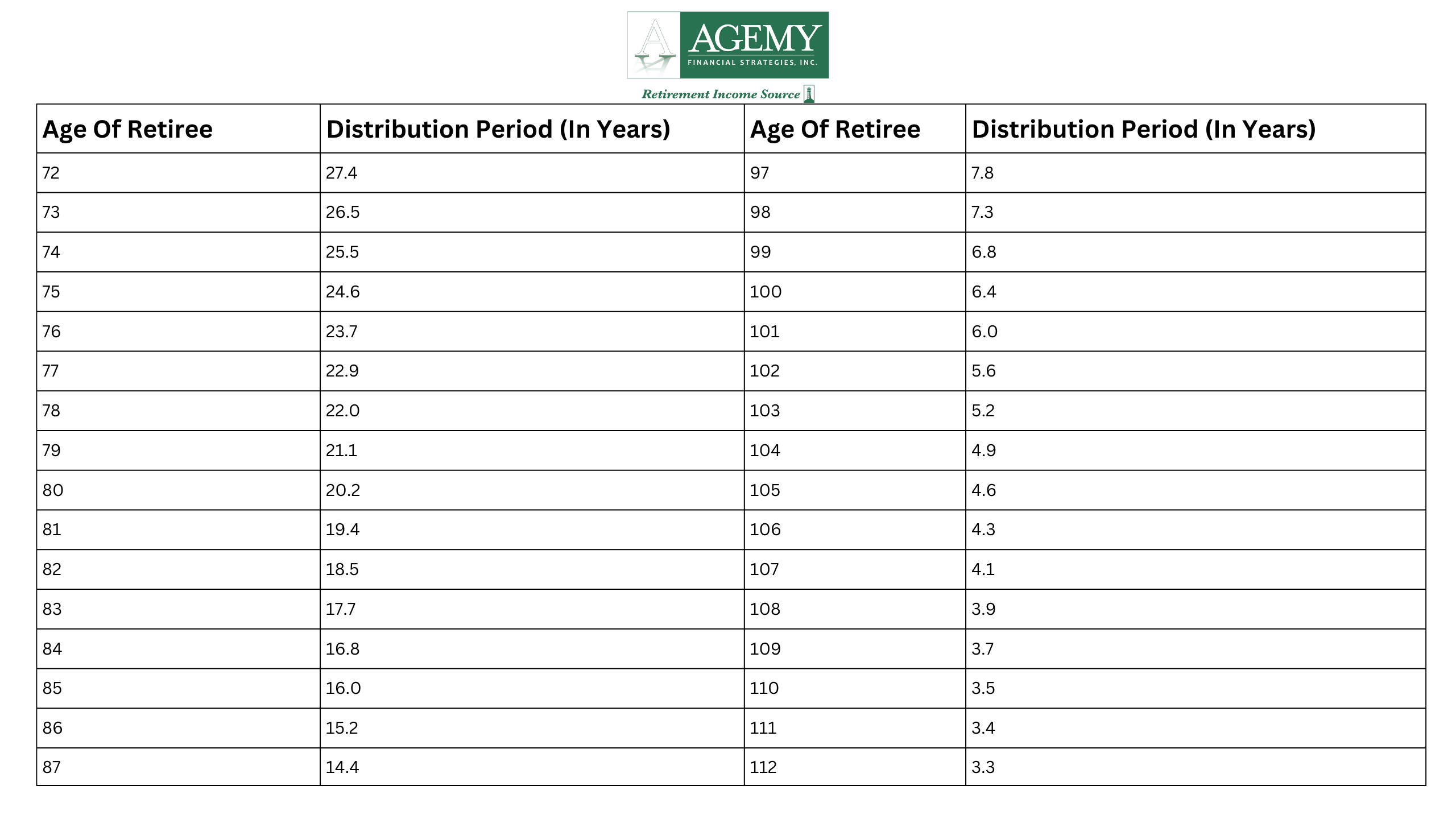
Calculating your Required Minimum Distribution (RMD) in 2025 is straightforward, with a few key steps. The IRS provides tables that determine your life expectancy factor based on your age, which you’ll use to calculate your RMD. Here’s a step-by-step guide:

  1. Determine Your Account Balance: Start with your retirement account balance as of December 31st of the previous year. This amount will serve as the basis for your RMD calculation.
  2. Find Your Life Expectancy Factor: Using the IRS Uniform Lifetime Table, locate the life expectancy factor corresponding to your age. This factor is updated periodically, so make sure you use the latest table for accuracy.
  3. Calculate the RMD: Divide your account balance by the life expectancy factor. The result is the minimum amount you must withdraw from your account for the year.

Below is a portion of the IRS Uniform Lifetime Table to illustrate life expectancy factors by age:

Source: Internal Revenue Service (IRS)

Common Mistakes to Avoid

Navigating RMDs can be challenging; even small missteps can have significant financial consequences. Being mindful of some of the most frequent pitfalls can help you protect your retirement savings and maximize the benefits of these withdrawals. Here are three key mistakes to watch out for when planning your RMDs:

  • Missing the Deadline: Missing your RMD deadline can lead to hefty penalties. Know your required distribution date and withdraw the correct amount.
  • Not Planning for Taxes: RMDs can push you into a higher tax bracket. Working with a fiduciary advisor can help you create a strategy to manage these distributions in a tax-efficient manner.
  • Overlooking Beneficiary Designations: Your beneficiaries will have their own RMD requirements based on the inherited RMD rules. Regularly review your designations to align with your estate and financial goals.

Working with a fiduciary can help ensure that your RMDs are managed to align with your financial goals and help you make the most of your retirement savings.

Working With an Advisor 

New tax laws, potential shifts in Medicare premiums, income bracket adjustments, and evolving rules around charitable giving mean that your retirement income strategy may need some fine-tuning. Staying informed is essential for making the most of these adjustments and preparing your RMDs effectively.

At Agemy Financial Strategies, we provide personalized insights into your RMD responsibilities and tax-efficient strategies to help you manage these distributions. Our fiduciary advisors are dedicated to helping you meet your RMD obligations while optimizing your financial situation within IRS guidelines. We’ll work closely with you to assess your income needs in retirement and develop a plan that aligns with your financial goals and adapts to new regulations.

As part of our commitment to supporting your financial well-being, we offer tools like our free online RMD Calculator to help you estimate your required withdrawals. For more details on our services, please see our service offerings page here.

Final Thoughts

Navigating RMDs effectively requires staying informed about changing rules and understanding how these mandatory withdrawals impact your retirement income. Planning, keeping abreast of IRS updates, and consulting with financial advisors can help ensure that RMDs work in your favor while minimizing tax liabilities.

At Agemy Financial Strategies, our team is here to provide personalized guidance and support tailored to your financial needs and goals. Let us help ensure your tax obligations are appropriately managed throughout your retirement.

Preparing for 2025 doesn’t have to be overwhelming—let us help guide you toward a well-planned and prosperous new year. Contact us today to schedule your complimentary consultation.


Disclaimer: The information provided in this blog is for educational purposes only and is not intended as specific financial or investment advice. Each individual’s financial situation is unique, and any changes to your retirement income strategy or RMD planning should be discussed with a qualified financial advisor. We recommend consulting with our team at Agemy Financial Strategies to ensure your decisions align with your financial goals, risk tolerance, and the latest IRS regulations.

Significant changes to IRAs and 401(k)s in 2025 bring new opportunities to save for retirement, but staying informed is essential to making the most of them. 

These updates, driven by the SECURE 2.0 Act and other recent legislative measures, are designed to boost savings potential and streamline retirement planning for millions of Americans. Here’s an in-depth look at the major changes to retirement accounts in 2025, how they may affect your financial strategy, and what steps you can take to help optimize your retirement plan.

1. Increased Catch-Up Contribution Limits 

If you’re 50 or older, you’re likely familiar with catch-up contributions—additional amounts you can contribute to your retirement accounts to accelerate your savings. For 2025, these limits will increase significantly for eligible savers:

401(k) Plans:

  • The total contribution limit for taxpayers 50 and older will be $31,000, which includes a $23,500 base contribution limit and a $7,500 catch-up contribution—unchanged from 2024.
  • For those aged 60 to 63, catch-up contributions will rise to $11,250up from $7,500 in 2024. This means that, including the increased catch-up allowance, total contributions for this group can reach $34,750, including the increased catch-up allowance.
  • These changes reflect a new rule allowing individuals aged 60 to 63 to contribute over $10,000 or 150% of the 2024 catch-up limit, adjusted for inflation.

IRAs:

  • Similarly, the IRA catch-up contribution limit, currently $1,000, will be indexed to inflation. This adjustment helps ensure the contribution amount keeps pace with rising costs.

The increased contribution limits for 401(k)s and IRAs allow individuals to save more money for retirement. This is especially beneficial for those nearing retirement age who may have a shorter timeline to accumulate wealth.

2. SIMPLE IRAs & Catch-Up Contributions 

For 2025, the base contribution limit increases slightly to $16,500, while the catch-up limit for those aged 50 and older remains unchanged at $3,500. However, a significant enhancement is coming for participants aged 60 to 63. This group’s catch-up contribution limit will increase to $5,000 or 150% of the standard age 50 catch-up contribution limit, adjusted for inflation.

In 2025, Individuals in this age range can contribute $5,250 more to their SIMPLE IRAs, providing a valuable opportunity to accelerate their retirement savings. For 2026, these limits will be adjusted annually for inflation, helping ensure contributions keep pace with rising costs.

These changes make SIMPLE IRAs a more powerful tool for retirement planning, particularly for those nearing retirement. Working alongside a trusted fiduciary advisor can help you navigate the complexities of Roth catch-up contributions and conversions.

3. Automatic Enrollment & Escalation in Employer Plans

To encourage more Americans to participate in workplace retirement plans, automatic enrollment and escalation features will become mandatory for most new 401(k) and 403(b) plans. Here’s how it works:

  • Automatic Enrollment: Employees are automatically enrolled in their company’s retirement plan. However, automatic enrollment does not mean mandatory participation. Employees can change the rate or opt out by electing a zero percent (0%) contribution rate.
  • Automatic Escalation: The initial escalation contribution amount must be at least 3% but no more than 10%. Each year thereafter, that amount is increased by 1 percent until it reaches at least 10%, but no more than 15%.

These features aim to help make retirement saving easier and more consistent, particularly for younger employees who may otherwise delay starting their retirement journey.

4. New 10-Year Rule For Inherited IRAs 

If you inherited an IRA from someone who passed away on or after January 1, 2020, the IRS now requires you to withdraw all funds from the account by December 31st of the tenth full calendar year after the original account holder’s death. This rule replaces the traditional “stretch IRA” strategy, which previously allowed beneficiaries to extend withdrawals—and tax-deferred growth—over their lifetimes.

While the 10-year withdrawal rule applies to most beneficiaries, certain individuals can still utilize the stretch IRA provisions. These include:

  • Surviving spouses.
  • Children under the age of 21 (withdrawals must begin once they reach 21).
  • Beneficiaries no more than 10 years younger than the decedent.
  • Individuals who are disabled or chronically ill.

For these exceptions, beneficiaries may withdraw funds over their lifetimes, starting the year after the decedent’s death. Surviving spouses also have the option to roll the inherited IRA into their own IRA, deferring required withdrawals until they reach their own “required beginning date” (RBD).

5. Inherited IRA RMD Penalties

The IRS has delayed implementing the final rules for required minimum distributions (RMDs) from inherited IRAs until 2025. During this transitional period, beneficiaries who did not take RMDs from their inherited IRAs between 2021 and 2024 have been granted relief from penalties.

However, starting in 2025, a 25% penalty will apply to those who fail to take their required RMD. Staying informed and proactive is essential to avoid penalties and help ensure compliance with the updated rules. Working with a fiduciary can help you navigate new RMD laws and help ensure you’re on the right track to avoid penalties.

6. New Retirement Savings “Lost and Found”

With Americans holding many jobs over their lifetime, it’s not uncommon to lose track of retirement accounts from former employers. Currently, 29.2 million forgotten 401(k) accounts hold an estimated $1.65 trillion in assets.

To address this, the SECURE 2.0 Act established the Retirement Savings Lost and Found database, managed by the Department of Labor. This tool helps individuals locate lost retirement accounts using data submitted by plan administrators and uploaded by the Employee Benefits Security Administration (EBSA). To use the database, you’ll need a Login.gov account. Setup requires:

  • Legal name
  • Date of birth
  • Social Security number
  • A mobile device
  • Driver’s license photos (front and back)

How an Advisor Can Help Optimize Your Retirement Plan

At Agemy Financial Strategies, our fiduciary advisors are dedicated to providing guidance that aligns with your best interests. Taking a holistic approach, we carefully analyze every aspect of your financial situation to help you achieve your envisioned retirement. Here’s how we can support you:

  1. Maximize Contributions: We’ll help you take full advantage of the increased contribution limits for 2025 and guide you in prioritizing the maximum catch-up amount to your 401(k), helping ensure you make the most of this critical savings opportunity.
  2. Evaluate Roth Options: If you’re a high earner, we can help you assess how Roth catch-up contributions fit into your tax strategy. Our advisors will evaluate the benefits of paying taxes now for tax-free withdrawals later, helping you make informed decisions.
  3. Reassess Retirement Goals: With automatic escalation features becoming more common, our team will work with you to regularly review your contribution percentages. This will help your savings strategy align with your goals and financial situation.
  4. Plan for Inflation: We’ll help you factor inflation adjustments into your long-term savings plan. Staying proactive can help preserve your purchasing power and maintain financial stability throughout retirement.

Final Thoughts

Understanding the changes to retirement accounts in 2025 is critical for making informed decisions about your financial future. These updates present new opportunities to save, invest, and grow your wealth but also require thoughtful planning. At Agemy Financial Strategies, we’re here to help you confidently navigate these changes and create a strategy tailored to your unique financial goals.

Contact us today to learn how we can help you secure a prosperous retirement.


Frequently Asked Questions (FAQs)

1. How do I know if I’m eligible for increased catch-up contributions?

To qualify for the higher catch-up contributions, participants must meet specific criteria: they must be aged 60 to 63 in December of that calendar year. These Individuals can utilize the enhanced catch-up contribution limits. Verifying your eligibility with your retirement plan provider is important, as different providers may have different rules.

2. What happens if I don’t want to participate in automatic enrollment?

Employees can opt out of automatic enrollment or adjust their contribution rate anytime.

3. Are Roth contributions better than traditional pre-tax contributions?

This depends on your current income, tax bracket, and retirement goals. Roth contributions can be advantageous if you anticipate being in a higher tax bracket in retirement.

4. How does inflation affect IRA contribution limits?

For 2025, IRA catch-up contributions will be indexed to inflation, helping savers to contribute more as the cost of living rises.

5. Can part-time workers participate in any retirement plan?

Eligibility varies by employer. However, the SECURE 2.0 Act helps ensure that part-time employees who work at least 500 hours per year for two consecutive years participate in their company’s 401(k) plan. This expands access to retirement savings for long-term part-time workers, even if eligibility may differ based on individual company policies.


Disclaimer: This blog is for informational purposes only and should not be considered financial, legal, or tax advice. Always consult the qualified fiduciary advisors at Agemy Financial Strategies to help determine how these changes apply to your circumstances.