Posts

When most people think about retirement, they imagine freedom, travel, family time, and enjoying the fruits of a lifetime of hard work. But beneath those dreams often lies a lingering fear: “Will I run out of money?”

The truth is, many retirees are making the same critical mistake—they’re chasing growth in the stock market rather than securing reliable income. And that mistake can cost them not just peace of mind, but their entire retirement lifestyle.

Here’s what the smartest retirees know—and what most financial advisors don’t tell you: The key to a stress-free retirement isn’t about how much money you’ve saved, it’s about how much income your portfolio can generate.

Welcome to the retiree’s best-kept secret.

Why Income, Not Growth, Is the Foundation of a Secure Retirement

Retirement Secrets

Most financial professionals build retirement plans around the idea of accumulating a large nest egg, usually invested heavily in growth stocks or mutual funds. The assumption is: “If the market keeps growing, your portfolio will too.”

But here’s the flaw: The market doesn’t grow in a straight line.

There are up years and down years. And if you’re withdrawing money from your portfolio during a down year, you’re not just losing value—you’re locking in losses and reducing your future income potential.

Instead, retirees should be thinking like landlords. Just as landlords collect rent month after month, regardless of the housing market’s value, retirees can—and should—collect steady income from investments designed to pay them regularly.

What Does Income-Based Retirement Look Like?

An income-first retirement strategy focuses on building a portfolio of assets that generates reliable, predictable cash flow. These include:

This approach means your lifestyle isn’t dependent on whether the S&P 500 is up or down. You’ll know what’s coming in, month after month, year after year.

It’s not about growth—it’s about certainty.

How Is This Different from Traditional Retirement Planning?

Retirement Secrets

Let’s look at a typical growth-based portfolio. If your $1.5 million nest egg is invested in stocks yielding 2%, you’ll get just $30,000/year in income. The rest depends on market gains, which can be unpredictable.

With an income-focused approach? That same $1.5 million could potentially generate $90,000/year in contractual or dividend income, and possibly more if actively managed for value.

And thanks to compounding and strategic trading, that “extra” 1–2% return each year could translate into over $300,000 in additional earnings over a decade.

Why Haven’t You Heard About This?

Because it doesn’t benefit Wall Street.

Wall Street firms make money whether you gain or lose, as long as your money stays invested. Their priority is assets under management, not the outcome of your retirement.

And frankly, many advisors simply don’t know how to build income-generating portfolios. The skill set required is different, more hands-on, and requires deep expertise in bonds, credit markets, and alternative income vehicles.

This is where Agemy Financial Strategies comes in.

How Agemy Financial Strategies Can Help

Retirement Secrets

At Agemy Financial Strategies, we’ve been helping retirees enjoy stress-free retirements for over 30 years. We believe that everyone deserves a retirement defined by confidence, not anxiety.

Here’s how we do it:

✔ Income-First Planning: We prioritize building portfolios that generate contractual, predictable income, not just paper gains.

✔ Tactical Investment Management: Our team actively manages your portfolio to buy low, sell high, and capture additional yield—often gaining an extra 1–2% per year through professional trading strategies.

✔ True Diversification: We go beyond ETFs and mutual funds. Our clients enjoy portfolios that are resilient to market chaos and tailored to withstand volatility.

✔ Fiduciary Responsibility: As fiduciaries, we are legally and ethically obligated to put your interests first, not Wall Street’s.

✔ Personalized Retirement Income Plans: You’ll receive a custom roadmap with income projections, retirement milestones, and peace-of-mind calculations—so you know exactly how your money will support your goals.

We call this approach “More Life Than Money”—and we’d love to help you experience it firsthand.

Final Thoughts: Take the “Hope” Out of Retirement

A good retirement plan doesn’t rely on hope.

Hope that the market does well.
Hope that you don’t live too long.
Hope that you won’t outspend your savings.

Retirement should be lived with certainty, not speculation.

The retiree’s best-kept secret is simple: Invest for income, not just growth. And with the right strategy, you can enjoy more than enough income to live the way you want for the rest of your life, without fear of running out.


Frequently Asked Questions (FAQs)

  1. What is the biggest mistake retirees make with their money?
    They stay invested in a growth-oriented portfolio and withdraw funds during market downturns—locking in losses. Shifting to an income-focused strategy helps provide more stability and predictability.
  2. Is income investing safe?
    Income investing can be very safe when diversified and managed properly. It focuses on assets with contractual payouts and less market volatility, potentially offering more consistent returns than growth-only strategies.
  3. Can I still get growth in an income-focused portfolio?
    Yes. While the primary goal is income, your portfolio can still grow. Active management can help provide strategic gains on top of the steady income stream—think of growth as the “icing on the cake.”
  4. What’s the ideal time to switch from growth to income investing?
    Typically, 5–10 years before retirement is the best time to start rebalancing toward income. But it’s never too late to make the shift—even if you’re already retired.
  5. How do I get started with Agemy Financial Strategies?
    Call us at 800-725-7616 or visit www.agemy.com. We’ll set up a free consultation to review your goals and explore how to help you maximize your retirement income.

Ready to make your income work for you?

Retirement Secrets

Call Agemy Financial Strategies at 800-725-7616 for your free copy of the white paper “TR = I + G: The Formula for a More Successful Retirement” and begin your journey toward peace, purpose, and plenty in retirement.


Disclaimer: This content is for educational purposes only and should not be considered financial or investment advice. Please consult with the fiduciary advisors at Agemy Financial Strategies before making any investment decisions.

Ongoing reports and headlines highlight a mixed economic outlook, with some sectors showing resilience while others face headwinds due to tariffs and uncertainty.

The recent contraction of the U.S. economy by 0.3% in the first quarter of 2025 may appear modest on paper, but for individuals approaching or in retirement, it can serve as a key signal. Even small shifts in economic indicators can have ripple effects across investment markets, interest rates, consumer confidence, and ultimately, your retirement income security.

At Agemy Financial Strategies, we understand that affluent retirees and pre-retirees can’t afford to make reactive decisions based on short-term headlines. Instead, it’s about strategic foresight, proper risk management, and intentional wealth preservation. Here’s what you need to know.

A Closer Look at the Q1 Contraction

The 0.3% dip in GDP followed a period of steady growth, raising concerns about the broader economic trend. Here’s what contributed to the slowdown:

While these may seem like economic metrics for policymakers, they directly relate to retirement strategies, especially for those with significant assets at stake.

Key Areas Where Economic Slowdowns Impact Your Retirement Plan

1. Investment Strategy and Portfolio Diversification

Volatility and contractions in the economy often hit equity markets first—and hardest. For retirees, the priority isn’t chasing returns, but protecting wealth while maintaining sufficient growth.

  • Evaluate your exposure to equities, bonds, and alternative assets.
  • Consider dividend-generating or inflation-hedged investments.
  • Avoid the “sequence of returns” risk by maintaining enough cash or liquid assets to help avoid drawing down principal during market dips.

Agemy Financial Strategies can help review your current allocation and stress test your portfolio against different market scenarios.

2. Interest Rates, Inflation, and Income Streams

In a cooling economy, the Fed may shift to lower interest rates to encourage spending. While this could help borrowing costs, it also has implications for:

  • Fixed-income yields (which may decline)
  • Inflation pressures, especially if supply-chain constraints persist
  • Real purchasing power, particularly for retirees on fixed incomes

It’s essential to align your income strategy with both current interest rates and inflation forecasts. Agemy helps clients integrate TIPS, laddered bonds, and diversified income vehicles to protect purchasing power.

3. Tax Planning in an Evolving Landscape

Lower GDP often prompts fiscal policy adjustments, including potential tax reforms. As your retirement income sources vary—from IRAs to pensions to capital gains—it’s important to assess how changing tax rates might impact:

Our fiduciary advisors at Agemy are experienced in proactive tax strategy to help ensure your income remains as tax-efficient as possible, no matter the economic cycle.

4. Estate Planning Amid Market Volatility

A drop in asset values might affect the total size of your estate. If this impacts your legacy goals, it may be time to:

Volatility can create estate planning opportunities, especially if you anticipate a market rebound or plan to transfer assets to heirs soon.

5. Rising Healthcare Costs and Longevity Risk

In times of economic pressure, federal healthcare funding could face cuts. Meanwhile, costs for long-term care and medical expenses continue to rise, regardless of the economic climate.

A sound retirement plan must account for:

  • Long-term care insurance
  • Health Savings Accounts (HSAs)
  • Medicare and supplemental coverage strategies

Planning for healthcare costs early can help prevent sudden financial strain later.

How to Navigate Economic Uncertainty with Confidence

1. Conduct Regular Portfolio Checkups

Just like your annual physical, your portfolio needs a checkup too. Reviewing it during times of uncertainty helps ensure you’re not overexposed to risk and that your investments are working in your favor.

2. Reaffirm Your Financial Goals

Are your current retirement strategies still aligned with your goals? As economic conditions shift, your financial objectives might need to be adjusted. Agemy’s advisors can help you identify blind spots and fine-tune your plan.

3. Maintain a Long-Term Perspective

Economic contractions, no matter how uncomfortable, are part of a normal business cycle. Staying the course and focusing on your long-term goals helps avoid impulsive decisions that can hurt your retirement outlook.

4. Work with a Trusted Fiduciary Partner

At Agemy Financial Strategies, our fiduciary duty is to put your best interests first. We offer personalized wealth planning that evolves with you and the broader market landscape.

Final Thoughts: Your Retirement Deserves a Resilient Strategy

The 0.3% GDP contraction in Q1 2025 is a reminder that even mild economic changes can have real implications for those nearing retirement. The good news? You don’t have to navigate this alone.

With over 30 years of experience guiding clients through all market conditions, Agemy Financial Strategies helps affluent families, professionals, and retirees adapt, preserve, and grow their wealth in the face of change.

How Agemy Financial Strategies Can Help

In uncertain economic times, your retirement strategy needs more than guesswork—it requires deep knowledge, personalization, and foresight. That’s where Agemy Financial Strategies comes in.

With over three decades of experience guiding affluent individuals and families, our team provides comprehensive, fiduciary-based financial planning focused on long-term security and short-term flexibility.

Here’s how we help you stay on course—even when the economy wavers:

  • Customized Retirement Income Planning: We analyze all your income streams—Social Security, pensions, investments—and structure a reliable, tax-efficient plan to help cover your expenses for life.
  • Strategic Investment Management: Our advisors actively monitor market conditions and adjust your investment mix to help protect against downside risk while capturing growth opportunities when available.
  • Proactive Tax Optimization: We build tax strategies into every part of your plan, including Roth conversions, tax-loss harvesting, and distribution planning to help you keep more of what you’ve earned.
  • Healthcare & Long-Term Care Strategy: Rising healthcare costs are one of retirement’s biggest threats. We help you prepare with smart coverage options, LTC planning, and health savings strategies.
  • Legacy and Estate Planning Coordination: Your wealth should support not only your lifestyle but also your legacy. We collaborate with estate attorneys and CPAs to help align your goals with your estate structure.
  • Stress Testing for Peace of Mind: We run your plan through multiple economic and market scenarios to help ensure your strategy holds up, even if the economy doesn’t.

A Plan That Evolves as Life and the Market Do

At Agemy Financial Strategies, we don’t believe in one-size-fits-all retirement planning. Instead, we take time to understand your lifestyle, your priorities, and your legacy goals, building a roadmap that adapts with you and the world around you.

Ready to strengthen your retirement plan with a team that puts your best interests first?

Schedule a no-obligation consultation today, and let’s build a future that’s as resilient as it is rewarding.

Frequently Asked Questions

Q: What if my retirement portfolio lost value due to the Q1 slowdown?
A: Don’t panic. Reassess your asset allocation and consult with a fiduciary advisor. Market dips can be an opportunity for rebalancing and tax optimization.

Q: Should I consider a Roth conversion now?
A: If you anticipate higher taxes later or if your portfolio temporarily dips, a Roth conversion may be advantageous. Always consult with your advisor before moving forward.

Q: How can I help protect against inflation in retirement?
A: Diversify into inflation-resistant assets like TIPS or real estate. Consider dynamic withdrawal strategies that adjust to inflation.

Q: What healthcare costs should I plan for in retirement?
A: Medicare, supplemental insurance, and long-term care expenses. Begin planning early to help ensure you can cover these costs without compromising your lifestyle.

Q: Is now a good time to gift assets to my heirs?
A: If asset values are temporarily down, it could be an ideal time to transfer wealth while minimizing tax implications. Discuss this with your financial advisor.

Disclaimer: This content is for educational purposes only and should not be considered financial or investment advice. Please consult with the fiduciary advisors at Agemy Financial Strategies before making any investment decisions.

Market volatility is a natural part of investing. Whether triggered by economic downturns, geopolitical events, interest rate changes, or unexpected global crises, volatility can leave retirees and soon-to-be retirees uncertain about their financial future. 

If you’re planning for or currently in retirement, understanding how to navigate market fluctuations can help you stay on track toward your financial goals. This blog will explore how market volatility impacts retirement savings, strategies to help protect your wealth, and actionable steps to maintain financial stability during uncertain times.

Understanding Market Volatility and Its Impact on Retirement

Market volatility refers to the frequency and magnitude of price fluctuations in financial markets. While history shows that markets generally trend upward over time, short-term swings can be unsettling—especially for retirees who depend on their investments for income.

Examining the S&P 500 from 1993 to mid-2023the average annual return over the past 30 years has been 9.90% (or 7.22% when adjusted for inflation). Despite periods of downturns, the market has delivered strong returns, including five consecutive years of high growth. However, volatility remains a constant, making it crucial for retirees to have a strategy to navigate market fluctuations while preserving their financial stability.

How Market Volatility Affects Retirement Savings

When stock prices swing unpredictably, the value of investment portfolios can fluctuate significantly, which may impact long-term financial security. While short-term market downturns are normal, they can pose unique risks for retirees who depend on their investments for steady income. Here’s how market volatility can impact your retirement savings:

  1. Portfolio Value Fluctuations – Market downturns can lead to potential lower portfolio balances, impacting your ability to withdraw income sustainably.
  2. Emotional Decision-Making – Investors often panic and sell assets at a loss, locking in declines rather than allowing their portfolio time to recover.
  3. Sequence of Returns Risk – Withdrawing funds from a declining portfolio can accelerate depletion, potentially causing retirees to outlive their savings.
  4. Inflation Concerns – Inflation can erode purchasing power, making it critical to have investments that keep pace with rising costs.

Fortunately, there are strategies to help retirees and pre-retirees navigate these challenges and maintain financial security.

1. Maintain a Diversified Portfolio

Diversification is one of the most effective ways to manage risk and protect retirement savings from market volatility. By spreading your investments across different asset classes, you reduce the impact of a downturn in any single market sector, helping to create a more stable and resilient portfolio. Key components of a well-diversified portfolio include:

  • Equities (Stocks) – Stocks offer long-term growth potential and help your portfolio keep up with inflation. While they come with higher volatility, a carefully selected mix of domestic and international stocks can provide potential returns over time.
  • Fixed-Income Securities (Bonds & CDs) – Bonds, Treasury securities, and Certificates of Deposit (CDs) provide stability and predictable income, making them essential for retirees looking to reduce risk.
  • Alternative Investments – Assets such as real estate, commodities, and private equity can serve as a potential hedge against stock market fluctuations and economic uncertainty, offering additional layers of diversification.

A well-balanced portfolio should be regularly reviewed and adjusted based on risk tolerance, retirement timeline, and financial goals. Working with a trusted fiduciary can help ensure your asset allocation aligns with your long-term retirement objectives while helping to manage market volatility.

2. Have a Sound Retirement Income Strategy


One of the biggest challenges retirees face is making sure that their savings last throughout retirement. A well-structured withdrawal strategy can help mitigate the impact of market downturns by providing a stable income stream while preserving long-term assets. Here are some strategies to consider:

  • Bucket Strategy: Dividing assets into short-term, mid-term, and long-term buckets based on liquidity needs.
  • Dividend and Interest Income: Investments that generate regular income can help retirees avoid selling assets during downturns.

The best withdrawal strategy depends on individual circumstances, including risk tolerance, life expectancy, and income needs. A fiduciary can help customize a strategy that helps ensure financial security while navigating market volatility.

3. Review and Rebalance Your Portfolio

Market fluctuations can cause your investment portfolio to drift from its original asset allocation, potentially increasing risk exposure.

  • Selling Overweighted Assets: If certain investments have grown significantly, they may now represent a larger percentage of your portfolio than intended, increasing your risk exposure. Selling a portion of these assets can help bring your allocation back into balance.
  • Reinvesting in Underweighted Areas: Market downturns or shifts in economic conditions may leave some asset classes underrepresented. Buying into these areas can help restore your portfolio’s intended diversification.
  • Maintaining Your Risk Profile: Your risk tolerance may change as you approach retirement. Regularly reviewing your portfolio allows you to shift toward a more conservative mix when needed, ensuring you’re positioned for long-term stability.

Rebalancing should be done at least annually or whenever significant market changes occur. Working with Agemy Financial Strategies, you can help optimize your portfolio to align with your retirement goals while minimizing unnecessary risk.

4. Stay Disciplined and Avoid Emotional Investing

Market downturns often spark fear and uncertainty, leading some investors to make impulsive decisions that can jeopardize their long-term financial security. Emotional investing—such as panic selling during a decline or chasing high-performing stocks at their peak—can derail even the most well-planned retirement strategy.

History has shown that staying invested during turbulent times can lead to better long-term outcomes. Take the 2008 financial crisisthis global recession triggered a steep market decline, causing many investors to panic and sell off assets. However, those who stayed the course saw substantial portfolio recovery in the following years as markets rebounded. The key to successful long-term investing is discipline—sticking to your strategy, avoiding reactionary decisions, and trusting your financial plan.

5. Work with a Fiduciary Advisor

Navigating market volatility requires strategic planning. A fiduciary advisor can help develop a personalized investment strategy aligning with retirement goals. At Agemy Financial Strategies, we help retirees and soon-to-be retirees develop investment strategies to withstand market fluctuations. Our team prioritizes your best interests—offering transparent, personalized guidance to help you stay on track toward your retirement goals. Here’s how:

  • Personalized Portfolio Strategies: Tailored to your risk tolerance, income needs, and long-term objectives.
  • Risk Management Approaches: Strategies to help safeguard your retirement savings from market downturns.
  • Ongoing Monitoring & Adjustments: Regular portfolio reviews to ensure your plan adapts to changing market conditions.
  • Retirement Income Planning: Sustainable withdrawal strategies to help maintain financial stability throughout retirement.

Final Thoughts

Market volatility is a reality, but it doesn’t have to disrupt your retirement plans. You can stay on track with a well-diversified portfolio, a solid emergency fund, a disciplined withdrawal strategy, and expert financial guidance. At Agemy Financial Strategies, we’re here to help you confidently navigate market fluctuations.

Let’s create a retirement plan that works for you—contact us today to set up your complimentary consultation.


Frequently Asked Questions (FAQ)

Should I move my investments to cash during a market downturn?

While cash provides stability, moving all investments to cash during a downturn may result in missed growth opportunities when markets recover. A balanced approach, including a mix of investments, can help manage risk while keeping long-term growth potential. Working alongside a fiduciary advisor can help you navigate the right strategy.

How can I protect my retirement income from market fluctuations?

Consider a mix of income-generating investments, maintaining a cash reserve, and having a structured withdrawal strategy. A fiduciary advisor can help you integrate diversification strategies and portfolio rebalancing, which can also help reduce risk.

What is the best asset allocation for retirees?

Asset allocation should reflect your risk tolerance, time horizon, and income needs. Many retirees follow a 60/40 portfolio mix (60% equities, 40% fixed income), but adjustments may be necessary based on individual circumstances. An advisor can help you create a strategy that best suits your financial needs.

What role does inflation play in retirement planning?

Inflation reduces purchasing power, meaning retirees need a strategy that includes investments capable of keeping pace with rising costs, such as stocks, real estate, or inflation-protected securities.


Disclaimer: This article is for informational purposes only and should not be considered financial advice. Investment strategies should be tailored to individual circumstances, and past market performance does not indicate future results. Consult with the qualified fiduciary advisors at Agemy Financial Strategies before making investment decisions.

Market fluctuations often tempt investors to try to time the market, buying low and selling high to help maximize returns. However, research consistently shows that this strategy rarely works as intended. 

According toa recent study, from 2004 to 2023, six of the seven best market days occurred after large decline days. But what happens if you sell and miss those days? Your potential return can fall dramatically.

Rather than attempting to outguess the market, staying invested long-term—or prioritizing time in the market—has historically been the more effective approach to building wealth. In this blog, we’ll discuss the differences between these two investment philosophies and share a fiduciary’s perspective on maximizing long-term financial growth.

The Allure and Risk of Timing the Market

The idea of timing the market—buying stocks when prices are low and selling when they peak—sounds like a foolproof way to maximize returns and avoid losses. On the surface, it’s an attractive strategy: who wouldn’t want to sidestep market downturns and cash in on rising prices?

While the appeal of market timing is understandable, successfully executing this strategy is a different story. Market movements are influenced by economic data, global events, interest rate changes, and investor sentiment—factors that even seasoned professionals struggle to predict with precision.

According to research by Nobel Prize-winning psychologist Daniel Kahneman, around 90% of investment decisions are influenced by emotions, with only 10% being driven by pure logic. Fear and greed often drive investors to sell in downturns—locking in losses—or chase high-performing stocks too late, resulting in missed gains.

Beyond emotional pitfalls, market timing also introduces higher transaction costs and potential tax consequences, which can further erode returns. Instead of trying to predict short-term movements, long-term investors who stay the course tend to see far better results over time.

Why Time in the Market Matters

Rather than trying to predict short-term market movements, a far more effective approach to wealth growth is staying invested for the long haul. Historically, investors who remain in the market—rather than attempting to time their entry and exit points—experience higher returns, reduced risk, and the full benefits of compounding growth.

Key Risks of Market Timing

Attempting to time the market is difficult and can be financially costly. Investors who try to jump in and out of the market based on short-term fluctuations often suffer from poor timing, missing key rebounds, and compounding their losses. Below are some of the biggest risks associated with market timing.

1. Emotional Investing

Emotions often drive irrational financial decisions. Investors who attempt to time the market frequently make panic-driven trades, selling off investments when prices drop and jumping back in when markets are already on the rise—essentially, buying high and selling low, the opposite of a profitable strategy.

2. Higher Costs and Taxes

Frequent buying and selling can lead to higher transaction costs and tax liabilities. Capital gains taxes on short-term trades, brokerage fees, and other costs can eat into investment returns, making market timing an even less effective strategy.

3. Lack of Consistency

Even if an investor successfully times the market once, doing so repeatedly over decades is nearly impossible. Economic conditions, interest rates, and global events influence stock prices in difficult-to-predict ways. A single misstep—exiting the market too early or re-entering too late—can lead to significant long-term opportunity costs.

The Power of Compounding

One of the strongest reasons for staying invested is the power of compounding—when your investment gains generate additional earnings over time. The longer you stay invested, the greater the compounding effect. Here’s how it works:

  • When you invest, your money has the potential to earn returns.
  • Over time, those returns generate additional earnings, which then compound themselves.
  • The longer your money remains in the market, the more opportunities it has to grow.

The Market Rewards Patience

Historical data shows that the market trends upward over the long term, even though short-term fluctuations are inevitable. While occasional downturns can be unsettling, the market has consistently recovered from major declines. Consider the following key insights:

  • The S&P 500 has averaged an annual return of around 10% (before inflation) over the past century despite recessions, market crashes, and periods of volatility.
  • Investors who stayed in the market during major downturns, such as the 2008 financial crisis, saw their portfolios recover and grow significantly in the following years.

Reducing Risk with a Long-Term Strategy

When investors focus on time in the market, they can potentially help reduce the risks associated with short-term volatility. Instead of worrying about day-to-day fluctuations, they may benefit from:

  • Market recoveries: Historically, the market has rebounded from every downturn.
  • Lower emotional decision-makingLong-term investors are less likely to panic and sell at the wrong time.
  • A disciplined investment approach: Staying the course allows investors to stick to their financial plan rather than reacting to market noise.

A Fiduciary’s Perspective on Long-Term Wealth Growth


At Agemy Financial Strategies, we take a proactive approach to long-term wealth growth. Market volatility is inevitable, but with a well-structured financial plan, you can navigate it confidently. For over 35 years, Agemy Financial Strategies has been dedicated to empowering retirees and pre-retirees through comprehensive services like retirement planningwealth management, and legacy planning. Here’s how we help our clients build sustainable wealth:

  1. Focus on Goals, Not Market Fluctuations: Instead of reacting to short-term market events, we emphasize creating a financial plan aligned with individual goals, risk tolerance, and time horizons.
  2. Diversification and Asset Allocation: A well-diversified portfolio helps manage risk and optimize returns. Our fiduciaries help ensure that your investment choices are tailored to meet your unique needs rather than chasing market trends.
  3. Behavioral Coaching and Education: Investors often need guidance during market downturns. Our advisors help clients stay disciplined by avoiding emotional decisions that could harm long-term results.
  4. Risk Management and Tax Efficiency: Long-term investing doesn’t mean ignoring risk. We help clients make tax-efficient investment decisions and adjust portfolios based on evolving life circumstances while focusing on wealth preservation.

Final Thoughts

Building long-term wealth requires a strategic, disciplined approach—and at Agemy Financial Strategies, we’re here to help you stay on course. Your financial future is too important to leave to chance. Whether you’re planning for retirement, growing your investments, or preserving wealth for future generations, our award-winning team is committed to providing personalized guidance at every step.

Let’s create an investment strategy tailored to your goals. Contact us today to get started.


FAQ: Timing vs. Time in the Market

What is the biggest risk of market timing?
The biggest risk is missing the market’s best days, which can significantly reduce long-term returns. Investors who attempt to time the market often make emotional decisions that result in buying high and selling low.

How long should I stay invested in the market?
Your investment timeframe depends on your financial goals, risk tolerance, and retirement plans. However, history shows that staying invested for at least 10 to 30 years may help you to take full advantage of compounding growth and market recoveries. Partnering with the trusted advisors at Agemy Financial Strategies can help ensure you have the right strategy that aligns with your goals while helping you confidently navigatemarket fluctuations.

What if I need to access my money before retirement?
diversified investment strategy includes liquid assets for short-term needs while keeping long-term investments growing. A fiduciary advisor can help balance liquidity with growth.

Can dollar-cost averaging help reduce risk?
Dollar-cost averaging spreads investments over time, reducing volatility’s impact and avoiding market timing’s pitfalls.

How do fiduciary advisors help with long-term investing?
Fiduciary advisors can help investors by creating customized strategies to help ensure investment decisions align with your overall financial goals. At Agemy Financial Strategies, our fiduciary commitment means that every recommendation we provide is made in your best interests, helping you stay on track toward financial security.


Disclaimer: This article is for educational purposes only and does not constitute financial advice. Investing involves risk, and past performance is not indicative of future results. Before making investment decisions, consult with the trusted fiduciary advisors at Agemy Financial Strategies.

Real estate has long been a cornerstone of wealth-building, offering opportunities for steady income, diversification, and long-term growth. For those approaching retirement, it’s not just about whether to include real estate in your portfolio—it’s about choosing the right approach to suit your goals and lifestyle.

Deciding what to do with yourself in the period between Christmas and the New Year can feel confusing for us all. More unsettling? The daunting decision between Real Estate Investment Trusts (REITs) and direct property ownership! While the festivities take a quick break, use your time off to research each option, as each has its own benefits and challenges, making it essential to understand how they align with your financial plans.

This blog dives into the pros and cons of both strategies, helping you make informed decisions and position your real estate investments for success in retirement.

What Are REITs? 

Real Estate Investment Trusts (REITs) own, operate, or finance income-generating real estate. They pool funds from multiple investors, allowing shareholders to own a portion of large-scale properties without directly managing them. REITs are traded on public stock exchanges, making them an accessible and liquid investment vehicle.

More than 45% of American households own REITs, nearly double the estimate from two decades ago. They can be a good fit if you want the diversification benefits of real estate without the commitment and responsibilities of directly owning property. To better understand how REITs work, let’s explore the three main types available to investors, each with unique features and benefits:

  1. Equity REITs: These REITs focus on owning and managing properties. Some examples include apartment complexes, office buildings, and shopping malls. Investors have the potential to earn income through rental revenue.
  2. Mortgage REITs: Investing in mortgages and mortgage-backed securities has the potential to generate income from interest payments.
  3. Hybrid REITs: These combine the strategies of equity and mortgage REITs, offering potential income from rent and interest.

Now that we know more about what REITs entail let’s look at the pros and cons.

Pros of REITs

  1. Liquidity

One of the most significant benefits of REITs is their high liquidity. Since REIT shares are traded on stock exchanges, investors can quickly buy or sell them, unlike physical real estate transactions, which can take weeks or months. This liquidity is particularly advantageous for investors needing immediate access to funds without being locked into long-term real estate ownership.

  1. Diversification

REITs allow investors to spread their exposure across various properties, sectors, and geographies. For example, a single REIT may include assets like shopping malls, apartment complexes, healthcare facilities, and industrial warehouses. This built-in diversification can help reduce the risk of potential loss that could occur if an individual property or sector underperforms. It’s an efficient way to participate in the real estate market without the concentration risk of owning one or two properties.

  1. Accessibility

REITs offer a low barrier to entry compared to direct property ownership. Instead of needing tens or hundreds of thousands of dollars for a down payment on a property, investors can gain exposure to real estate markets with the cost of a single REIT share. This accessibility can make REITs a practical choice for small-scale investors or those just starting to diversify their portfolios into real estate.

Cons of REITs

  1. Market Volatility

Since REITs are traded on stock exchanges, they are subject to the same market volatility as other publicly traded securities. Their values can fluctuate based on economic conditions, interest rates, or changes in investor sentiment, regardless of the underlying real estate performance. This volatility can be challenging for investors seeking stability or those uncomfortable with the stock market’s swings.

  1. Limited Control

Investing in REITs means relinquishing decision-making power to the REIT’s management team. Investors cannot control which properties the REIT buys, sells, or develops. This lack of control can be a drawback for those who prefer a hands-on approach to managing their investments or want to focus on specific property types or locations.

  1. Tax Implications

While REITs often pay attractive dividends, these payouts are typically taxed as ordinary income rather than benefiting from the lower tax rates associated with qualified dividends or long-term capital gains. This can result in a higher tax burden for investors, particularly those in higher tax brackets. For tax efficiency, REITs may be better suited for tax-advantaged accounts like IRAs or 401(k)s.

What Is Direct Property Ownership? 

Direct property ownership involves purchasing and owning physical real estate, such as residential properties, commercial spaces, or undeveloped land. Investors earn income by leasing the property or profiting from its appreciation over time. This approach requires hands-on involvement or the hiring of property management services.

Unlike REITs, direct ownership gives investors full control over property management and decision-making. However, it comes with responsibilities like tenant management, property upkeep, and navigating real estate market fluctuations.

Let’s look deeper at the pros and cons of direct property ownership.

Pros of Direct Property Ownership

  1. Building Equity

One of the primary benefits of direct property ownership is the ability to build equity over time. As you pay down the mortgage, your ownership stake in the property increases. This creates a valuable asset that can be leveraged for future investments or financial needs. Unlike other investments, real estate allows you to combine equity growth with income generation, such as rental payments, making it a powerful wealth-building tool.

  1. Potential for Appreciation

Real estate has a historical tendency to appreciate over time, offering investors the potential for substantial capital gains. Investors can benefit from increasing property values by holding long-term property long-term, particularly in growing markets or areas with rising demand. This potential for growth makes real estate a valuable component of a long-term investment strategy.

  1. Inflation Hedge

Real estate is often considered a natural hedge against inflation because property values and rental income typically rise over time, outpacing it. This ability to preserve and potentially increase purchasing power during inflationary periods makes real estate a reliable store of value. This characteristic makes direct property ownership particularly attractive for investors seeking long-term stability.

Cons of Direct Property Ownership

  1. Illiquidity

One of the most significant drawbacks of owning physical property is its lack of liquidity. Unlike REITs or stocks, selling a property can take several months and involves high transaction costs, including real estate agent commissions, closing fees, and potential repairs or upgrades to prepare the property for sale. This lack of liquidity can be a drawback for retirees who need quick access to funds.

  1. Management Burden

Direct property ownership requires active involvement, making it far from a passive investment. Owners are responsible for property maintenance, tenant relations, and compliance with local laws and regulations. Even when hiring a property manager, the owner is ultimately accountable for decisions and outcomes, which can still demand time and effort.

  1. Market Dependency

The value and income real estate generates are heavily influenced by local market conditions, economic trends, and interest rate fluctuations. For instance, an economic downturn or oversupply of rental properties in a specific area can lead to declining property values and rental income. Similarly, rising interest rates can make mortgages more expensive, reducing affordability and demand. These factors can create unpredictable fluctuations in income and value, requiring property owners to carefully research and monitor market conditions to mitigate risks.

Key Considerations for Investors

Choosing between REITs and direct property ownership depends on your financial goals, time horizon, risk tolerance, and tax strategy. Each option has unique strengths and potential drawbacks; understanding these factors can help you make an informed decision.

  1. Financial Goals: If you’re seeking consistent income with minimal effort, REITs may be the better choice as they provide potential dividends and require no active management. On the other hand, direct property ownership may be ideal for those prioritizing control over their investment and potential long-term property appreciation.
  2. Time Horizon: REITs’ liquidity and ease of access can benefit investors nearing retirement. In contrast, younger investors with a longer time horizon may benefit from the potential appreciation and equity growth associated with owning property directly. Because every investor’s journey is different, consulting a fiduciary advisor is crucial to help your decisions align with your financial goals.
  3. Risk Tolerance: REITs inherently offer diversification, spreading risk across multiple properties or sectors, helping reduce the impact of underperformance in any single asset. Direct property ownership, however, concentrates risk into fewer assets, which could be advantageous for investors willing to take on more responsibility for higher potential returns.
  4. Tax Strategy: Tax advantages can vary significantly between the two options. REITs may have limited tax benefits compared to direct ownership, which can offer depreciation and other deductions. Consulting an advisor or tax professional can be essential to help optimize your investment strategy based on your tax situation.

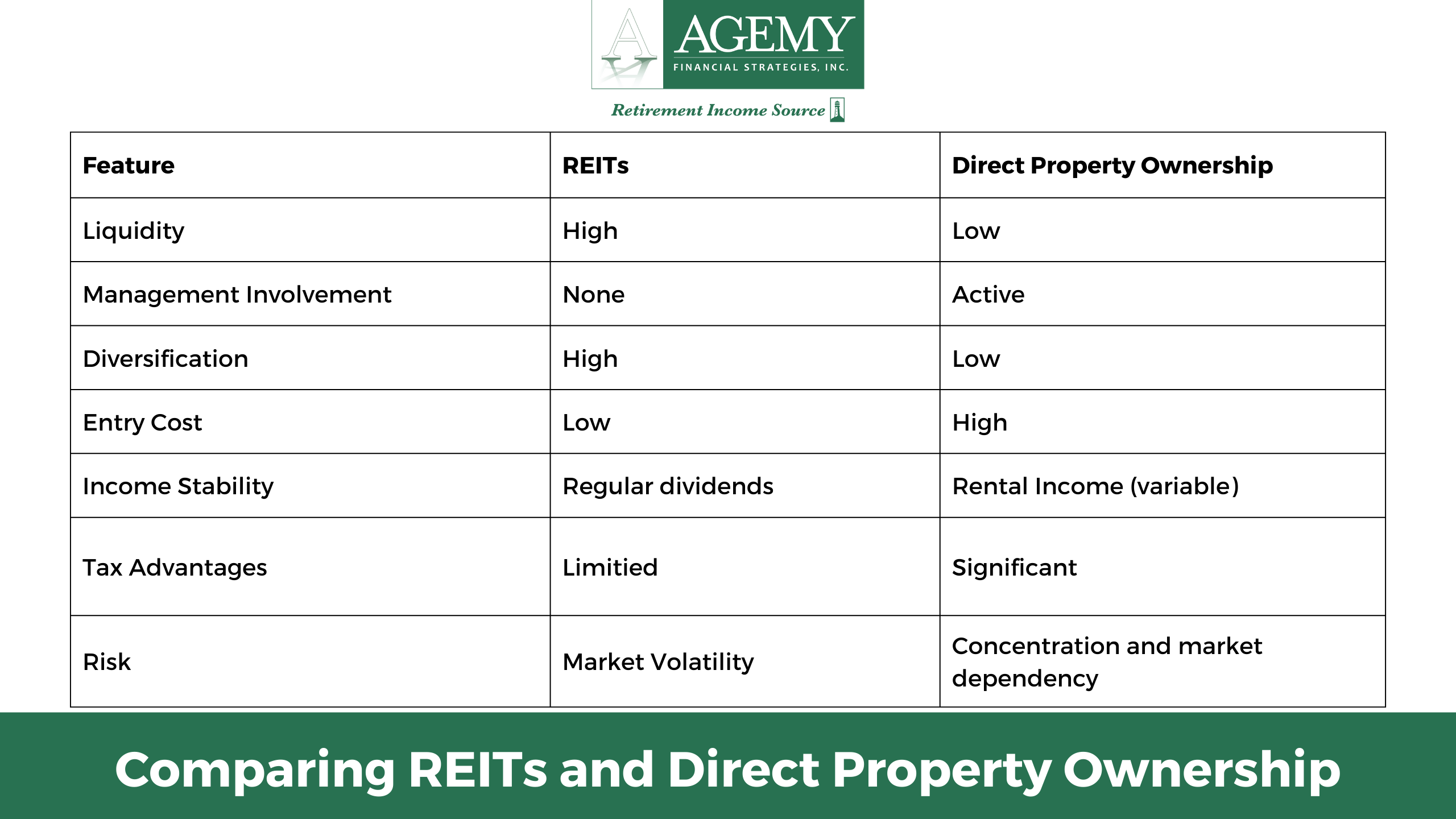
To make this decision easier, we’ve outlined the key differences between REITs and direct property ownership in the table below. Use it as a quick reference to compare their features side by side:

Partner With a Fiduciary Advisor

Investing in real estate during retirement can pose complexities, especially for those managing significant portfolios. If you’re looking for a fiduciary advisor with extensive experience in real estate investments, Agemy Financial Strategies is here to help.

Fiduciary advisors are legally obligated to prioritize your best interests, delivering impartial advice and recommendations aligned with your financial goals. Our seasoned professionals can help you identify opportunities and make well-informed decisions tailored to your unique needs and objectives.

Our advisors are adept at seamlessly integrating your real estate investments into your investment portfolio, helping to ensure they remain balanced and diversified. To explore our full-service offerings, see here.

Final Thoughts

REITs and direct property ownership offer unique advantages, making the right choice dependent on your financial goals, risk tolerance, and time horizon. At Agemy Financial Strategies, we help investors navigate the complexities of real estate investments for their financial portfolios. For over 30 years, our team of fiduciaries has guided clients in exploring opportunities in REITs and other investment vehicles to build resilient, diversified portfolios.

Contact us today to learn how we can help you achieve your financial aspirations and make informed decisions about real estate investments.


Disclaimer: This blog is intended for educational purposes only and should not be considered financial, tax, or legal advice. The information provided is general and may not apply to your financial situation. Investment decisions should always be based on your unique circumstances, goals, and risk tolerance. We recommend consulting a qualified financial advisor, such as our team at Agemy Financial Strategies, for personalized guidance tailored to your needs. Past performance does not indicate future results, and all investments carry inherent risks, including potential loss.

Retiring with ample wealth is a universal goal, and saving up cash is a common strategy to achieve a carefree retirement. But is it possible to over-save for your golden years? The answer could surprise you. 

To save or not to save. That is the question…

Since childhood, a common lesson is to save our pennies for the future. But as our money grows, the question shifts to whether we should invest that money or keep it secured for a rainy day. While investing our money can be risky, simply saving our money alone can result in loss.

Let’s explore what over-saving means and how to strike the right balance to maximize your financial resources. Here’s what you need to know.

Understanding The Risks of Over-Saving

Having extra savings is a problem many wish to have. But, over-saving or stashing away more funds than necessary for retirement can come with challenges.

A life led by excessive frugality might mean missing out on the very essence of what makes life rich and memorable: travel, hobbies, and cherished moments with loved ones. It also limits the potential for growth opportunities related to investing your money.

So, what are the pros and cons related to saving versus investing? Let’s delve deeper into the potential pitfalls of over-saving and why striking a balance is essential.

Pros of Saving Money for Retirement

1. Liquidity

Saving for retirement provides a crucial level of liquidity that investing may only sometimes deliver. Your money is readily accessible, allowing you to tap into it for emergencies without facing penalties or restrictions. Evaluating your comfort level with your current allocation between saving and investing each month is essential in managing your financial future effectively.

2. Protection from Market Volatility

It’s reassuring to know that your retirement funds can remain relatively shielded from the tumultuous swings of the financial markets. Many bank and thrift savings accounts offer an added layer of security through insurance provided by the Federal Deposit Insurance Corporation (FDIC), which protects your funds up to $250,000. In contrast, investing doesn’t come with such a safety net.

3. Predictable Growth

When you save for retirement, the growth of your funds is generally more predictable than the potentially unpredictable nature of investments. Savings accounts and other conservative options typically offer a fixed or predictable interest rate, though these gains are usually relatively small. This predictability can offer a clearer understanding of how your retirement savings will grow over time, making it easier to plan for your future financial needs with greater certainty.

Cons of Saving Cash for Retirement

1. Missed Market Gains

Traditional savings accounts help you opt for a conservative strategy while prioritizing safety over growth. While this approach shields your money from the inherent volatility of financial markets, it also means potentially missing out on substantial gains.

2. Limited Growth

Savings accounts, while offering security, often provide lower interest rates than the potential investment returns. Over the long term, this disparity in growth rates can lead to a situation where your savings fail to keep pace with the rising cost of living (inflation), potentially eroding your purchasing power during retirement.

3. Risk of Outliving Savings

A study by Cerulli Associates found the biggest worry for both retirement savers and retirees, at 58%, is outliving their money. As technological advances enable longer lifespans, the prospect of living well into retirement becomes increasingly likely. Investing offers the potential for higher returns, offering greater confidence that your savings will endure through your retirement years.

Pros of Investing for Retirement

Embracing the potential for financial growth and security, investing for retirement offers a path to unlocking a world of benefits that can significantly help to enhance your golden years.

1. Compounding Interest

One of the most significant advantages of investing for retirement is the power of compounding interest. When you invest your money, it has the potential to grow exponentially over time. Compounding allows your earnings to generate additional earnings, leading to substantial gains over the long term. The earlier you start investing, the more time your money has to benefit from compounding.

2. Potential for Higher Returns

When the value of your investments goes up. You can earn money on your investments when they increase in value. For example, a stock’s price won’t stay the same price forever — ideally, the company grows and makes money, and it becomes more valuable overall. Historically, investments in assets like stocks, bonds, and real estate offer higher average returns than traditional savings accounts. Although financial markets offer no certainties, investing opens doors to accelerated wealth accumulation, outpacing the growth achievable through saving alone.

3. Short-Term Opportunities

While most investors should avoid trying to time the market, there can be some excellent opportunities to earn sizable short-term gains if you’re a savvy and experienced investor.

4. Diversifying for Risk Management

Diversification is crucial for managing risk and achieving retirement goals. It spreads investments across multiple asset classes, reducing the impact of market fluctuations on retirement savings. A diversified portfolio includes asset classes with different risks and returns, such as stocks, bonds, and real estate.

Regular review and rebalancing of a diversified portfolio are essential. Working with a financial advisor can help you develop a well-diversified portfolio that aligns with your risk tolerance and retirement goals.

Cons of Investing for Retirement

1. Emotional Stress

Market volatility can lead to emotional stress, especially if you constantly monitor your investments. Many investors are “loss-averse,” meaning they feel the pain of losses more acutely than the pleasure of gains. Loss aversion can create a tendency to panic and make drastic changes to your portfolio when faced with losses. This can negatively impact your long-term financial goals.

2. Gains are Taxed

With few exceptions, stock market gains are taxable when you sell your holdings. If you sell a position that you’ve held for less than a year, any gains you earn will be taxed at your ordinary tax rate. If you hold on to a stock for more than a year, you’ll be able to take advantage of a lower long-term capital gains tax when you sell. But that cost will still eat into your return.

3. Inherent Risk

Investing always involves some level of risk. Markets can be unpredictable, and the value of your investments can fluctuate. There’s no guarantee that you’ll make a profit, and you could lose money, especially in the short term.

Finding The Right Balance

Choosing between investing and saving hinges on several crucial factors, including your risk tolerance, financial needs, and your money’s accessibility. Investing holds the promise of potentially yielding significantly higher returns than savings accounts. However, this advantage carries its risks, especially when considering shorter timeframes.

If you are struggling to find the perfect balance for you, working with a retirement income professional, such as a Fiduciary advisor can help. One of the most beneficial aspects of working with a Fiduciary is that they are legally required to put your best interests first, providing unbiased advice to help you make the most informed decisions. When choosing an advisor, asking relevant questions about their experience and approach to retirement income planning is a great first step. Doing so lets you determine if the advisor/firm aligns with your goals, needs, and beliefs.

Let’s Get to Work!

Saving and investing are often lumped together as the sole alternative to spending money, but each strategy has its own advantages and disadvantages. In general, you should save to preserve your money and invest to grow your money. Depending on your specific goals and when you plan to reach them, you may choose to do both.

Exactly how much to put toward savings versus investing depends on your current needs and your future goals, which is why seeking guidance from a financial professional can be beneficial in finding the right balance for you. At Agemy Financial Strategies, we’re here to guide you every step of the way.

Our team of Fiduciary advisors is well-versed in comprehensive retirement planning services to help you reap a steady income stream throughout your golden years. We aim to help you live a rich life in every sense of the word, making the most out of every financial resource possible. Ready to get started?

Contact us today to schedule your complimentary consultation.


Disclaimer: This content is for educational purposes only and should not be considered financial or investment advice. Please consult with the fiduciary advisors at Agemy Financial Strategies before making any investment decisions.

Federal fund rates currently sit at 4.75% to 5%, and the implications of this rate cut will affect everything from borrowing costs to investment strategies. Understanding how this shift affects their financial strategy is essential for investors nearing retirement. Let’s explore the Fed’s rate cut for investors preparing for retirement, from how it might affect your investment portfolio to its influence on key financial decisions and long-term retirement planning. Here’s what you need to know.

Understanding The Fed’s Rate Cut 

On September 18, 2024, the Federal Reserve cut its benchmark interest rate by half a percentage point. This marked the end of its longest cycle of rate hikes in over a decade. According to Joe Brusuelas, chief economist at RSM US, the Fed’s pivot signifies a return to a more normalized economic environment. “We had three years of extremely aggressive policy out of the Fed. We’re now pivoting toward normalizing rates in the post-pandemic economy,” Brusuelas said.

From a fiduciary standpoint, the Fed’s decision could have immediate and long-term implications for those nearing retirement. Michael Madowitz, a principal economist at the Roosevelt Institute, notes that the rate cut underscores the Fed’s confidence in controlling inflation and signals that the economy has recovered enough to support sustainable growth. But what does this mean for your retirement strategy? Let’s break down the areas most affected by the rate cut.

Mortgage Rates and Housing: Opportunities and Challenges

For many Americans, especially those approaching retirement, the housing market is a key part of their financial plans. Whether you’re considering downsizing, buying a second home, or refinancing your current mortgage, the Fed’s recent rate cut could lower borrowing costs. Typically, when interest rates drop, mortgage rates follow, making it easier to lock in favorable terms on home loans.

This could create opportunities for investors nearing retirement. Lower mortgage rates might make it more appealing to invest in real estate, such as purchasing a smaller home or a vacation property. However, it’s important to understand that the effects of the Fed’s rate cut may take some time to fully materialize. Working alongside a financial advisor can help you capitalize on the benefits of lower interest rates while helping your investments align with your financial strategy.

Savings and Investments: Adapting to a New Landscape


Interest rates on savings accounts and certificates of deposit (CDs) are a key consideration for those nearing retirement. Historically, high rates have benefited savers, offering a safe way to grow wealth without market risk. However, those yields will likely decrease with the Fed’s rate cut.

While lower interest rates may reduce the return on savings accounts, this also presents opportunities for more strategic investment. As rates fall, Americans will likely shift money fromsavings accounts into the stock market. The prospect of better returns in equities may drive this shift, particularly for HNWIs with a higher risk tolerance.

As fiduciaries, we help clients navigate these changes thoughtfully. Exploring alternative strategies for retirees relying on interest income can help provide income and growth. Our goal is to help your investment portfolio align with your long-term objectives, even as the interest rate environment changes.

The Stock Market: Potential Gains and Increased Volatility

Historically, lower interest rates have been positive for the stock market, reducing business borrowing costs and encouraging investment. However, the current rate cut comes when the market is already volatile. There is no consistent pattern in how markets respond after significant rate-hiking cycles, and some analysts believe the Fed’s decision may already be priced in.

While lower rates may support higher stock prices, market volatility remains a significant concern. Investors nearing retirement should approach the market cautiously, balancing the potential for gains with the need for stability in their portfolios. Here are some investment strategies that can help you manage volatility:

  • Diversification: Maintaining a diverse portfolio that includes a mix of asset classes (stocks, bonds, real estate) helps manage risk and reduce exposure to market volatility.
  • Dividend-Paying Stocks: These stocks provide income through dividends, offering more stability than growth stocks during volatile times.
  • Bonds: Bonds, especially government or high-quality corporate bonds, tend to be less volatile than stocks and can offer steady returns, making them a safer option during uncertain periods.

With the potential for increased volatility, it’s essential to regularly review your investment strategy to ensure it aligns with your risk tolerance and long-term retirement goals. Working with a fiduciary can provide valuable guidance and help you make informed decisions in your best interest.

Keeping an Eye on Inflation 

One of the primary goals of the Federal Reserve’s previous rate hikes was to curb inflation. The current annual inflation rate is 2.5%, the lowest since February 2021. While the risk of inflation seems to have subsided for now, certain goods and services may continue to rise in cost due to factors outside of the Fed’s control.

For retirees, managing these escalating costs is crucial. Rising healthcare expenses, unpredictable insurance premiums, and fluctuating housing costs can impact your financial stability during retirement. A comprehensive retirement strategy can help account for these potential increases to help ensure long-term security.

Here are some key areas to consider when planning for inflationary impacts:

  • Healthcare & LTC costs: Medical expenses tend to rise faster than general inflation, making planning for long-term care and health-related expenses essential.
  • Housing costs: Whether you own or rent, housing costs can fluctuate, especially with supply shortages and high demand in certain areas.
  • Insurance premiums: As climate-related risks grow, premiums for homeowners’ insurance and other policies could increase, requiring careful coverage review.

As fiduciaries, we emphasize the importance of creating a retirement plan that accounts for rising costs in critical areas such as healthcare. Ensuring adequate savings and insurance coverage is essential for financial security in retirement.

The Importance of Fiduciary Guidance

At Agemy Financial Strategies, we recognize that the Federal Reserve’s decisions can have significant implications for those approaching retirement. As fiduciaries, we aim to provide personalized, unbiased advice that puts your best interests first. The recent rate cut presents opportunities and challenges, making careful planning essential to protect your financial future. Here are a few ways our financial team can help you:

  • Personalized Retirement Planning: We take the time to understand your unique financial situation, retirement goals,and risk tolerance. Whether you’re considering adjusting your investment portfolio or reevaluating your income streams, we craft a tailored plan to meet your long-term objectives.
  • Investment Strategy Adjustments: We’ll help you determine the right investment mix to balance risk and reward and help your portfolio stay resilient through market fluctuations.
  • Planning for Care Costs: We’ll work with you to develop a custom plan for long-term healthcare expenses, including potential insurance needs, helping you secure your financial well-being.
  • Tax-Efficient Strategies: Tax-efficient planning becomes even more important with changing interest rates. We’ll help you navigate the tax implications of your financial decisions, from withdrawals to capital gains, optimizing your tax strategy to preserve wealth over the long term.

Final Thoughts

The Federal Reserve’s rate cut marks a significant shift in the U.S. economic landscape, and it’s essential for those preparing for retirement to understand how this change impacts their financial strategy. At Agemy Financial Strategies, we are committed to helping you make informed decisions that align with your long-term goals. In this evolving economic environment, now is the time to review your retirement plan and ensure you are well-positioned for future growth.

Contact us to learn how we can support your financial goals and help you navigate this evolving environment.

Renewable energy has garnered widespread popularity across various industries, sparking innovation and sustainability. What if we approach wealth-building with a similar mindset?

Renewable wealth is a concept that involves making mindful financial decisions that serve our best interests – while helping the next generations’ needs. In a society marked by environmental concerns, social responsibility, and economic uncertainty, pursuing wealth has taken on a new dimension. Building renewable wealth is a conscious strategy to encompass ongoing financial prosperity and future peace of mind.

Let’s explore 5 key tips for building renewable wealth and how they interconnect to create a sustainable and purpose-driven approach to financial success. But first…

What is Renewable Wealth?

Renewable wealth is a financial strategy that focuses on leveraging your resources for optimal financial growth. It redefines traditional notions of wealth by highlighting the importance of conscious decision-making in tandem with financial growth. A fitting way to describe/explain this idea is through the chicken and egg analogy:

Consider savings (or income) as the egg and investing (like in stocks) as the chicken. Savings, the eggs, offer a consistent return, much like the sustenance provided by food. When you reinvest those savings, it’s akin to acquiring more chickens, which, in turn, produce more eggs. This cycle consistently repeats: the more chickens (investments) you have, the more eggs (returns) you get. Over time, due to the magic of compounding, this leads to exponential growth in your investments. It’s a balance between steady income (the eggs) and accelerating growth (acquiring more chickens), culminating in sustainable long-term wealth.

So, how do you create the right balance and build a “renewable wealth portfolio”? It all starts with your mindset.

1. Having The Right Mindset 

The renewable wealth strategy involves adopting a specific mindset that aligns with ethical and innovative social initiatives. Ultimately, renewable wealth seeks to create a harmonious synergy between financial growth, environmental preservation, and the betterment of society for future generations.

We often think wealth is only about money, but it is more than that. Your positive or negative mindset plays a crucial role in your wealth-building journey. Coined the “Millionaire Mindset,” being wealthy isn’t just about having a lot of money. It’s more about adopting a specific mindset. For its followers, this mindset means shifting how you see the world to reach your dreams and requires consistently adopting purposeful habits and thoughts.

Essentially, wealthy retirees often operate from a mindset of plenty, which boosts their confidence and success. To help you reach your goals, act as if you’ve already achieved them. In that space, your success fuels more success.

2. Maximizing Income 

Maximizing income to pursue renewable wealth involves a two-fold approach: seeking financial opportunities and ensuring they align with your goals. The higher your income, the more you can allocate towards savings and investments, accelerating your wealth-building journey.

Moreover, a higher income allows you to comfortably meet your daily needs while setting aside substantial retirement funds. Here are a few tips to help you maximize your income:

  • Diversify Your Renewable Wealth Portfolio: A typical portfolio could include bonds, bond funds, CDs, and dividend-paying stocks. If you are seeking to invest for a greener future, you can align your investments with your values by investing in products that seek attractive returns while benefiting society, such as investing in clean energy stocks. Furthermore, ESG investing means buying the shares of companies that score highly on environmental and societal responsibility metrics.
  • Utilize Individual Retirement Accounts (IRAs):  IRAs are tax-advantaged retirement savings accounts that individuals can contribute independently. IRAs allow you to tailor your renewable portfolio to risk tolerance and financial and personal goals.
  • Explore Real Estate Investments: Real estate investments offer retirees a diverse range of options to consider. From owning rental properties that provide steady cash flow to investing in Real Estate Investment Trusts (REITs), you have various avenues to leverage the potential benefits of real estate in your investment portfolios. What’s more, investing in “green buildings” and eco-friendly developments not only helps reduce carbon emissions but also provides financial returns through energy savings, tax incentives, and higher property values.

When combined with prudent financial planning and strategic investments, maximizing your income is a powerful means to secure a comfortable retirement.

3. Timing the Market

Financial markets are unpredictable, and staying patient when your investments are on the line can be challenging. Take the example of the S&P 500 index: after reaching its lowest point in October 2022, it has managed to recover most of the losses suffered during the bear market. The previous year was marked by a decline of at least 20% from its highest value. By the end of July 2023, the S&P 500 was down by just 4.4% from its peak in January 2022. This recovery showed improvement compared to the notable 25% drop experienced in October 2022.

This lesson shows that if you leave the market too early or a market drop never materializes, you could miss out on significant additional positive returns. By staying invested rather than trying to time it — it could yield better results over the long term.

Staying patient and waiting out volatility is key to building renewable wealth.

4. Preserve Your Legacy

Renewable energy is all about creating a safe and sustainable future for the next generations. In order to create renewable wealth for your loved ones, you need to protect your hard-earned assets to pass down.

Estate planning entails creating various documents, outlining the designating of healthcare proxies, and establishing powers of attorney if you were to pass away. This level of preparation can bring peace of mind to you and your family. Without a clear estate plan, the distribution of assets can lead to conflicts and disputes among family members. Other benefits of having an estate plan include the potential to minimize tax burdens, help secure your family business continuity, and have the power to help ensure your loved ones receive their inheritance.

5. Working With a Financial Advisor

An experienced financial advisor can help you chart a course that aligns with your financial goals and values. As economic conditions, tax laws, and personal circumstances change, you must revisit your retirement strategy and make necessary adjustments. This may involve reevaluating your investment allocations and risk management approach to ensure they align with your evolving needs and financial situation.

Staying informed about market trends and working closely with your financial advisor can provide valuable insights and guidance. At Agemy Financial Strategies, our team of financial advisors is here to walk you through the process of achieving renewable wealth so that your money can work hard for you and you can reap the benefits of a comfortable retirement.

By regularly reviewing and adjusting your plan, you can make informed decisions to help maximize your retirement savings and help ensure financial security for loved ones – and future generations.

Last Thoughts

Building renewable wealth transcends the traditional pursuit of financial success. At Agemy Financial Strategies, we understand that building wealth that survives more than one generation requires more than financial assets.

With the proper planning, you can set up your renewable wealth portfolio to bring financial success for hundreds of years.

Set up your complimentary strategy session here today.


Disclaimer: This content is for educational purposes only and should not be considered financial or investment advice. Please consult with the fiduciary advisors at Agemy Financial Strategies before making any investment decisions.

For every investor, the world has become a hard place. But for those reaching retirement, pressure is significantly mounting. Here’s how to cope with a roller-coaster market on the lead up to your golden years. 

When you think of retirement, many Americans imagine a fun and relaxing lifestyle. However, preparing for retirement is no easy task– especially with volatility and rising interest rates. This past year has been especially challenging to plan for retirement. The economy has been turbulent and many are having a hard time keeping up with the cost of living.

It’s estimated that 1.5 million retirees have re-entered the U.S. labor market over the past year due to such factors as more flexible work arrangements, rising costs, and the inability to keep up while on a fixed income (according to an analysis of Labor Department data by Nick Bunker, an economist at Indeed). Additionally, 25% of Americans feel they have to delay their retirement plans because of disrupted savings resulting from increased prices and market instability.

During such an uncertain time many are second guessing their road to retirement. However, a down market should not deter you from reaping the benefits of a fruitful retirement. Here are a few tips to help you prepare for your golden years in a volatile market.

Evaluate Risk Tolerance

When it comes to risk tolerance, having a diversified portfolio will help minimize the impact of risk and total loss in a volatile market. The right mix of investments for you will depend on your unique circumstances, including your age, investment goals, and risk tolerance.

The key is to find the right balance of risk and reward for you.

Investing Without Emotions

It can be hard not to invest with emotions. After all, it’s your hard-earned cash you’re watching rise and fall. Market volatility is a stressful environment for anyone with money in the stock market. Investing with emotions can lead to significant losses.

It can be difficult to impulse buy or sell stocks when the market is experiencing a hiccup. In the end, it’s hard to predict market behavior—so try not to make any risky or permanent decisions regarding your portfolio when it’s likely that current market conditions are temporary. Stick to your investment plan and build on these important building blocks:

  • A retirement date. Figure out how long you’ll have to save.
  • Your major life goals. Plan for small and big events in the future.
  • Your tolerance for risk. Find your comfort zone.

Your plan is like a safety belt when the market starts seesawing. Stay on track by sticking to it during market swings.

Having a Plan in Place

When it comes to planning for retirement, having a long-term plan can help ease stress and keep you on track for the long-run. Market volatility can tempt you to want to ditch your plan, but it’s important to think long-term. If you’re nearing retirement it may be an appropriate time to make some small changes in order to reduce the chances of major risk. Make sure to rebalance your investment plan on a regular basis — quarterly, semiannually or once a year. Why? Because volatile markets can change the proportion of your funds in different asset classes. Therefore, rebalancing resets your portfolio to your desired investment mix.

Note: It’s important not to make any significant changes without consulting your financial advisor. A trusted advisor is crucial to your success when preparing for retirement during a volatile market.

Final Thoughts

Don’t let market volatility derail your retirement savings plan. With the market’s current conditions, it may not be as smooth of sailing as you’d hope for–but market downturns don’t last forever.

The investment professionals at Agemy Financial Strategies can help you make sure your investments and assets are mixed to create a balanced plan for your unique retirement goals. Regardless of a volatile market, we can help strategize asset allocations to help stomach inflation, or revise your current plan to make helpful amendments.

If you’re looking for more ways to prepare for retirement with inflation, connect with the team at Agemy Financial Strategies here to help you get started on your portfolio diversification journey today.

September was a rocky month for the stock market and may have offered a stark preview of what the final weeks leading up to the presidential election will be like for Wall Street. Towards the end of the month, both the Dow Jones Industrial Average and the S&P 500 were flirting with correction territory, which officially means a 10% decline from their peak highs.* Meanwhile the Nasdaq was down by more than 10%, as the tech rally that has helped buoy the index and the markets in general throughout the Covid-19 crisis ended. With one of the most contentious elections in American history now just weeks away, and the coronavirus still pummeling parts of the economy, a nervous, mostly down-trending market may very well be the norm right up to November 3rd, and possibly beyond that.

In truth, what we saw in September was typical from a historical perspective. The two months before a presidential election are almost always a volatile period for the markets for two reasons. One is simply uncertainty over the election’s outcome, and that’s obviously a big factor where this race is concerned. Most polls continue to show Joe Biden leading among voters, and Wall Street knows a Biden victory would likely mean a rollback or amendment of the Trump administration’s corporate tax cuts. That, of course,

could further undercut economic growth at a time when it’s already shrunk massively due to the pandemic. On the other hand, there is plenty of debate as to whether a Trump victory would automatically be better for the economy and trigger a new market rally—particularly in light of the pandemic.

The other issue that typically makes big investors nervous just before an election is the legislative inertia that occurs. Politicians are too focused on politics to get anything done, and that’s a major concern this year since the House and Senate have yet to agree upon a follow-up to the Coronavirus Aid, Relief and Economic Security (CARES) Act approved in March.** This is true despite the fact that lawmakers and economists almost universally agree that additional relief measures are needed, especially with all the uncertainty still surrounding the pandemic as we head into fall.

Autumn’s Unknowns

As I’m sure you’re aware, the U.S. surpassed 200,000 deaths linked to Covid-19 in September, the most of any nation in the world.*** Meanwhile, infection rates began spiking again across much of Europe, and in parts of America as schools reopened. Will that trend continue as autumn deepens? It’s possible, and the economic impacts could ramp up again too as outdoor seating options that have allowed many restaurants and other businesses to hang on during the summer months disappear in colder parts of the country. The dining industry has already been hit extremely hard by the pandemic. According to an economic impact analysis by Yelp, over 50% of its restaurants had already closed permanently by early summer, and the number has likely increased since.****

Even if no major resurgence in infections does occur this fall, the economic fallout of the coronavirus crisis seems likely to drag on for other reasons. Those include the psychological impact of the pandemic, and the comfort level most consumers have attained with alternative forms of shopping and recreation. Already, major chains have announced they will not host traditional in-store “Black Friday” sales this year, and for the first time ever, the Macy’s Thanksgiving Day Parade will be an entirely virtual event!

So far, the massive shift to things like e-commerce, videoconferencing, and virtual entertainment has managed to offset the impact of business closures and social distancing rules and helped limit some of the economic damage from Covid-19. However, the longer-term repercussions of this shift have probably yet to be felt as they relate to things like jobs, bottom-line corporate growth, and overall economic stability. Big investors know this, and it’s another reason they’re likely to keep “one finger on the trigger” in the last quarter of the year, ready to pull out if nervousness gives way to fear and triggers another major market downturn.

Uncommon and Unprecedented

While a nervous market in the months before an election is historically common, there also some things about our current situation that make it very uncommon—namely the pandemic and the highly divisive political climate surrounding this election. So far Wall Street has shown amazing resilience in the face of these issues, but that’s due largely to another factor that isn’t merely uncommon but entirely unprecedented. That is the massive amount of artificial stimulus the Federal Reserve has pumped into the economy since the Financial Crisis 10 years ago— which has become even more massive as a result of the pandemic.*****

Will the Fed’s “steroids” continue to pump up Wall Street and stave off another major correction even if coronavirus cases see another major spike this fall? Or even if another relief and stimulus package is not approved? Or even if there is a lengthy legal and congressional battle over the results of the election that prolongs legislative inertia and keeps Washington stuck in the muck like a stalled Jeep?

The bottom line is that these are all important questions to consider as you review your financial strategy this fall. Are you playing smart and sufficient financial defense at this crucial time? Are you well-positioned to take advantage of new opportunities that may emerge one day when the markets and economy are more stable again? Because, rest assured, that day will come!

*Marketwatch.com **“Virus Bill Blocked in Senate as Prospects Dim for New Relief,” AP, Sept. 10, 2020 ***“Unfathomable US Death Toll from Coronavirus Hits 200K,” AP, Sept. 22, 2020 ****“Yelp Finds 53% of Restaurants Have Permanently Closed,” Eater.com, June 26, 2020 *****“Stock Markets Have Now Seen the Peak of Fed Stimulus,” MarketWatch, Sept. 17, 2020