Posts

As we approach 2026, economic shifts, evolving tax policies, and financial market fluctuations make it more important than ever to reassess and refine your retirement goals

At Agemy Financial Strategies, we understand that each client’s financial landscape is unique, and we help craft strategies that optimize wealth preservation, legacy planning, and lifestyle objectives.

In this guide, we will explore how HNWIs can approach setting meaningful retirement goals for 2026, incorporating actionable strategies to help safeguard wealth, maximize opportunities, and achieve a fulfilling retirement.

Understanding the Landscape: Why 2026 Is a Crucial Year

The financial environment heading into 2026 presents both challenges and opportunities. While historically low interest rates have affected traditional investment yields, the markets continue to offer avenues for growth. For HNWIs, the interplay between taxation, estate planning, and investment performance has become increasingly significant:

Setting retirement goals in 2026 requires not only a snapshot of your current finances but also an understanding of how these macroeconomic shifts may influence your wealth trajectory.

Defining Retirement Goals: More Than a Number

2026 Retirement Goals (4)

For many high-net-worth individuals, retirement planning is not merely about accumulating wealth; it’s about crafting a vision for the lifestyle you want to lead post-career. Defining clear retirement goals is essential for shaping your financial strategy. Consider these elements:

  • Lifestyle Objectives: Do you envision traveling extensively, maintaining multiple residences, or pursuing philanthropic projects? Lifestyle expectations will dictate how much liquidity you need in retirement.
  • Legacy Planning: High-net-worth individuals often prioritize passing wealth to heirs, funding charitable foundations, or establishing trusts. Clearly articulating your legacy goals can shape investment and tax strategies.
  • Health and Longevity Planning: Ensuring your retirement funds account for potentially longer lifespans is critical.
  • Flexibility vs. Security: Determine the balance between maintaining a secure income stream and preserving flexibility to seize new opportunities, such as private investments or emerging markets.

A precise understanding of your retirement vision can help enable more accurate financial modeling and goal-setting.

Conducting a Comprehensive Financial Audit

Before setting concrete retirement targets, it’s vital to assess your current financial position in detail. For HNWIs, this audit should go beyond simple account balances:

  • Net Worth Analysis: Evaluate assets, including real estate, private equity holdings, business interests, art, and other tangible assets. Consider liquidity and market value.
  • Income Streams: Identify active and passive income sources. Review dividend-yielding investments, rental properties, royalties, and business profits.
  • Debt Management: Analyze leverage, including mortgages, lines of credit, and business loans, and plan for repayment schedules that align with retirement goals.
  • Retirement Accounts and Tax-Deferred Investments: Consider contribution limits, potential Required Minimum Distributions (RMDs), and tax optimization strategies for 401(k)s, IRAs, and other accounts.

This audit allows you to determine the gap between your current resources and your retirement vision, helping to shape realistic and achievable goals for 2026.

Setting Financial Benchmarks for 2026

2026 Retirement Goals (4)

Once your audit is complete, it’s time to set specific financial benchmarks. HNWIs often have more complex portfolios, and benchmarks should reflect both wealth preservation and growth objectives:

  • Target Retirement Income: Calculate the annual income you will need to sustain your lifestyle. This includes discretionary spending, healthcare, travel, and philanthropy. For HNWIs, you may need to factor in multiple residences, luxury expenditures, and tax obligations.
  • Savings Goals: Determine how much additional savings or investment growth is required to bridge the gap between current assets and target retirement income.
  • Investment Allocation Targets: Review your portfolio’s asset allocation to help ensure it aligns with your risk tolerance and retirement timeline. Consider a balance between liquid assets, growth equities, fixed income, and alternative investments.
  • Estate and Tax Planning Milestones: Set goals for minimizing estate taxes, optimizing trust structures, and leveraging charitable giving strategies. This can help ensure wealth preservation across generations.

Benchmarking provides a roadmap for actionable steps and offers a framework for tracking progress throughout the year.

Leveraging Tax-Efficient Strategies

Taxes can significantly impact retirement wealth, particularly for HNWIs with complex portfolios. A forward-looking tax strategy is essential:

  • Roth Conversions: Consider converting traditional IRA or 401(k) funds into Roth accounts in years when income is lower, potentially reducing long-term tax liabilities.
  • Charitable Contributions: Utilize donor-advised funds or charitable remainder trusts to achieve philanthropic objectives while reducing taxable income.
  • Capital Gains Optimization: Strategically manage the timing of asset sales to minimize capital gains taxes.
  • Estate Planning Tools: Implement trusts, family limited partnerships, and gifting strategies to transfer wealth efficiently while minimizing tax exposure.

By integrating tax strategies into retirement goal-setting, HNWIs can preserve more wealth and help ensure their retirement lifestyle remains financially sustainable.

Accounting for Healthcare and Long-Term Care

Healthcare expenses are a critical, often underestimated component of retirement planning. HNWIs should proactively address these costs:

  • Medicare and Private Insurance Planning: Evaluate coverage gaps and consider supplemental policies to address high-cost medical needs.
  • Long-Term Care Planning: Explore options such as long-term care insurance, hybrid life insurance policies, and self-funding strategies.
  • Wellness and Preventive Programs: Investing in preventive health measures can help reduce long-term medical expenses and improve quality of life in retirement.

Ensuring that healthcare and long-term care expenses are integrated into your 2026 retirement goals prevents unexpected financial strain and helps safeguard your wealth.

Diversification and Risk Management

A core principle for HNWIs is protecting and growing wealth through diversification and risk management. In 2026, this may include:

  • Portfolio Diversification: Maintain exposure across equities, fixed income, real estate, private equity, and alternative assets. Diversification can help reduce vulnerability to market volatility.
  • Geographic Allocation: Consider international investments to help hedge against regional economic fluctuations.
  • Insurance and Asset Protection: Review life insurance, umbrella policies, and liability coverage to protect wealth.
  • Scenario Planning: Stress-test your portfolio against potential economic shocks, market downturns, or unexpected personal events.

A disciplined approach to risk management helps ensure that your retirement goals are resilient under various market conditions.

Planning for Lifestyle and Legacy

2026 Retirement Goals (4)

For HNWIs, retirement planning extends beyond finances; it encompasses lifestyle aspirations and legacy goals:

  • Lifestyle Planning: Define how you wish to spend your retirement years. Consider travel, hobbies, volunteerism, and ongoing professional involvement. Lifestyle planning influences cash flow requirements and investment strategies.
  • Legacy Goals: Identify the financial legacy you wish to leave for heirs or philanthropic causes. Structured estate planning, trusts, and strategic gifting can help achieve these goals efficiently.
  • Philanthropy and Impact Investing: Align investments with personal values, supporting causes that matter to you while potentially providing tax benefits.

Clear articulation of lifestyle and legacy objectives helps ensure your retirement is not only financially secure but also personally meaningful.

Monitoring, Adjusting, and Staying Informed

Retirement goal-setting is not a one-time exercise. It requires ongoing monitoring and adjustment:

  • Regular Portfolio Reviews: Assess performance, rebalance assets, and make adjustments based on market conditions and personal circumstances.
  • Policy and Tax Updates: Stay informed about changes to tax law, estate planning regulations, and retirement account rules that may impact your strategy.
  • Professional Guidance: Collaborate with financial advisors, estate planners, tax professionals, and investment managers to help ensure your retirement plan remains aligned with your goals.

By maintaining flexibility and responsiveness, HNWIs can stay on track toward their 2026 and long-term retirement objectives.

Working With Agemy Financial Strategies

At Agemy Financial Strategies, we’re experienced in guiding high-net-worth individuals through the complex landscape of retirement planning. Our approach includes:

  • Personalized Financial Planning: Tailored strategies that reflect your unique lifestyle, risk tolerance, and wealth profile.
  • Advanced Tax and Estate Planning: Knowledgeable guidance to help optimize tax efficiency and ensure the smooth transfer of wealth.
  • Comprehensive Investment Strategies: Diversified portfolios designed to preserve capital, maximize growth, and mitigate risk.
  • Ongoing Support and Review: Continuous monitoring and adjustments to keep your retirement plan on course.

Partnering with Agemy Financial Strategies helps ensure that your 2026 retirement goals are not only realistic but also strategically designed for long-term success.

Final Thoughts 

2026 Retirement Goals (4)

Setting retirement goals for 2026 is a multifaceted endeavor for high-net-worth individuals. It requires a blend of financial acumen, strategic foresight, and personalized planning. By defining clear objectives, conducting thorough audits, leveraging tax-efficient strategies, and planning for healthcare, lifestyle, and legacy, you can confidently navigate the path toward a fulfilling and secure retirement.

At Agemy Financial Strategies, we understand the complexities faced by HNWIs and provide the expertise needed to translate your retirement vision into actionable strategies. As 2026 approaches, now is the ideal time to refine your goals, safeguard your wealth, and help ensure your retirement years reflect the lifestyle and legacy you desire.

Take the first step today. Contact Agemy Financial Strategies to start crafting your 2026 retirement plan and secure a future that aligns with your vision, values, and aspirations.


Frequently Asked Questions (FAQs)

 FAQ 1: What makes retirement planning different for high-net-worth individuals?

High-net-worth individuals have more complex financial portfolios, including multiple income streams, real estate, private equity, and business interests. Their retirement planning often involves advanced tax strategies, estate planning, philanthropy, and legacy considerations that go beyond traditional retirement savings plans.

FAQ 2: How should I set realistic retirement income goals for 2026?

Start by assessing your desired lifestyle, projected expenses, and potential sources of income. Consider discretionary spending, healthcare, travel, and legacy goals. Conducting a comprehensive financial audit with a trusted advisor can help determine the gap between your current assets and your target retirement income.

FAQ 3: How can tax planning impact my retirement strategy?

Effective tax planning can help preserve wealth and increase retirement income. Strategies may include Roth conversions, charitable giving, optimizing capital gains, and leveraging trusts or estate planning tools. Staying proactive with tax strategies helps ensure your assets work efficiently to support your retirement goals.

FAQ 4: Should I account for healthcare and long-term care in my retirement plan?

Yes. Healthcare and long-term care can significantly impact retirement expenses, especially for high-net-worth individuals who may require private coverage or specialized care. Planning for medical costs, insurance, and wellness programs can help ensure your retirement funds are sufficient for a comfortable lifestyle.

FAQ 5: How often should I review and adjust my retirement goals?

Retirement planning is dynamic. You should review your portfolio, tax strategy, and lifestyle goals at least annually or more frequently if there are major life changes or market shifts. Regular adjustments help ensure your plan remains aligned with your vision and adapts to evolving economic conditions.



Investment advisory services are offered through Agemy Wealth Advisors, LLC, a Registered Investment Advisor and fiduciary to its clients. Agemy Financial Strategies, Inc. is a franchisee of Retirement Income Source®, LLC. Agemy Financial Strategies, Inc. and Agemy Wealth Advisors, LLC are associated entities. Agemy Financial Strategies, Inc. and Agemy Wealth Advisors, LLC entities are not associated with Retirement Income Source®, LLC. The information contained in this e-mail is intended for the exclusive use of the addressee(s) and may contain confidential or privileged information. Any review, reliance or distribution by others or forwarding without the express permission of the sender is strictly prohibited. If you are not the intended recipient, please contact the sender and delete all copies. To the extent permitted by law, Agemy Financial Strategies, Inc and Agemy Wealth Advisors, LLC, and Retirement Income Source, LLC do not accept any liability arising from the use or retransmission of the information in this e-mail.

Why Misjudging Your Future Income Needs Can Threaten Your Financial Security and How to Avoid It

Retirement should be a time to slow down, enjoy what you’ve built, and live life on your own terms. But for millions of Americans, retirement brings more financial stress than expected; not because they failed to save entirely, but because they made one crucial mistake along the way. 

So, what is the single biggest mistake in retirement planning? For Andrew A. Agemy MRFC, Founder and CEO, who draws on decades of experience advising pre-retirees and retirees, the answer is unequivocal:

“The biggest mistake people make in retirement planning is underestimating how much income they’ll need—and how long they’ll need it.” His insight highlights a critical factor many overlook when preparing for a secure and comfortable retirement.

This single miscalculation can ripple into every part of your financial life. It affects your lifestyle, healthcare decisions, investment strategy, tax obligations, ability to leave a legacy, and even your emotional well-being in retirement.

But the good news? It’s a mistake you can avoid if you understand why it happens and how to correct the course.

In this in-depth guide, we’ll break down the root causes, the consequences, and the specific steps you can take now to help secure a retirement that’s truly sustainable.

Why So Many Americans Underestimate Their Retirement Income Needs

Retirement Planning Mistake

Many people approach retirement with a simple question: “How much do I need to save?” But the real question should be: “How much income will I need every single year, and will it last as long as I do?”

This shift in thinking matters because retirement has changed dramatically.

1. Longevity

Many retirees today will spend 25 to 30 years, or more, in retirement.

That means your savings must last longer than previous generations ever had to.

2. Inflation Erodes Purchasing Power

Even at modest levels, inflation chips away at your lifestyle. What costs $70,000 today may cost $100,000 in a decade.

Underestimating inflation is one of the biggest blind spots in retirement planning. A retirement built on static numbers simply won’t survive a dynamic economy.

3. Healthcare Costs Are Higher Than Expected

Healthcare is consistently one of the top three expenses in retirement. Medicare is not free, and long-term care is not covered by Medicare at all.

Without planning for rising healthcare and long-term care needs, retirees risk draining their savings faster than anticipated.

4. Retirement Is No Longer Linear

Retirement isn’t a straight line where spending steadily decreases. Today, it has phases:

  • Go-Go Years: Travel, hobbies, experiences; often the highest-spending phase.
  • Slow-Go Years: Spending stabilizes, but healthcare rises.
  • No-Go Years: Healthcare and support costs spike.

If you assume you’ll spend less each year, you’re likely underestimating what you truly need.

5. Overreliance on Rules of Thumb

Rules like the “4% withdrawal rule” or “save 10x your salary” can be helpful benchmarks, but they’re not personalized. They don’t account for taxes, market volatility, interest rate changes, or personal health.

Relying on oversimplified rules leads many retirees to assume their money will stretch farther than it actually will.

How Underestimating Income Needs Impacts Your Retirement

Retirement Planning Mistake

Underestimating the amount of income you’ll need can lead to a series of cascading problems. Here’s what this mistake looks like in real life.

1. Running Out of Money Too Soon

This is the most feared outcome and the hardest to recover from. Once you’re retired, you have fewer options to generate new income, and protecting what you have becomes vital.

Without accurate income projections, retirees may:

Running out of money is a real risk, not a hypothetical one.

2. Paying More in Taxes Than Necessary

Taxes don’t disappear in retirement. In fact, without a strategy, taxes can take an even bigger bite out of your income.

Underestimating income needs:

A coordinated tax strategy is often missing, and without it, income shortfalls become more severe.

3. Sacrificing Quality of Life

Misjudging income needs often leads to cutting back more than expected. Travel plans shrink, home maintenance is delayed, gifts to family are reduced, and the lifestyle you envisioned feels out of reach.

Retirement should be enjoyable, not restrictive due to planning mistakes.

4. Increased Stress and Anxiety

Financial uncertainty is one of the top sources of stress for retirees. When income doesn’t feel secure or predictable, it affects mental and emotional health.

Living with financial anxiety in retirement is avoidable, but only with a stronger income plan.

Why This Mistake Happens: The Psychology Behind Retirement Planning

Underestimating retirement income needs isn’t just a math issue; it’s a human issue. Several psychological factors contribute to this mistake.

1. Optimism Bias

Many people assume:

  • “I won’t live that long.”
  • “My expenses will drop significantly.”
  • “Healthcare won’t affect me personally.”

Optimism is helpful in life, but can be dangerous in retirement planning.

2. Difficulty Visualizing Future Expenses

Most people plan using today’s numbers, not tomorrow’s realities. It’s natural to underestimate future costs because they feel distant and abstract.

3. Fear of Confronting the Unknown

Thinking about aging, health issues, or market downturns can be uncomfortable. So people avoid detailed planning.

4. Lack of Education

Retirement planning isn’t widely taught. People rely on generic advice or guesswork rather than comprehensive analysis.

This is exactly where financial professionals can help provide clarity and direction.

The Solution: Focus on Income Planning, Not Just Savings

Retirement Planning Mistake

Traditional retirement planning focuses heavily on accumulation; saving and investing as much as possible. But the real challenge begins once the paychecks stop.

Accumulation gets you to retirement. Income planning gets you through retirement.

Here’s how to avoid underestimating your retirement income needs and build a plan that lasts.

5 Steps to Avoid the #1 Mistake in Retirement Planning

1. Calculate a Personalized Retirement Income Target

You need a realistic projection, not a rule of thumb. A comprehensive income analysis should include:

A detailed, customized plan is the foundation of retirement security.

2. Create a Multi-Source Income Strategy

A strong retirement plan doesn’t rely on a single income stream. It integrates:

  • Social Security
  • Pensions
  • Investment withdrawals
  • Tax-free income sources (like Roth accounts)
  • Real estate income
  • Cash reserves
  • Part-time income (if desired)

The goal is to create reliable, predictable income that supports your lifestyle.

3. Mitigate the Effects of Inflation

To help protect your purchasing power over decades, your plan should include:

Inflation-proofing is essential for long-term comfort.

4. Implement Tax-Smart Withdrawal Strategies

The order you withdraw funds from your accounts can significantly affect how long your money lasts.

A well-designed plan considers:

  • Roth conversions
  • Minimizing Social Security taxation
  • Reducing Medicare IRMAA penalties
  • Managing RMDs
  • Balancing tax-deferred, taxable, and tax-free accounts

A tax-efficient strategy helps put more money in your pocket and extends the life of your savings.

5. Stress-Test Your Retirement Plan

A strong retirement plan must be able to withstand:

Stress testing gives you peace of mind and allows you to make confident decisions, even during uncertain times.

How Agemy Financial Strategies Helps You Avoid This Critical Mistake

At Agemy Financial Strategies, we’ve spent decades helping retirees and pre-retirees navigate complex financial decisions with clarity and confidence. Our approach is rooted in education, transparency, and strategy.

Here’s what sets us apart:

✔ We Focus on Income First

Not just investments, but actual income you can depend on.

✔ We Prioritize Tax Efficiency

Because what you keep matters more than what you earn.

✔ We Build Sustainable, Personalized Plans

Every plan is tailored to your goals, lifestyle, and longevity.

✔ We Stress-Test for Real-Life Scenarios

Your plan must withstand changing markets, rising costs, and unpredictable expenses.

✔ We Provide Ongoing Guidance

Retirement planning isn’t one-and-done; it evolves as your life evolves.

Final Thoughts

Retirement Planning Mistake

The number one mistake in retirement planning, underestimating how much income you will need and how long you will need it, is both common and costly. But it’s also avoidable.

Your retirement should be secure, enjoyable, and stress-free. With the right strategy, disciplined planning, and guidance from trusted professionals, you can build a retirement income plan that truly lasts.

If you’re ready to avoid this mistake and build a plan designed to sustain the retirement you’ve dreamed of, Agemy Financial Strategies is here to help.

Ready to Strengthen Your Retirement Plan?

Let’s build an income plan that supports your lifestyle, helps protect your savings, and gives you confidence for the decades ahead.

Contact Agemy Financial Strategies today for a personalized retirement income analysis.


Investment advisory services are offered through Agemy Wealth Advisors, LLC, a Registered Investment Advisor and fiduciary to its clients. Agemy Financial Strategies, Inc. is a franchisee of Retirement Income Source®, LLC. Agemy Financial Strategies, Inc. and Agemy Wealth Advisors, LLC are associated entities. Agemy Financial Strategies, Inc. and Agemy Wealth Advisors, LLC entities are not associated with Retirement Income Source®, LLC. The information contained in this e-mail is intended for the exclusive use of the addressee(s) and may contain confidential or privileged information. Any review, reliance or distribution by others or forwarding without the express permission of the sender is strictly prohibited. If you are not the intended recipient, please contact the sender and delete all copies. To the extent permitted by law, Agemy Financial Strategies, Inc and Agemy Wealth Advisors, LLC, and Retirement Income Source, LLC do not accept any liability arising from the use or retransmission of the information in this e-mail.

From changing Federal Reserve rates to evolving tax brackets, the financial landscape is shifting quickly. As you prepare for the 2026 tax year, now is an ideal time to revisit key retirement planning fundamentals. Notably, the Internal Revenue Service has announced important updates, allowing savers and investors to adjust their strategies and maximize their future security.

These changes impact how much you can set aside, who qualifies for deductions, and how the phase‑outs operate.

Here’s what you need to know. 

What’s Changing? A Snapshot of the 2026 Limits

IRA Limits 2026

The IRS recently released its cost‑of‑living adjustment notice for 2026, and the headline figures are:

  • The annual contribution limit for IRAs (traditional + Roth combined) is increasing from $7,000 to $7,500.
  • The catch‑up contribution (for those age 50 and older) is increasing from $1,000 to $1,100.
  • For traditional IRA deduction eligibility (when you or your spouse are covered by a workplace plan), the income phase‐out ranges are increasing:
    • For single filers covered by a workplace plan: $81,000–$91,000 (up from $79,000–$89,000)
    • For married filing jointly (spouse making the contribution covered by a workplace plan): $129,000–$149,000 (up from $126,000–$146,000)
  • For Roth IRA contribution eligibility, the phase‐out ranges increase to:
    • Singles/Heads of Household: $153,000–$168,000 (up from $150,000–$165,000)
    • Married filing jointly: $242,000–$252,000 (up from $236,000–$246,000)
  • The limit for SIMPLE IRAs also increases (though our focus here is the general IRA).

These adjustments may seem modest, but they reflect meaningful changes, especially when compounded over time, and they can alter your optimal retirement savings strategy.

Why These Changes Matter

1. Increased Contribution Room

By boosting the IRA limit to $7,500 (+$500 over 2025), savers gain additional tax‑advantaged space. While $500 may sound small, over a multi‑decade horizon and combined with investment growth, this extra buffer can meaningfully increase retirement assets.

2. Deductions and Eligibility Shift Upward

Because the income phase‑out thresholds have risen, a greater number of taxpayers can qualify for either the full or partial deductible traditional IRA contribution, or contribute to a Roth IRA when previously limited. That opens up strategic flexibility.

3. Inflation Protection

These annual adjustments reflect inflation and help preserve purchasing power for retirement savings. Without adjustments, over time, the value of tax‑advantaged contributions would erode.

4. Strategic Planning Opportunities

Higher limits and higher thresholds give financial advisors and their clients more flexibility to optimize tax treatment, asset allocation, and timing of contributions (especially for catch‑up contributions for older savers).

Strategic Implications for Different Groups

IRA Limits 2026

Here’s how these changes affect various types of savers, and what to consider.

A. Younger Savers (Under 50)

Key takeaway: You can now contribute up to $7,500 for 2026.

  • If you’re not covered by a retirement plan at work, you may still deduct your traditional IRA contribution fully.
  • If you are covered, check the phase‑out; it begins at $81,000 for singles in 2026.
  • Roth IRAs become more accessible due to higher phase‐out thresholds; consider whether Roth vs. traditional makes more sense based on your tax expectations.
  • Use the extra room ($500) to “max out” earlier in the year rather than waiting until year‑end.

B. Mid‑Career Savers (~50‑59)

Key takeaway: You now have a catch‑up allowance of $1,100 for IRAs on top of the base $7,500 (so, $8,600 total if you do the full catch‑up).

  • If you haven’t yet taken full advantage of retirement‑savings opportunities, now is the time.
  • Consider whether you should split contributions between traditional and Roth IRAs depending on your current vs. future tax rate expectations.
  • If you have a workplace plan with catch‑up capabilities, coordinate between your IRA and your employer plan to help optimize total savings.

C. Approaching Retirement (60‑63)

Key takeaway: While the $7,500 (plus catch‑up) applies for IRAs, for 401(k)/403(b)/457 plans, there is “super catch‑up” potential.

  • This is a time to accelerate savings and help ensure you’re leveraging every tool.
  • It may be wise to revisit your expected retirement income, required distributions (RMDs), tax brackets, and how your IRA vs. 401(k)/Roth allocations will play out.

D. High‑Income Earners & Those with Complex Coverage Scenarios

Key takeaway: With thresholds shifting upward, eligibility is broader—but caveats remain.

  • If your income exceeds the new phase‑out thresholds for deduction or Roth eligibility, you may need to consider “backdoor” strategies (e.g., nondeductible traditional IRAs rolled into a Roth), but also be aware of the tax and legislative risks of such moves.
  • Check whether your spouse is covered by a workplace plan that affects the deduction phase‑out for you.
  • For those with multiple retirement accounts and significant assets, this is a great year to revisit how you allocate contributions, manage tax diversification (pre‑tax vs. Roth), and integrate with estate‑planning goals.

Practical Planning Steps for 2026

IRA Limits 2026

To help maximize the benefit of these IRA limit changes, here are practical steps you can consider taking: 

  1. Mark Your Calendar and Update Savings Plan
    • Adjust your payroll or brokerage auto‑contribution settings for 2026 to reflect the $7,500 limit (or $8,600 if age 50+).
    • Consider splitting contributions (January vs. monthly installments) to help reduce the risk of missing contributions later.
  2. Revisit Your Traditional vs. Roth IRA Strategy
    • A traditional IRA offers an immediate deduction (subject to income/coverage rules).
    • Roth IRA offers tax‑free growth and withdrawals (in many cases).
    • With higher phase‑outs, more people may now qualify for a Roth or partial deductibility of a traditional IRA.
    • Ask: “What do I expect my tax rate to be in retirement vs now?” If you anticipate higher taxes later, Roth may be more appropriate; if you’re in a higher tax bracket now and expect to be lower later, traditional might win out.
  3. Review Income Phase‑Outs Early
    • If your modified adjusted gross income (MAGI) is near or above the phase‑out ranges, plan accordingly. For example:
      • Single & covered by a workplace plan: $81,000–$91,000.
      • Married filing jointly & contributor covered by a workplace plan: $129,000–$149,000.
    • If you’re outside eligibility for deduction or Roth, consider alternative strategies (e.g., nondeductible IRA + Roth conversion).
    • Keep an eye on contributions and income as the year progresses; you may need to adjust withholdings or timing of income/unrealized gains to stay within thresholds.
  4. Coordinate With Employer Plans
    • While this blog focuses on IRAs, don’t forget employer‑sponsored plans (401(k), 403(b)). The base contribution limit for 2026 is $24,500.
    • The interplay between your employer plan and IRA can determine your optimal tax‑advantaged savings strategy. For example, if you’re maxing out your 401(k) and still have capacity, then the IRA becomes another layer.
  5. Catch‑Up Contributions for Older Savers
    • If you’re age 50 or older, you now have $1,100 additional room in IRAs.
    • If you’re also using catch‑ups in your employer plan or in a SIMPLE plan, map out how all of your catch‑ups work together.
    • Consider your “tax brackets,” estate‑planning implications (RMDs), and whether Roth conversions make sense now vs. later.
  6. Monitor Legislative and Regulatory Risk
    • Rules can change (e.g., treatment of Roth conversions, taxation of high‑income earners, required minimum distributions).
    • It’s wise to revisit your retirement plan annually (or more often) and adjust for regulatory shifts, not just inflation‑indexed changes.
  7. Focus on Investment Growth & Tax Efficiency
    • Contribution limits matter, but arguably more important is what happens after the contribution. Regularly review your investment mix, fees, rebalancing, and tax efficiency within and outside of tax‑advantaged accounts.
    • Especially for IRA accounts (traditional or Roth), consider your long‑term withdrawal strategy, tax diversification, and how these accounts integrate with taxable and tax‑free buckets.

Why You Should Act Now (Even Though It’s for 2026)

  • Advance Planning Matters: Setting up your contribution strategy now (including payroll elections or brokerage automatic settings) puts you ahead of the game rather than scrambling later.
  • Benefit of Early Contributions: The earlier you contribute, the longer your money can potentially grow tax‑advantaged.
  • Year‑End Income Management: Because eligibility (deduction or Roth) depends on income, you may want to manage income, bonuses, or capital gains timing in 2026 to stay within favourable ranges.
  • Coordination Across Accounts: If you have multiple accounts (401(k), IRA, HSA, taxable brokerage), then building an integrated strategy now helps you avoid surprises.
  • Leverage the Extra Room: Given the ceilings are rising, every dollar of tax‑advantaged savings matters; take full advantage.

Common Questions About Roth IRAs

Q: “Can I contribute $7,500 to a Roth IRA and another $7,500 to a traditional IRA in 2026?”
A: No, the $7,500 (plus the $1,100 catch‑up if applicable) is the total contribution limit across all IRAs (traditional + Roth) for the tax year. That means you must allocate it between the two types. Strategically, we’ll help you decide the split that makes sense given your tax bracket, expected future tax, and income eligibility.

Q: “I’m covered by a workplace retirement plan; can I still deduct my traditional IRA contribution?”
A: Possibly, it depends on your filing status and MAGI. For 2026, if you’re single and covered by a workplace plan, the deduction is phased out between $81,000–$91,000. Above $91,000, your deduction is eliminated. We’ll review your projected income to determine whether a deduction applies, whether a Roth makes more sense, or whether a nondeductible IRA + conversion strategy is appropriate.

Q: “I earn too much for a Roth IRA. Now what?”
A: The 2026 phase‑out for Roth contributions (single: $153,000–$168,000; married filing jointly: $242,000–$252,000) gives more leeway. If your income still exceeds those levels, you may consider a backdoor Roth approach: contribute nondeductible to a traditional IRA, then convert to Roth. But there are nuances (tax on existing traditional IRA balances, timing, legislative risk). We’ll walk you through whether that strategy works for you.

Q: “Does the new limit mean I should increase my contribution from $7,000 to $7,500?”
A: If you’re in a position to do so, yes. Increasing your contribution gives you extra tax‑advantaged savings. But contributing the max isn’t always the correct move for everyone. We’ll assess your cash flow, emergency reserves, employer match (if applicable), debt management, and overall financial picture to decide whether prioritizing IRA max contributes to your strategy.

Q: “How do these changes affect my employer‑sponsored plan (like a 401(k))?”
A: While this blog focuses on IRAs, the 2026 401(k) limit is rising to $24,500 (from $23,500), and catch‑up for those 50+ becomes $8,000 (from $7,500). We’ll look at both IRA and employer plan contributions in tandem. Often, the optimal strategy is to first capture any employer match, then maximize tax‑advantaged contributions across all vehicles.

How Agemy Financial Strategies Can Help

IRA Limits 2026

At Agemy Financial Strategies, we’re highly experienced in tailored retirement and wealth‑planning solutions. Here’s how we bring value to this update:

  • Personalized Contribution Planning: We’ll run projections for your tax bracket now and in retirement, factoring in the new 2026 limits, to determine the optimal mix of traditional vs. Roth contributions.
  • Income & Tax Phase‑out Modeling: We’ll analyze your income trajectory to determine whether you fall into phase‑out zones for deduction or Roth eligibility, and help you stay within favourable thresholds when possible.
  • Integrated Account Strategy: We look across IRAs, 401(k)s, HSAs, taxable accounts, and brokerage accounts to build a holistic savings and withdrawal strategy. We’ll also consider RMDs, legacy goals, and tax‑efficient withdrawals.
  • Year‑End and Mid‑Year Reviews: We’ll monitor for the rest of 2025 and 2026 to verify that your contribution elections, withholding, investment allocations, and income management stay aligned with your goals and the shifting regulatory environment.
  • Ongoing Oversight and Adjustment: Retirement planning is not “set it and forget it.” We’ll regularly revisit accounts, investment performance, tax law changes, and market dynamics to help keep your strategy optimized.

Final Thoughts: Seize the Opportunity

The 2026 IRA contribution limit increase is modest but meaningful, especially when combined with higher income thresholds and broader access to Roth opportunities. For many clients of Agemy Financial Strategies, this is a chance to boost savings, refine tax strategies, and align contributions more closely with long‑term goals.

Whether you’re just beginning your savings journey, accelerating toward retirement, or somewhere in between, now is the time to update your plan:

  • Evaluate whether you can increase your IRA contribution to $7,500 (or $8,600 if you’re age 50+).
  • Reassess your traditional vs. Roth IRA allocation given the new phase‑out ranges.
  • Coordinate your contributions across IRAs and employer plans.
  • Discuss with your advisor the case for backdoor Roth conversions, catch‑up strategies, and tax‑efficient retirement withdrawal planning.

At Agemy Financial Strategies, we’re committed to helping you navigate these changes, optimize what you can control, and keep your retirement strategy resilient in a changing environment. 

If you’d like to review your 2026 retirement‑savings plan, contribution elections, or tax‑efficient strategies, let’s schedule a time to connect at agemy.com. 


Investment advisory services are offered through Agemy Wealth Advisors, LLC, a Registered Investment Advisor and fiduciary to its clients. Agemy Financial Strategies, Inc. is a franchisee of Retirement Income Source®, LLC. Agemy Financial Strategies, Inc. and Agemy Wealth Advisors, LLC are associated entities. Agemy Financial Strategies, Inc. and Agemy Wealth Advisors, LLC entities are not associated with Retirement Income Source®, LLC. The information contained in this e-mail is intended for the exclusive use of the addressee(s) and may contain confidential or privileged information. Any review, reliance or distribution by others or forwarding without the express permission of the sender is strictly prohibited. If you are not the intended recipient, please contact the sender and delete all copies. To the extent permitted by law, Agemy Financial Strategies, Inc and Agemy Wealth Advisors, LLC, and Retirement Income Source, LLC do not accept any liability arising from the use or retransmission of the information in this e-mail.

Retirement is often envisioned as a time of financial freedom, personal growth, and the ability to enjoy life on your own terms. Yet, for many Americans, retirement can turn into a period of stress, uncertainty, and financial insecurity. The reason? Traditional retirement planning approaches are failing more people than they are helping.

At Agemy Financial Strategies, we recognize that conventional wisdom around retirement, relying solely on pensions, 401(k)s, or Social Security, is no longer sufficient. Life expectancy is rising, economic landscapes are shifting, and personal financial needs are more complex than ever. Understanding why traditional retirement planning may be falling short, and what you can do to fix it, is critical for building the secure and fulfilling retirement you deserve.

Here’s what you need to know. 

The Traditional Retirement Planning Model

Most retirement planning follows a predictable pattern:

  1. Work for several decades while contributing to employer-sponsored plans like 401(k)s or IRAs.
  2. Rely on Social Security as a safety net.
  3. Invest conservatively in bonds and stocks, following standard allocation models (e.g., 60/40 stocks-to-bonds ratio).
  4. Expect a fixed retirement age around 65 or 67.

While this model worked reasonably well in the past, several key factors have shifted, exposing its vulnerabilities.

1. Longer Life Expectancy Means More Financial Risk

Retirement Planning

One of the most significant changes is longevity. According to the U.S. Social Security Administration, the average 65-year-old today can expect to live another 20 years or more. Women, in particular, may live into their late 80s or early 90s.

Longer lifespans are wonderful, but they create financial pressure. Traditional planning models often assume retirement will last 15 years or less, leading to insufficient savings. Running out of money in your 80s or 90s is a real risk if your plan doesn’t account for longevity.

What to do:

  • Consider longevity insurance as part of your retirement plan.
  • Reevaluate withdrawal rates: The traditional 4% rule may not be realistic in today’s low-interest-rate environment.
  • Build a diversified portfolio designed to sustain income for 25-30 years or more.

2. Inflation Erodes Buying Power

Traditional plans often underestimate the long-term impact of inflation. The cost of living rises every year, and even moderate inflation can significantly reduce your purchasing power over a multi-decade retirement.

For example, if you retire with $1 million today, at a 3% annual inflation rate, that money will only have the purchasing power of about $552,000 in 25 years.

What to do:

3. Over-Reliance on Social Security

Social Security was never designed to be the sole source of retirement income. Yet, many people overestimate how much it will provide.

What to do:

  • Treat Social Security as supplemental income, not the foundation of your retirement plan.
  • Maximize benefits by delaying claiming until full retirement age, or even age 70, if feasible.
  • Diversify retirement income sources with personal savings, investments, and other income streams.

4. Static Investment Strategies Are Risky

Retirement Planning

Many traditional plans rely on a “set it and forget it” approach to investing, typically with static allocations that don’t evolve with market conditions or life changes.

  • A 60/40 stock-to-bond allocation may not be ideal during periods of market volatility or low-interest rates.
  • Investors approaching retirement may face sequence-of-returns risk, where early losses drastically reduce the sustainability of their savings.

What to do:

  • Implement dynamic investment strategies that adjust based on market conditions and your personal retirement timeline.
  • Rebalance your portfolio periodically to help reduce risk as you age.
  • Consider alternative investments or income-focused strategies to supplement traditional portfolios.

5. Health Care Costs Are Often Underestimated

Healthcare is one of the largest and least predictable expenses in retirement. It’s estimated that a 65-year-old couple retiring today may need over $345,000 to cover healthcare costs in retirement, not including long-term care.

Many traditional plans ignore this, leaving retirees financially exposed.

What to do:

  • Include comprehensive health care cost projections in your retirement plan.
  • Explore Health Savings Accounts (HSAs) as a tax-advantaged way to cover future medical expenses.
  • Consider long-term care insurance to help protect against the high cost of assisted living or nursing care.

6. Ignoring Lifestyle Inflation and Personal Goals

Traditional retirement plans often focus solely on numbers, how much you need to save, and when you can retire, without accounting for the lifestyle you want.

  • Do you plan to travel extensively?
  • Do you want to maintain a second home or support family members?
  • How much do hobbies, entertainment, or charitable giving factor into your retirement vision?

Failing to incorporate these elements can lead to a mismatch between savings and lifestyle, leaving retirees disappointed or forced to compromise.

What to do:

  • Clearly define your retirement goals and lifestyle expectations.
  • Model retirement scenarios based on both conservative and aspirational lifestyles.
  • Plan for flexibility, life changes, unexpected expenses, and opportunities that may arise.

7. Taxes Can Be a Hidden Threat

Many retirees underestimate how taxes impact their retirement income. Traditional plans often overlook the tax implications of withdrawing from 401(k)s, IRAs, or other taxable accounts.

  • Withdrawals from traditional retirement accounts are taxed as ordinary income.
  • Failing to plan can push retirees into higher tax brackets, reducing net income.
  • Required Minimum Distributions (RMDs) after age 73 may create unexpected tax burdens.

What to do:

  • Consider using tax-efficient strategies, such as Roth conversions, to help manage future tax exposure.
  • Diversify between taxable, tax-deferred, and tax-free accounts.
  • Consult a financial advisor to model tax impacts across different retirement income scenarios.

8. Lack of Contingency Planning

Life is unpredictable. Market downturns, health crises, or unexpected family obligations can derail even the best-laid plans. Traditional planning often fails to incorporate contingencies.

What to do:

  • Maintain an emergency fund even in retirement.
  • Consider insurance options, such as long-term care or disability insurance, to help mitigate risk.
  • Revisit your retirement plan annually and adjust for changes in life circumstances.

Why Agemy Financial Strategies Offers a Better Approach

Retirement Planning

At Agemy Financial Strategies, we understand that the traditional “one-size-fits-all” retirement plan is outdated. Our approach emphasizes:

  1. Personalized Planning: Every client has unique goals, timelines, and risk tolerances. We design strategies that reflect your life, not a generic model.
  2. Dynamic Investment Management: We proactively adjust portfolios to reflect market conditions, minimize risk, and sustain income.
  3. Tax-Smart Strategies: We integrate tax planning into retirement strategies to help preserve wealth and maximize after-tax income.
  4. Comprehensive Risk Management: Our plans consider longevity, healthcare, and unexpected life events to protect your retirement security.
  5. Lifestyle Alignment: Retirement planning should reflect your desired lifestyle, not just your savings balance. We help you create a plan that aligns with your dreams.

By considering the whole picture, investments, taxes, healthcare, lifestyle, and risk, Agemy Financial Strategies helps clients bridge the gaps left by traditional retirement planning.

Actionable Steps to Revamp Your Retirement Plan

Even if you’ve been following a traditional approach, there’s time to course-correct. Here’s how to get started:

Step 1: Conduct a Comprehensive Retirement Assessment

  • Evaluate your current savings, investments, and projected income.
  • Identify potential shortfalls, considering inflation, healthcare costs, and lifestyle goals.

Step 2: Diversify Income Sources

  • Combine Social Security, pensions, retirement accounts, and other investments.
  • Consider alternative investments for steady income.

Step 3: Incorporate Tax Planning

  • Use Roth conversions, strategic withdrawals, and tax-efficient investments.
  • Plan for RMDs and their potential impact on taxes.

Step 4: Plan for Longevity and Healthcare

  • Include projected medical costs and long-term care needs.
  • Reassess your healthcare coverage and explore supplemental insurance options.

Step 5: Align Your Plan With Your Lifestyle Goals

  • Quantify the costs of your desired lifestyle.
  • Incorporate travel, hobbies, family support, and charitable giving into financial projections.

Step 6: Review and Adjust Regularly

  • Life and markets change; your plan should too.
  • Schedule annual reviews with a financial advisor to make necessary adjustments.

Common Retirement Planning Mistakes to Avoid

Even with good intentions, many retirees make mistakes that undermine their financial security:

  • Starting too late: Time is a critical asset in compounding wealth.
  • Underestimating inflation: Even small inflation rates can drastically reduce purchasing power.
  • Failing to diversify: Relying on a single account or investment type increases vulnerability.
  • Ignoring taxes: After-tax income is what truly matters in retirement.
  • Neglecting risk management: Unexpected life events can derail unprotected plans.

The Bottom Line

Retirement Planning

Traditional retirement planning may provide a basic framework, but it often falls short of meeting modern retirees’ needs. Longer lifespans, inflation, rising healthcare costs, and changing markets mean that relying solely on conventional methods can leave you financially exposed.

At Agemy Financial Strategies, we take a comprehensive, personalized approach to retirement planning. By considering your lifestyle, goals, risk tolerance, and the broader economic environment, we create strategies designed not just to survive retirement, but to thrive in it.

Your retirement should be a time of opportunity and freedom, not worry and compromise. Don’t leave it to chance, revamp your plan with a forward-thinking approach that addresses the shortcomings of traditional strategies.

Take Action Today

If you’re ready to move beyond outdated retirement models and secure a financially confident future, Agemy Financial Strategies is here to help. Schedule a consultation today and start building a retirement plan that works for you, because your golden years deserve more than a one-size-fits-all approach.


Investment advisory services are offered through Agemy Wealth Advisors, LLC, a Registered Investment Advisor and fiduciary to its clients. Agemy Financial Strategies, Inc. is a franchisee of Retirement Income Source®, LLC. Agemy Financial Strategies, Inc. and Agemy Wealth Advisors, LLC are associated entities. Agemy Financial Strategies, Inc. and Agemy Wealth Advisors, LLC entities are not associated with Retirement Income Source®, LLC. The information contained in this e-mail is intended for the exclusive use of the addressee(s) and may contain confidential or privileged information. Any review, reliance or distribution by others or forwarding without the express permission of the sender is strictly prohibited. If you are not the intended recipient, please contact the sender and delete all copies. To the extent permitted by law, Agemy Financial Strategies, Inc and Agemy Wealth Advisors, LLC, and Retirement Income Source, LLC do not accept any liability arising from the use or retransmission of the information in this e-mail.

October 31st is World Savings Day, a reminder not just to save, but to strategically preserve and grow wealth, particularly for high-net-worth individuals approaching or already in retirement. 

At Agemy Financial Strategies, we understand that for HNWIs, financial planning in the retirement years is less about accumulation and more about protection, tax efficiency, and legacy.

Retirement is a stage where your hard-earned wealth must continue working for you, generating reliable income, weathering market volatility, and leaving a meaningful legacy for loved ones or charitable causes.

World Savings Day is the perfect moment to reflect on your strategies, help ensure your plan aligns with your lifestyle goals, and confirm that your wealth is optimized for longevity and impact.

The Unique Challenges for High-Net-Worth Retirees

For HNWIs, retirement planning is complex and nuanced. Unlike the typical saver, your priorities often include:

  • Maintaining a lifestyle that aligns with decades of hard work and achievement.
  • Minimizing tax exposure, especially with large portfolios, multiple income streams, and investment properties.
  • Managing risk to preserve wealth against market volatility and unexpected expenses.
  • Strategic charitable giving to reduce tax burdens and leave a lasting legacy.
  • Legacy and estate planning to help ensure your wealth benefits future generations efficiently.

These challenges require more than a cookie-cutter approach; they demand strategic, personalized planning with foresight and precision.

Rethinking “Savings” in Retirement

For high-net-worth individuals nearing retirement, the concept of saving transforms: it’s no longer just about accumulation. It becomes about strategic wealth preservation, smart allocation, and risk-managed growth.

  • Preservation: Protecting principal against market swings, inflation, and unforeseen expenses.
  • Growth: Ensuring your wealth continues to grow enough to support your lifestyle and charitable goals.
  • Liquidity: Maintaining access to cash for lifestyle, emergencies, and opportunities.
  • Tax Efficiency: Minimizing exposure through strategic withdrawals, charitable giving, and advanced planning techniques.

At Agemy Financial Strategies, we help clients navigate this transition with strategies designed to balance risk and opportunity in their wealth portfolio.

Strategic Approaches to Wealth in Retirement

1. Optimize Retirement Income Streams

High-net-worth retirees often have multiple sources of income, including:

  • Pensions and Social Security
  • Investment portfolios (stocks, bonds, ETFs)
  • Rental or business income

The key is coordination. Withdrawing from the right accounts at the right time to help minimize taxes and maximize lifetime income. Strategic sequencing of withdrawals, Roth conversions, and investment income management can dramatically improve long-term outcomes.

2. Protect Against Market Volatility

Even experienced investors face market fluctuations. For HNWIs, protecting capital is crucial to maintaining lifestyle and legacy goals. Strategies may include:

  • Diversification across asset classes
  • Tactical allocation to low-volatility or fixed-income investments
  • Use of alternative investments for downside protection

Agemy Financial Strategies helps clients assess risk tolerance, create tailored investment allocations, and implement strategies that preserve wealth without sacrificing opportunity.

3. Tax-Efficient Wealth Management

Taxes can significantly erode retirement income if not managed strategically. High-net-worth individuals may face a variety of unique challenges, including:

Strategies we implement include:

  • Roth conversions to help reduce future RMDs
  • Charitable giving and donor-advised funds for tax-optimized philanthropy
  • Tax-loss harvesting to offset capital gains
  • Strategic asset location across taxable, tax-deferred, and tax-free accounts

Effective tax planning can help ensure your wealth works smarter, not harder, keeping more of your money in your hands.

4. Legacy and Estate Planning

For HNWIs, World Savings Day is an opportunity to reflect on how wealth will impact future generations. Proper planning can help:

Advanced tools include:

  • Trust structures for wealth protection and control
  • Generational gifting strategies to help maximize tax efficiency
  • Charitable planning to leave a meaningful impact while helping to reduce the taxable estate

Agemy Financial Strategies works directly with our clients to help ensure wealth preservation strategies align with personal, family, and philanthropic goals.

5. Consider the Role of Strategic Philanthropy

High-net-worth individuals often see charitable giving as part of a legacy strategy. Smart giving can help:

  • Reduce taxable income
  • Create lasting impact for causes you care about
  • Engage heirs in family philanthropic traditions

Tools like donor-advised funds, charitable remainder trusts, and private foundations allow for flexibility and strategic planning, making your generosity more tax-efficient and meaningful.

Action Steps for World Savings Day

This World Savings Day, take intentional steps to review, refine, and optimize your retirement strategy:

  1. Review Retirement Income Streams: Evaluate pensions, Social Security, investments, and business income for efficiency.
  2. Assess Your Risk Management: Ensure your portfolio is diversified, protected, and aligned with your lifestyle needs.
  3. Analyze Tax Planning Opportunities: Identify opportunities for Roth conversions, charitable giving, and tax-loss harvesting.
  4. Review Estate Planning Documents:Wills, trusts, and gifting strategies should reflect current goals and laws.
  5. Consult a Financial Expert: Partner with a fiduciary advisor to help ensure your strategy balances growth, security, and legacy goals.

Even small adjustments now can dramatically impact income, taxes, and wealth transfer outcomes over the next decade.

Why Agemy Financial Strategies Is the Partner You Need

At Agemy Financial Strategies, we understand that wealth in retirement is multi-faceted, personal, and complex. We help clients:

  • Maximize retirement income through tax-efficient withdrawals and income sequencing.
  • Preserve and grow wealth while managing risk and market volatility.
  • Plan for legacy and philanthropy, ensuring wealth serves your family and causes meaningfully.
  • Align financial decisions with life goals, lifestyle, and long-term vision.

We take a holistic approach, integrating investment managementtax planning, and estate strategies to create a comprehensive, actionable plan tailored for HNWIs.

Final Thoughts

World Savings Day is more than a reminder to save; it’s a call to optimize, protect, and leverage wealth for a secure and fulfilling retirement. For high-net-worth individuals, the stakes are higher, but so are the opportunities. With careful planning, strategic decision-making, and guidance from Agemy Financial Strategies, your wealth can continue to support your lifestyle, protect your family, and help leave a meaningful legacy.

This October 31st, take action. Review your income streams, assess your risk, refine tax strategies, and ensure your legacy plans are aligned with your goals. Every decision today shapes the freedom, security, and impact of tomorrow.

Contact Agemy Financial Strategies to schedule a consultation and ensure this World Savings Day marks a turning point in your retirement strategy because your wealth deserves to work as hard as you have.

FAQs

1. Why is World Savings Day relevant for high-net-worth retirees?

World Savings Day is more than a reminder to save; it’s an opportunity for HNWIs to review, optimize, and protect wealth. For retirees or those nearing retirement, it’s a perfect time to ensure income streams, tax strategies, and legacy plans are aligned with lifestyle goals and long-term security.

2. How can I make my retirement income more tax-efficient?

Tax efficiency is critical in retirement. Strategies include Roth conversions,strategic withdrawals from taxable and tax-deferred accountstax-loss harvesting, and charitable giving. These approaches help reduce tax liability, preserve wealth, and increase the longevity of your retirement income.

3. What steps should I take to protect my wealth from market volatility?

Protecting wealth involves diversification across asset classesallocation to lower-volatility investments, and risk management strategies tailored to your lifestyle needsAgemy Financial Strategies creates personalized portfolios to help balance growth and safety, even during uncertain markets.

4. How can I incorporate charitable giving into my retirement plan?

Strategic philanthropy can help reduce taxes while leaving a meaningful legacy. Options include donor-advised funds, charitable remainder trusts, and private foundations. These tools allow HNWIs to support causes they care about while helping to maximize financial and tax benefits.

5. Why should I work with a financial advisor as I approach retirement?

High-net-worth retirement planning is complex, involving income sequencing, tax management, estate planning, and legacy strategies. A fiduciary advisor like Agemy Financial Strategies provides personalized guidance, proactive strategies, and ongoing support to help ensure your wealth supports your lifestyle, protects your family, and fulfills your legacy goals.

Investment advisory services are offered through Agemy Wealth Advisors, LLC, a Registered Investment Advisor and fiduciary to its clients. Agemy Financial Strategies, Inc. is a franchisee of Retirement Income Source®, LLC. Agemy Financial Strategies, Inc. and Agemy Wealth Advisors, LLC are associated entities. Agemy Financial Strategies, Inc. and Agemy Wealth Advisors, LLC entities are not associated with Retirement Income Source®, LLC

The information contained in this e-mail is intended for the exclusive use of the addressee(s) and may contain confidential or privileged information. Any review, reliance or distribution by others or forwarding without the express permission of the sender is strictly prohibited. If you are not the intended recipient, please contact the sender and delete all copies. To the extent permitted by law, Agemy Financial Strategies, Inc and Agemy Wealth Advisors, LLC, and Retirement Income Source, LLC do not accept any liability arising from the use or retransmission of the information in this e-mail.

“Is $1 million enough to retire comfortably in Connecticut?” It’s one of the most asked questions in retirement planning, and the honest answer is: it depends. 

The short version: for some people in Connecticut, $1 million can fund a comfortable retirement if they plan carefully and have low housing or health-care burdens; for others, especially those facing high mortgage payments, expensive long-term care needs, or a desire for an active, travel-heavy lifestyle, it may fall short.

This blog walks through the numbers, the Connecticut-specific factors that change the calculus, realistic scenarios, and practical strategies to help you (or your clients) decide whether $1M will get you down the mountain, and how Agemy Financial Strategies can help plan the descent.

The Basic Math: What $1M Looks Like in Retirement

Disclaimer: This material is for educational purposes only and does not constitute individualized financial, legal, or tax advice. Consult your professional fiduciary advisors about your specific situation and state-specific rules.

A common rule of thumb is the 4% safe withdrawal rate (SWR): withdraw 4% of your portfolio in year one, then adjust that dollar amount for inflation each subsequent year. On a $1,000,000 portfolio, 4% = $40,000 per year before taxes. That’s a helpful starting point, but it’s only a guideline, not a guarantee. Market returns, longevity, inflation, and sequence-of-returns risk can make a big difference in whether that $40,000 lasts 30+ years.

If you target a more conservative 3.5% withdrawal, that’s $35,000 per year. If you’re aggressive and accept more risk, a 5% withdrawal yields $50,000 initially, but with a higher chance of depleting the portfolio over a long retirement. Those small percentage differences matter a lot when you multiply them by decades. (1,000,000 × 0.04 = 40,000; 1,000,000 × 0.035 = 35,000; 1,000,000 × 0.05 = 50,000.)

Which number is “enough” hinges on your annual spending needs after factoring in guaranteed income (Social Security, pensions), taxes, and major expected costs like housing and healthcare.

Connecticut Matters: Cost of Living, Housing, Taxes, and Long-Term Care

Cost of Living

Connecticut’s overall cost of living index is well above the national average. Multiple cost-of-living trackers place Connecticut roughly 12–13% higher than the U.S. average, driven largely by housing and utilities. That means a retiree who needs $50,000 a year to live comfortably in a mid-cost state may need closer to $56,000–$57,000 in Connecticut for the same lifestyle. 

Housing/Home Prices

Median home prices in Connecticut vary widely by county and town (coastal Fairfield County towns are far pricier than inland Litchfield or Windham County), but statewide median sale prices recently have been in the mid-$400k range according to current market trackers. If you still have a mortgage in retirement, a higher home price translates into higher recurring housing costs and pressure on your nest egg. If you own your home outright, property taxes and maintenance remain important considerations: Connecticut has among the highest effective property-tax rates relative to home value in the nation. 

State Taxes on Retirement Income

Connecticut’s tax rules can affect how far $1M will go. Connecticut taxes many types of retirement income; Social Security benefits may be exempt for lower-income seniors, but pension and IRA distributions are generally taxable at the state level (with some exemptions and phase-outs for certain incomes or ages). That means withdrawals from a traditional IRA or taxable account may face both federal and Connecticut income tax, reducing your net spendable income. Tax treatment varies by individual circumstance, so state taxation is an essential piece of planning for Connecticut retirees. 

Healthcare and Long-Term Care Costs

Healthcare is often the single largest variable in retirement budgets. Medicare covers many medical costs beginning at age 65, but premiums, supplemental plans (Medigap), prescription drugs, dental, hearing, and vision care add expenses. Long-term care (home health aides, assisted living, nursing homes) can be extremely expensive and is priced locally. Connecticut’s state data and reports show a wide range of private-pay rates for home health and nursing care by town and agency; many retirees underestimate this cost. If long-term care is needed, a large portion of a $1M nest egg can be consumed quickly.

What Typical Retirees Actually Spend

National analyses show wide variation in retiree spending. Some households live on under $25,000 a year in retirement; others spend $60,000+, depending on lifestyle and location. Retirement researchers estimate average retiree household spending in the $40k–$60k range, depending on age group and region. Connecticut’s higher cost of living pushes the local average toward the upper end of that range. Which group you fall into determines whether $1M is likely to be sufficient. 

Scenario Analysis: Real Examples for Connecticut Retirees

Below are simplified scenarios; real retirements are messier, but these illustrate the tradeoffs.

Scenario A — Modest Lifestyle, Mortgage-Free, Owns Car, Average Health

  • Portfolio: $1,000,000 (taxable/Roth/IRA mix)
  • Guaranteed income: Social Security $20,000/year
  • Desired spending: $55,000/year gross
  • Gap to fund from portfolio = $35,000/year
  • Withdrawal rate required = 3.5% (1,000,000 × 0.035 = 35,000)

Outcome: At a conservative 3.0–3.5% sustainable withdrawal, and if healthcare costs remain typical and taxes are managed, this retiree likely can sustain a comfortable, moderate Connecticut retirement. This scenario benefits from being mortgage-free and having Social Security. Taxes on withdrawals and state income tax still reduce spendable income, so careful tax-aware withdrawal sequencing (Roth conversions, taxable vs. tax-deferred withdrawals) helps.

Scenario B — Active Lifestyle, Travel, Second Home, Some Healthcare Costs

  • Portfolio: $1,000,000
  • Social Security: $18,000/year
  • Desired spending: $85,000/year
  • Gap to fund from portfolio = $67,000/year → 6.7% initial withdrawal rate

Outcome: A 6.7% withdrawal rate is aggressive and likely unsustainable over a multi-decade retirement without other income sources. This retiree will likely exhaust the $1M or face significant lifestyle cuts unless they reduce spending, delay retirement, or generate supplemental income.

Scenario C — High Medical / Long-Term Care Risk

  • Portfolio: $1,000,000
  • Social Security: $22,000/year
  • Desired living expenses: $60,000/year
  • Unexpected long-term care: nursing facility costs or extended home health ($7,000–$12,000+/month depending on level and location)

Outcome: One year of high-level long-term care can easily consume $100k+, quickly eroding the nest egg. For retirees with a family history of chronic illness or cognitive decline risk, $1M alone may be insufficient unless long-term care insurance, hybrid life/long-term care products, or safety-net planning is arranged.

Practical Strategies to Make $1M Go Further in Connecticut

If $1M is your starting point, you don’t have to accept doom or blind faith; there are practical levers:

1. Secure a guaranteed income first

Maximize reliable income sources. Consider delaying Social Security if feasible (benefits grow for each year you delay up to age 70), understand pensions, and consider partial annuitization for a portion of savings to cover essential living expenses. Locking in income for basics reduces sequence-of-returns risk.

2. Control housing costs

Housing is the single biggest expense for many Connecticut retirees. Options:

  • Pay off the mortgage before retiring to lower recurring expenses.
  • Downsize to a smaller home or move to an area with lower property taxes.
  • Consider a reverse mortgage only if you understand the tradeoffs.
  • Rent in a desirable area to avoid high property taxes and maintenance (depends on the market).

3. Tax-efficient withdrawal sequencing

Blend withdrawals from taxable accounts, tax-deferred IRAs, and Roth accounts strategically. Roth withdrawals can be tax-free; doing Roth conversions in lower-income years can help reduce future required minimum distributions and state tax exposure.

4. Healthcare coverage and long-term care planning

Budget for Medicare premiums, supplemental insurance, and out-of-pocket costs. Evaluate long-term care insurance or hybrid life/LTC policies long before care is needed; premiums are lower and underwriting is easier at earlier ages.

5. Adjust the withdrawal rate dynamically

Instead of a fixed 4% rule, use a dynamic withdrawal strategy that reduces spending after poor market returns and increases it after good performance. This adaptive approach improves portfolio longevity.

6. Consider part-time work or phased retirement

Working part-time in retirement can help reduce withdrawals, delay Social Security, and preserve lifestyle.

7. Estate and legacy planning

If leaving a legacy is important (as many Connecticut families expect to pass wealth to children or charities), structuring accounts, gifting strategies, and life insurance can help preserve some capital for heirs while still funding a comfortable retirement.

Rules of Thumb: When $1M Is Likely Enough (And When It Isn’t)

$1M is potentially enough if:

  • You own your home free and clear or have low housing costs.
  • You expect a modest lifestyle (annual spending in the mid-$30k to low-$60k range).
  • You have a guaranteed income (Social Security, pension) that covers a healthy portion of essential needs.
  • You have relatively good health and low expected long-term care needs.

$1M is less likely to be enough if:

  • You still carry a mortgage or high rent.
  • You plan expensive travel or maintain multiple properties.
  • You face high local property taxes or expensive private healthcare needs.
  • You have family patterns that suggest a high probability of long-term care.

A Quick Sensitivity Example: How Taxes and COLA Affect the Number

Start with $40,000 withdrawal (4% rule) on $1M. Subtract Connecticut + federal tax (amount depends on filing status and deductions), even a modest combined effective tax rate of 15% reduces $40,000 to $34,000 net.

Then account for a Connecticut cost-of-living premium of ~12% on your target spending bucket, that same lifestyle now needs roughly $44,800 in gross spending rather than $40,000.

That gap shows why $1M at 4% may not be enough once taxes and higher local costs are built into the plan. (Numbers above are illustrative; exact taxes depend on individual income sources and deductions.) 

How Agemy Financial Strategies Approaches the Question

At Agemy Financial Strategies, we don’t answer the “is $1M enough?” question with a single number. We build personalized retirement blueprints that examine:

  • Your current portfolio composition and tax status.
  • Realistic spending needs and discretionary priorities.
  • Housing and healthcare exposure, including the likelihood of long-term care.
  • Social Security claiming strategies, pension options, and possible annuitization.
  • A stress-tested withdrawal plan across market scenarios, including lower and higher volatility outcomes.

We model multiple scenarios (best case, base case, stress case) and present clear tradeoffs: retire now and reduce travel, delay retirement X years to improve odds, buy LTC insurance, do a partial annuitization, or adopt a dynamic spending plan.

Final Thoughts 

$1,000,000 is a significant milestone and can absolutely fund a comfortable Connecticut retirement for many people, especially if combined with Social Security, paid-off housing, good health, and disciplined withdrawals. But Connecticut’s higher cost of living, property taxes, and the unpredictable cost of long-term care mean that $1M will not guarantee the same lifestyle everywhere in the state.

If you want certainty about your situation, the right next step is not to compare to a generic “enough” metric; it’s to run a plan using your actual numbers: your expected Social Security payout, your mortgage status, your desired annual spending, your health profile, and your tolerance for market risk.

Want to Know if $1M Is Enough for You?

At Agemy Financial Strategies, we’re highly experienced in retirement-income planning, “helping you make it down the mountain.” We’ll build a realistic, tax-aware plan, model how long your money will last under different scenarios, and create a practical path to the retirement lifestyle you want while protecting legacy goals.

Contact us today for a complimentary retirement readiness review and a custom scenario that answers the question specifically for your situation.

Visit agemy.com or call our office to schedule your consultation.

Investment advisory services are offered through Agemy Wealth Advisors, LLC, a Registered Investment Advisor and fiduciary to its clients. Agemy Financial Strategies, Inc. is a franchisee of Retirement Income Source®, LLC. Agemy Financial Strategies, Inc. and Agemy Wealth Advisors, LLC are associated entities. Agemy Financial Strategies, Inc. and Agemy Wealth Advisors, LLC entities are not associated with Retirement Income Source®, LLC

The information contained in this e-mail is intended for the exclusive use of the addressee(s) and may contain confidential or privileged information. Any review, reliance or distribution by others or forwarding without the express permission of the sender is strictly prohibited. If you are not the intended recipient, please contact the sender and delete all copies. To the extent permitted by law, Agemy Financial Strategies, Inc and Agemy Wealth Advisors, LLC, and Retirement Income Source, LLC do not accept any liability arising from the use or retransmission of the information in this e-mail.

Retirement planning is a deeply personal journey, and one of the most pressing questions many Coloradans face is: “Is $1 million enough to retire comfortably in Colorado?” 

The answer is nuanced and depends on various factors, including lifestyle choices, healthcare needs, housing decisions, and tax considerations.

At Agemy Financial Strategies, we believe in providing personalized financial guidance. This blog delves into the specifics of retiring in Colorado with a $1 million nest egg, offering insights tailored to the state’s unique economic landscape.

What $1 Million Looks Like in Retirement

Disclaimer: This material is for educational purposes only and does not constitute individualized financial, legal, or tax advice. Consult your professional fiduciary advisors about your specific situation and state-specific rules.

A commonly cited guideline is the 4% safe withdrawal rate (SWR), which suggests withdrawing 4% of your portfolio in the first year of retirement and adjusting that amount for inflation in subsequent years. For a $1 million portfolio, this equates to:

  • 4% Withdrawal Rate: $40,000 per year before taxes.

While this serves as a helpful starting point, it’s essential to recognize that market returns, longevity, inflation, and sequence-of-returns risk can significantly impact whether that $40,000 lasts throughout retirement.

  • 3.5% Withdrawal Rate: $35,000 per year.
  • 5% Withdrawal Rate: $50,000 per year (with a higher risk of depleting the portfolio over time).

The adequacy of these amounts hinges on your annual spending needs after accounting for guaranteed income sources like Social Security, pensions, taxes, and major expenses such as housing and healthcare.

Colorado-Specific Factors: Cost of Living, Housing, Taxes, and Healthcare

Cost of Living

Colorado’s cost of living is approximately 13% higher than the national average, primarily driven by housing costs. This means that a retiree who needs $50,000 a year to live comfortably in a mid-cost state may require closer to $56,500 in Colorado for the same lifestyle.

Housing

The median home price in Colorado is around $541,198, with variations depending on the region. For instance, in Colorado Springs, the median home price has reached a record high of $500,000. If you’re mortgage-free, your housing expenses may be limited to property taxes and maintenance. However, if you still carry a mortgage, these costs can significantly impact your retirement budget.

Taxes

Colorado imposes a flat state income tax rate of 4.4% as of 2025. However, retirees may benefit from deductions on retirement income:

  • Ages 55–64: Up to $20,000 in pension or annuity income can be deducted.
  • Ages 65 and older: Up to $24,000 in pension or annuity income can be deducted.

This means that for many retirees, withdrawals from traditional IRAs or 401(k)s may be subject to both federal and state taxes, reducing your net spendable income.

Healthcare and Long-Term Care Costs

Healthcare is often the single largest variable in retirement budgets. While Medicare covers many medical costs starting at age 65, premiums, supplemental plans (Medigap), prescription drugs, dental, hearing, and vision care add expenses. Long-term care, such as home health aides or nursing homes, can be extremely costly and varies by location. It’s crucial to plan for these potential expenses, as they can quickly erode your nest egg.

What Typical Retirees Actually Spend

National analyses show wide variation in retiree spending. Some households live on under $25,000 a year in retirement; others spend $60,000+, depending on lifestyle and location. Retirement researchers estimate average retiree household spending in the $40k–$60k range, depending on age group and region. Colorado’s higher cost of living pushes the local average toward the upper end of that range. Which group you fall into determines whether $1M is likely to be sufficient.

Scenario Analysis: Real Examples for Colorado Retirees

Below are simplified scenarios illustrating how a $1 million portfolio might fare in Colorado:

Scenario A — Modest Lifestyle, Mortgage-Free, Owns Car, Average Health

  • Portfolio: $1,000,000 (taxable/Roth/IRA mix)
  • Guaranteed income: Social Security $20,000/year
  • Desired spending: $55,000/year gross
  • Gap to fund from portfolio: $35,000/year
  • Withdrawal rate required: 3.5%

Outcome: At a conservative 3.0–3.5% sustainable withdrawal rate, and if healthcare costs remain typical and taxes are managed, this retiree likely can sustain a comfortable, moderate Colorado retirement.

Scenario B — Active Lifestyle, Travel, Second Home, Some Healthcare Costs

  • Portfolio: $1,000,000
  • Social Security: $18,000/year
  • Desired spending: $85,000/year
  • Gap to fund from portfolio: $67,000/year → 6.7% initial withdrawal rate

Outcome: A 6.7% withdrawal rate is aggressive and likely unsustainable over a multi-decade retirement without other income sources. This retiree will likely exhaust the $1M or face significant lifestyle cuts unless they reduce spending, delay retirement, or generate supplemental income.

Scenario C — High Medical / Long-Term Care Risk

  • Portfolio: $1,000,000
  • Social Security: $22,000/year
  • Desired living expenses: $60,000/year
  • Unexpected long-term care: nursing facility costs or extended home health ($7,000–$12,000+/month depending on level and location)

Outcome: One year of high-level long-term care can easily consume $100k+, quickly eroding the nest egg. For retirees with a family history of chronic illness or cognitive decline risk, $1M alone may be insufficient unless long-term care insurance, hybrid life/long-term care products, or safety-net planning is arranged.

Practical Strategies to Make $1M Go Further in Colorado

If $1M is your starting point, you don’t have to accept doom or blind faith; there are practical levers:

  1. Secure a guaranteed income first: Maximize reliable income sources. Consider delaying Social Security if feasible (benefits grow for each year you delay up to age 70), understand pensions, and consider partial annuitization for a portion of savings to cover essential living expenses. Locking in income for basics reduces sequence-of-returns risk.
  2. Control housing costsHousing is the single biggest expense for many Colorado retirees. Options:
    • Pay off the mortgage before retiring to lower recurring expenses.
    • Downsize to a smaller home or move to an area with lower property taxes.
    • Consider a reverse mortgage only if you understand the tradeoffs.
    • Rent in a desirable area to avoid high property taxes and maintenance (depends on the market).
  3. Tax-efficient withdrawal sequencing: Blend withdrawals from taxable accounts, tax-deferred IRAs, and Roth accounts strategically. Roth withdrawals can be tax-free; doing Roth conversions in lower-income years can help reduce future required minimum distributions and state tax exposure.
  4. Healthcare coverage and long-term care planning: Budget for Medicare premiums, supplemental insurance, and out-of-pocket costs. Evaluate long-term care insurance or hybrid life/LTC policies long before care is needed; premiums are lower and underwriting is easier at earlier ages.
  5. Adjust the withdrawal rate dynamically: Instead of a fixed 4% rule, use a dynamic withdrawal strategy that may help reduce spending after poor market returns and increase it after good performance. This adaptive approach improves portfolio longevity.
  6. Consider part-time work or phased retirement: Working part-time in retirement can help reduce withdrawals, delay Social Security, and preserve lifestyle.
  7. Estate and legacy planning: If leaving a legacy is important, structuring accounts, gifting strategies, and life insurance can help preserve some capital for heirs while still funding a comfortable retirement.

When $1M Is Likely Enough (And When It Isn’t)

$1M is potentially enough if:

  • You own your home free and clear or have low housing costs.
  • You expect a modest lifestyle (annual spending in the mid-$30k to low-$60k range).
  • You have a guaranteed income (Social Security, pension) that covers a healthy portion of essential needs.
  • You have relatively good health and low expected long-term care needs.

$1M is less likely to be enough if:

  • You still carry a mortgage or high rent.
  • You plan expensive travel or maintain multiple properties.
  • You face high local property taxes or expensive private healthcare needs.
  • You have family patterns that suggest a high probability of long-term care.

A Quick Sensitivity Example: How Taxes and COLA Affect the Number

Start with a $40,000 withdrawal (4% rule) on $1M. Subtract Colorado + federal tax (amount depends on filing status and deductions), even a modest combined effective tax rate of 15% reduces $40,000 to $34,000 net.

Then account for a Colorado cost-of-living premium of ~13% on your target spending bucket, that same lifestyle now needs roughly $45,000 in gross spending rather than $40,000.

That gap shows why $1M at 4% may not be enough once taxes and higher local costs are built into the plan.

How Agemy Financial Strategies Approaches the Question

At Agemy Financial Strategies, we don’t answer the “is $1M enough?” question with a single number. We help build personalized retirement blueprints that examine:

  • Your current portfolio composition and tax status.
  • Realistic spending needs and discretionary priorities.
  • Housing and healthcare exposure, including the likelihood of long-term care.
  • Social Security claiming strategies, pension options, and possible annuitization.
  • A stress-tested withdrawal plan across market scenarios, including lower and higher volatility outcomes.

We model multiple scenarios (best case, base case, stress case) and present clear tradeoffs: retire now and reduce travel, delay retirement X years to improve odds, buy LTC insurance, do a partial annuitization, or adopt a dynamic spending plan.

Final Thoughts

$1,000,000 is a significant milestone and can absolutely fund a comfortable Colorado retirement for many people, especially if combined with Social Security, paid-off housing, good health, and disciplined withdrawals. But Colorado’s higher cost of living, property taxes, and the unpredictable cost of long-term care mean that $1M will not guarantee the same lifestyle everywhere in the state.

If you want certainty about your situation, the right next step is not to compare to a generic “enough” metric; it’s to run a plan using your actual numbers: your expected Social Security payout, your mortgage status, your desired annual spending, your health profile, and your tolerance for market risk.

Want to Know if $1M Is Enough for You?

At Agemy Financial Strategies, we’re highly experienced in retirement-income planning, “helping you make it down the mountain.” We’ll build a realistic, tax-aware plan, model how long your money will last under different scenarios, and create a practical path to the retirement lifestyle you want while protecting legacy goals.

Contact us today for a complimentary retirement readiness review and a custom scenario that answers the question specifically for your situation.

Visit agemy.com or call our office to schedule your consultation.

Investment advisory services are offered through Agemy Wealth Advisors, LLC, a Registered Investment Advisor and fiduciary to its clients. Agemy Financial Strategies, Inc. is a franchisee of Retirement Income Source®, LLC. Agemy Financial Strategies, Inc. and Agemy Wealth Advisors, LLC are associated entities. Agemy Financial Strategies, Inc. and Agemy Wealth Advisors, LLC entities are not associated with Retirement Income Source®, LLC

The information contained in this e-mail is intended for the exclusive use of the addressee(s) and may contain confidential or privileged information. Any review, reliance or distribution by others or forwarding without the express permission of the sender is strictly prohibited. If you are not the intended recipient, please contact the sender and delete all copies. To the extent permitted by law, Agemy Financial Strategies, Inc and Agemy Wealth Advisors, LLC, and Retirement Income Source, LLC do not accept any liability arising from the use or retransmission of the information in this e-mail.

One of the most critical aspects of retirement planning is managing taxes efficiently. Two key elements that can significantly impact your retirement income are Required Minimum Distributions (RMDs) and capital gains. Understanding these factors and implementing strategic planning can help you preserve more of your wealth and ensure your income lasts throughout retirement.

In this blog, we’ll explore what RMDs and capital gains are, why they matter, and how you can help plan your retirement income in a tax-efficient way.

What Are RMDs?

Required Minimum Distributions (RMDs) are the minimum amounts that the IRS requires you to withdraw from certain retirement accounts once you reach a specific age. The purpose of RMDs is to help ensure that individuals eventually pay taxes on their tax-deferred retirement savings.

Accounts Subject to RMDs

RMDs apply to the following account types:

  • Traditional IRAs
  • SEP IRAs and SIMPLE IRAs
  • 401(k), 403(b), and 457(b) plans
  • Other employer-sponsored retirement plans

It’s important to note that Roth IRAs do not have RMDs during the original account owner’s lifetime, making them a powerful tool for tax planning.

RMD Age and Calculation

Currently, the RMD age is 73 (for individuals turning 73 after December 31, 2023). Previously, it was 72. Your RMD is calculated based on your account balance as of December 31 of the previous year, divided by a life expectancy factor published by the IRS.

For example, if your IRA balance is $500,000 and your IRS life expectancy factor is 27, your RMD for the year would be approximately $18,518.

Consequences of Missing an RMD

Failing to take your RMD can be costly. The IRS imposes a 50% excise tax on the amount you should have withdrawn but did not. For example, if your required distribution was $20,000 and you did not take it, you could owe $10,000 in penalties. This makes careful planning crucial.

Understanding Capital Gains

While RMDs apply to tax-deferred accounts, capital gains typically apply to taxable investment accounts. Capital gains occur when you sell an investment for more than you paid for it.

Types of Capital Gains

  • Short-term capital gains: Gains on assets held for one year or less are taxed at your ordinary income tax rate, which can be as high as 37% at the federal level.
  • Long-term capital gains: Gains on assets held for more than one year are taxed at a lower rate, typically 0%, 15%, or 20%, depending on your taxable income.

For retirees, capital gains can be a powerful tool for supplementing income, particularly if planned strategically to help minimize tax liability.

Tax Considerations

Even though long-term capital gains rates are generally lower than ordinary income rates, selling investments indiscriminately can still push you into a higher tax bracket. Additionally, gains can affect other taxes, such as:

  • Medicare surtax: High-income retirees may be subject to a 3.8% Net Investment Income Tax.
  • Social Security taxation: Your capital gains could make more of your Social Security benefits taxable.

Why RMDs and Capital Gains Matter Together

Many retirees hold both tax-deferred accounts (like IRAs or 401(k)s) and taxable accounts (like brokerage accounts). Coordinating distributions and capital gains sales can help reduce your overall tax burden.

The Tax-Efficiency Challenge

RMDs are taxed as ordinary income. If you also sell investments in a taxable account, the combination of ordinary income and capital gains can push you into a higher tax bracket. Poorly timed withdrawals and sales can trigger unnecessary taxes, reducing the longevity of your portfolio.

Example Scenario

Imagine a retiree with $800,000 in a traditional IRA and $200,000 in a taxable brokerage account. Their RMD for the year is $30,000. If they also sell $50,000 worth of stocks in the brokerage account with $20,000 in long-term gains, their taxable income could jump, increasing the tax rate on both RMDs and capital gains.

Strategically managing these withdrawals can help reduce taxes, preserve more wealth, and provide more consistent retirement income.

Strategies for Tax-Efficient Retirement Income

Here are practical strategies retirees can use to help optimize withdrawals and manage taxes:

1. Consider Roth Conversions

Roth conversions involve transferring funds from a traditional IRA or 401(k) into a Roth IRA. Taxes are paid at the time of conversion, but future withdrawals, including RMDs, are tax-free.

Benefits:

  • Reduces future RMDs, potentially lowering taxable income in retirement.
  • Provides a tax-free income source for later years.
  • Can be timed in lower-income years to help minimize the conversion tax impact.

Example: Converting $50,000 from a traditional IRA to a Roth IRA in a year when your income is unusually low may result in paying taxes at a lower rate than you would in future years when RMDs increase your taxable income.

2. Strategically Withdraw from Taxable Accounts

Selling investments in a taxable account before reaching the RMD age can help you manage future RMDs more efficiently. This is sometimes called tax bracket management.

Advantages:

  • Helps allow you to take advantage of lower long-term capital gains rates.
  • Helps reduce the size of tax-deferred accounts, thereby reducing future RMDs.
  • Helps provide cash flow for early retirement without increasing ordinary income.

Tip: Work with your financial advisor to map out withdrawals and capital gains sales over multiple years, keeping your tax bracket in mind.

3. Charity Donations

Qualified charitable distributions (QCDs) allow retirees to donate directly from their IRAs to a qualified charity.

Benefits:

  • Counts toward your RMD, satisfying IRS requirements.
  • Excluding taxable income can help lower your overall tax burden.
  • Supports causes you care about while helping to reduce taxes.

Example: A $10,000 QCD reduces both your RMD and taxable income by $10,000.

4. Harvest Capital Losses

Offset capital gains with capital losses from your taxable accounts. This strategy, known as tax-loss harvesting, can reduce your taxable income.

Advantages:

  • Helps minimize taxes owed on capital gains.
  • Can be used to offset up to $3,000 of ordinary income per year.
  • Helps provide flexibility for future years’ gains.

Tip: Keep in mind the wash-sale rule, which prevents claiming a loss if you buy the same or substantially identical security within 30 days.

5. Consider Timing RMDs

If possible, retirees can strategically time withdrawals from tax-deferred accounts to manage taxable income.

Example:

If your RMD is $25,000 but your total income is close to a tax bracket threshold, you might take slightly less RMD and cover the rest from Roth or taxable accounts to avoid jumping into a higher bracket.
In some cases, spreading RMDs over multiple accounts or taking partial distributions in advance of RMD age (where allowed) can help reduce the annual tax burden.

6. Monitor State Taxes

State income taxes vary significantly and can impact both RMDs and capital gains. Retirees living in high-tax states may want to explore options such as:

  • Moving to a state with lower or no income tax.
  • Using tax-advantaged accounts strategically.
  • Consulting with a tax professional for state-specific strategies.

Balancing Income Needs with Tax Efficiency

Ultimately, retirement planning is a balancing act. You want enough income to cover living expenses, while helping minimize taxes and preserve your portfolio.

Key considerations include:

  • Income sequencing: Decide which accounts to draw from first: taxable, tax-deferred, or tax-free (Roth).
  • Brackets and thresholds: Stay mindful of tax brackets, Medicare premiums, and Social Security taxation thresholds.
  • Longevity risk: Ensure that withdrawals do not deplete your assets too early.

Working with a Fiduciary Advisor

Managing RMDs and capital gains can be complex, and the stakes are high. A skilled fiduciary  advisor can help:

  • Project future RMDs and taxable income.
  • Create a coordinated withdrawal strategy.
  • Implement Roth conversions, QCDs, and tax-loss harvesting efficiently.
  • Monitor and adjust strategies as tax laws and personal circumstances change.

At Agemy Financial Strategies, we’re experienced in helping retirees create tax-efficient income strategies that balance the need for cash flow with the goal of preserving wealth. Proactively planning can help you reduce unnecessary taxes, protect your portfolio, and enjoy a more secure retirement.

Key Takeaways

  1. RMDs are mandatory withdrawals from tax-deferred accounts and are taxed as ordinary income.
  2. Capital gains occur in taxable accounts and can be managed strategically to help minimize taxes.
  3. Combining RMDs and capital gains planning helps optimize tax efficiency and retirement income.
  4. Strategies like Roth conversions, charitable giving, tax-loss harvesting, and timing withdrawals can help reduce taxes and increase financial flexibility.
  5. Working with a financial advisor helps ensure a personalized, comprehensive approach to retirement income planning.

Tax-efficient retirement planning is not just about paying fewer taxes; it’s about creating a sustainable, predictable income stream for the life you envision. Understanding RMDs, capital gains, and strategic planning options can help you maximize your retirement savings, protect your wealth, and enjoy the lifestyle you’ve worked so hard to achieve.

Contact Agemy Financial Strategies

If you want to help ensure your retirement income is tax-efficient and sustainable, Agemy Financial Strategies can guide you. Our team provides tailored strategies to help retirees manage RMDs, capital gains, and other critical financial considerations.

Contact us today to schedule a consultation and start planning for a retirement that’s as smart as it is fulfilling.

Frequently Asked Questions (FAQs)

1. What is the difference between RMDs and capital gains?
Answer: RMDs (Required Minimum Distributions) are mandatory withdrawals from tax-deferred retirement accounts like traditional IRAs and 401(k)s, taxed as ordinary income. Capital gains occur when you sell investments in taxable accounts for a profit. Unlike RMDs, capital gains can be managed and timed strategically to help reduce taxes.

2. At what age do I have to start taking RMDs?
Answer: The current RMD age is 73 for individuals turning 73 after December 31, 2023. Previously, it was 72. RMDs are calculated annually based on your account balance and life expectancy factor published by the IRS.

3. Can I avoid paying taxes on my RMDs?
Answer: While RMDs themselves are generally taxable as ordinary income, you can help to reduce their impact through strategies like Roth conversions, charitable donations via Qualified Charitable Distributions (QCDs), or careful withdrawal planning that balances income across different account types.

4. How do capital gains affect my retirement taxes?
Answer: Selling investments in taxable accounts can help generate short-term or long-term capital gains. These gains may push you into a higher tax bracket, affect Social Security taxation, or trigger additional taxes like the Medicare surtax. Strategic planning can help minimize the tax impact while providing supplemental retirement income.

5. Should I work with a financial advisor to manage RMDs and capital gains?
Answer: Absolutely. Managing RMDs and capital gains can be complex, with multiple tax rules, income thresholds, and planning strategies to consider. A financial advisor can help create a personalized, tax-efficient plan that helps balance income needs, preserves wealth, and adapts to changing tax laws and personal circumstances.

Disclaimer: This material is for educational purposes only and does not constitute individualized financial, legal, or tax advice. Consult your professional advisors about your specific situation and state-specific rules.

When you’ve spent years building wealth, the last thing you want is to watch it quietly drain away at the finish line. Yet that’s exactly what happens to many high-net-worth individuals (HNWIs): not through one catastrophic mistake, but through dozens of small, fixable gaps, what professionals call estate leakage.

Estate leakage is the unintended loss of net worth across your lifetime and at death due to taxes, fees, legal friction, poor titling, outdated documents, family conflict, and inefficient structures. Think of it like a slow leak in a luxury yacht: you might not notice right away, but left unaddressed, it can compromise the whole voyage.

This guide breaks down the biggest sources of leakage, shows how they show up in real life, and outlines concrete moves to plug the leaks before they cost you and your heirs.

What Exactly Is “Estate Leakage”?

Estate leakage is any unnecessary reduction in the assets ultimately available to you, your heirs, or your philanthropic causes. It can occur:

  • During life (e.g., avoidable taxes, lawsuits, creditor claims, poor diversification, inefficient charitable giving).
  • At death (e.g., probate costs, state estate taxes, federal estate or generation-skipping transfer taxes, liquidity shortfalls, and forced sales).
  • After death (e.g., litigation among heirs, trustee mistakes, beneficiary missteps, tax law mismatches).

The hallmark of leakage is that it’s preventable with proactive planning. But planning doesn’t mean a stack of documents collecting dust. It means coordination across advisors (financial, legal, tax, insurance), ongoing updates, and a design that reflects your asset mix and family dynamics.

The Most Common Leaks and How They Drain Wealth

1) Outdated or Incomplete Estate Documents

What leaks: Assets pass in ways you didn’t intend; probate delays; guardianship uncertainty; family disputes.

Red flags:

  • Wills and trusts older than 3–5 years (or never reviewed after major life events).
  • No revocable living trust or pour-over will.
  • No powers of attorney or healthcare directives.

Plug it:

  • Create or update a revocable living trust, pour-over will, durable powers of attorney, and healthcare documents.
  • Add a “living balance sheet” to inventory accounts, entities, insurance, key documents, and passwords.
  • Establish a review cadence (at least every 2–3 years or after big life changes).

2) Beneficiary & Titling Mistakes

What leaks: Accounts bypass your will and trust unintentionally; assets land with the wrong person; ex-spouse inherits; avoidable taxes.

Red flags:

  • “Set it and forget it” beneficiaries on IRAs, 401(k)s, life insurance, and annuities.
  • Joint ownership that defeats trust planning.
  • Transfer-on-death (TOD/POD) designations that conflict with your tax or family plan.

Plug it:

  • Audit beneficiaries annually and after births, deaths, divorces, and remarriages.
  • Align account titling with your trust strategy (e.g., fund the revocable trust; use TOD/POD selectively).
  • For complex families, consider trusts as beneficiaries to help control timing, taxes, and protections.

3) Probate & Court Friction

What leaks: Public proceedings, delays, statutory fees, and legal costs. In some states, probate can be lengthy and expensive.

Red flags:

  • Sole ownership with no trust or TOD/POD.
  • Real estate across multiple states.

Plug it:

  • Use a revocable trust to help avoid probate and keep affairs private.
  • Use ancillary trusts or LLCs for out-of-state real estate to avoid multiple probates.
  • Keep your asset schedule updated so the trust is actually funded.

4) Federal & State Transfer Taxes (and the “Step-Up” Problem)

What leaks: Unnecessary estate, gift, or generation-skipping transfer (GST) taxes; lost basis step-ups; inefficient lifetime gifts.

Red flags:

  • Large individual estates that could face federal estate tax if thresholds change.
  • Residence or property in states with separate estate or inheritance taxes.
  • Gifting low-basis assets outright without a strategy.

Plug it:

  • Coordinate lifetime gifting (annual exclusion gifts, 529 “superfunding,” charitable gifts).
  • Use spousal lifetime access trusts (SLATs), grantor retained annuity trusts (GRATs), intentionally defective grantor trusts (IDGTs), or family LLC/LPs with valuation discounts where appropriate.
  • Manage basis: keep high-basis/step-up-eligible assets in the estate; consider swap powers in certain trusts.
  • Consider domicile planning if you split time among states with more favorable regimes.

5) Retirement Account Pitfalls (post-SECURE Act)

What leaks: Compressed distribution schedules; “income in respect of a decedent” (IRD) taxed at high rates; missed planning for special situations.

Red flags:

Plug it:

  • Coordinate Roth conversions in lower-tax years.
  • Consider charitable remainder trusts (CRTs) to spread taxable income for certain beneficiaries.
  • Update trust language to align with current distribution rules.
  • Align beneficiary choices with tax profiles (e.g., leave pre-tax assets to charity; after-tax to heirs).

6) Illiquidity & Forced Sales

What leaks: Fire-sale of concentrated positions, closely held businesses, or trophy real estate to raise cash for taxes or equalization.

Red flags:

  • An estate dominated by private business or illiquid real assets.
  • No buy-sell agreement or poor funding.
  • Estate tax due with no liquidity plan.

Plug it:

  • Maintain adequate liquidity and credit lines.
  • Use irrevocable life insurance trusts (ILITs) to provide tax-efficient liquidity.
  • Draft and fund buy-sell agreements; consider key person coverage.
  • Rehearse the “Day Two plan”: what gets sold, when, and at what minimums.

7) Concentration & Single-Asset Risk

What leaks: A sudden drop in a single stock, business, or sector wipes out decades of gains.

Red flags:

  • Employer stock, pre-IPO shares, or private company value >30–40% of net worth.
  • Emotional attachment to a legacy holding.

Plug it:

  • Engineer a systematic diversification plan (10b5-1 for insiders, exchange funds, collars, charitable strategies to manage taxes).
  • Think in tranches and time windows; hedge where appropriate.

8) Business Succession Gaps

What leaks: Leadership vacuums, valuation disputes, tax inefficiency, family conflict, and failed continuity.

Red flags:

  • No written succession plan or governance structure.
  • Unfunded or outdated buy-sell agreements.
  • Key leaders are uninsured; no incentive or retention plans.

Plug it:

  • Formalize a succession roadmap with roles, timelines, and decision rights.
  • Keep valuations current; fund buy-sell with life and disability insurance.
  • Use trusts and voting/nonvoting shares to separate control from economics.
  • Build a family employment policy and advisory board for accountability.

9) Creditor, Lawsuit, and Divorce Exposure

What leaks: Personal guarantees, professional liability, and marital property claims.

Red flags:

  • Personal assets commingled with business risks.
  • No umbrella liability coverage.
  • Gifting outright to children in volatile marriages or professions.

Plug it:

  • Use LLCs/LPs, proper titling, and tenancy by the entirety where available.
  • Maintain umbrella liability and a liability-aware investment strategy.
  • Favor discretionary, spendthrift trusts over outright gifts to heirs.

10) Cross-Border & Non-Citizen Spouse Issues

What leaks: Treaty misalignment, double taxation, blocked transfers to a non-citizen spouse, overlooked reporting.

Red flags:

  • Assets or heirs in multiple countries.
  • Non-citizen spouse or green card status in flux.

Plug it:

  • Use Qualified Domestic Trusts (QDOTs) for non-citizen spouse planning where needed.
  • Coordinate advisors across jurisdictions; review treaties, reporting, and situs rules.
  • Consider where trusts are established (situs) for creditor protection and tax efficiency.

11) Philanthropy Done the Hard Way

What leaks: High compliance costs, timing mismatches, and suboptimal asset selection for gifts.

Red flags:

  • Writing checks instead of gifting appreciated assets.
  • A private foundation, when a donor-advised fund (DAF) or charitable trust, would be simpler.
  • No policy on family participation or grantmaking.

Plug it:

  • Donate appreciated securities; avoid triggering gains.
  • Use a DAF for simplicity or CLTs/CRTs for tax and income engineering.
  • Draft a philanthropy charter so giving reflects your values and reduces conflict.

12) Digital Assets, Passwords, and the “Unknown Unknowns”

What leaks: Lost crypto, inaccessible accounts, domain names, or valuable IP; subscription creep.

Red flags:

  • No digital asset inventory or password vault.
  • No executor authority for digital assets.

Plug it:

  • Maintain a secure password manager with emergency access.
  • Add digital asset powers in estate documents.
  • Keep an updated list of domains, IP addresses, social handles, and subscription commitments.

Real-World Snapshots

  • The Concentrated Founder: A founder died with most wealth in pre-IPO stock. No liquidity plan; estate forced to sell during a lock-up trough. A prearranged hedging/diversification plan and ILIT-funded liquidity could have preserved millions.
  • The Two-State Homeowner: A couple held properties in several states under their personal names. Multiple probates delayed distribution for 18 months and racked up fees. Titling via revocable trusts and/or LLCs would have avoided it.
  • The Outdated Trust: A trust written before major tax law changes forced accelerated retirement distributions to a young beneficiary in a high tax bracket. Redrafting could have smoothed taxes and protected assets longer.
  • The Entrepreneur Without a Map: No buy-sell agreement, no valuation, and no key person insurance. After an unexpected death, creditors pressed, and a low-ball sale followed. A funded buy-sell and contingency plan might have saved the legacy.

The HNWI Playbook to Plug Leaks

Think of this as a sequence, not a one-time project. Each move supports the next. (This material is for educational purposes only and does not constitute individualized financial, legal, or tax advice.)

1) Assemble a Coordinated Team

  • Lead advisor/quarterback to coordinate your attorney, CPA, insurance professional, and investment team.
  • Agree on shared documents, a secure data room, and decision timelines.

2) Map Your Balance Sheet Like a Business

  • Produce a living balance sheet: entities, accounts, policies, liabilities, basis, beneficiaries, titling, and jurisdiction.
  • Add a family org chart: who’s involved, roles, and readiness.

3) Update the Core Documents

  • Revocable trust + pour-over will.
  • Financial and healthcare powers of attorney.
  • Guardianship (if applicable).
  • Letter of wishes and ethical will to share values and intent.

4) Engineer Tax Outcomes

  • Coordinate annual exclusion gifts, 529 plans, and intra-family loans.
  • Consider SLATs, GRATs, IDGTs, and family LLC/LPs to shift growth.
  • Manage basis and step-ups: evaluate which assets to retain vs. gift.
  • Align with state tax realities; review domicile and property situs.

5) Optimize Retirement Accounts

  • Model Roth conversions across your retirement income plan.
  • Update trust language for current distribution rules.
  • Consider CRTs or charities for large IRD assets.

6) Diversify & De-Risk

  • Build a multi-year plan for concentrated positions (trading windows, collars, exchange funds).
  • Use tax-aware rebalancing, loss harvesting, and charitable strategies.

7) Lock Down Business Continuity

  • Write and rehearse your succession plan.
  • Keep valuations current; fund buy-sell agreements.
  • Consider key person and disability buy-out policies.

8) Create Liquidity on Your Terms

  • Maintain cash buffers and committed credit lines.
  • Use ILIT-owned life insurance to create estate liquidity without swelling the taxable estate.
  • Pre-plan sales with price floors and governance.

9) Protect from Creditors & Claims

  • Separate risk with LLCs/LPs and proper titling.
  • Use spendthrift trusts for heirs.
  • Maintain umbrella liability and review policy alignment annually.

10) Make Philanthropy Efficient

  • Contribute appreciated assets to a DAF for instant deduction and flexible timing.
  • Use CLTs/CRTs to pair tax goals with income needs.
  • Involve family with a written giving mission and decision cadence.

11) Secure the Intangibles

  • Centralize passwords and digital assets.
  • Record IP ownership, licensing, and royalty flows.
  • Document family traditions, values, and stewardship expectations.

High-Impact Tools (and When They Fit)

  • Revocable Living Trust: Everyone with meaningful assets in multiple accounts or states, privacy, and probate avoidance.
  • ILIT (Irrevocable Life Insurance Trust): Estate tax liquidity and equalization among heirs without growing the taxable estate.
  • SLAT: Shift appreciation while keeping spousal access; best with strong marital stability and careful reciprocal trust design.
  • GRAT: Efficiently move appreciation of volatile or high-growth assets to heirs with minimal gift tax.
  • IDGT + Installment Note: Sell appreciating assets to a grantor trust for estate freeze and income tax efficiency.
  • Family LLC/LP: Centralize management, enable discounts where appropriate, and add governance.
  • DAF / CRT / CLT: Streamline giving, reduce concentration, manage income taxes, and involve family across generations.
  • Buy-Sell Agreement: Set clear exit mechanics and fund it; life and disability coverage aren’t optional.

The Human Side: Heirs, Governance, and Communication

Technical perfection doesn’t matter if your family can’t navigate the plan. Leakage often starts with silence.

  • Family meetings (annual or milestone-based) to explain the “why,” not just the “what.”
  • Governance documents: family charter, investment policy for trusts, philanthropy mission.
  • Stewardship education: introduce heirs to advisors, simulate real decisions with small “training” trusts, and set expectations.

A well-run family behaves like an enduring enterprise: clear purpose, role clarity, decision rules, and continuity of leadership.

An HNWI Estate Leakage Checklist

Use this for a quick self-audit:

  1. Do I have a current revocable trust, will, POAs, and healthcare directives (reviewed within 3 years)?
  2. Are all accounts and real estate titles to align with my trust and beneficiary strategy?
  3. Have I run a Roth conversion and retirement distribution analysis for tax smoothing?
  4. Do my trusts reflect modern retirement account rules and distribution objectives?
  5. Is there a plan to diversify concentrated positions over time (including hedging or charitable strategies)?
  6. Do I have a liquidity plan (cash, credit, ILIT) to avoid forced sales or rushed decisions?
  7. Is my business succession plan written, funded, and rehearsed?
  8. Have I addressed state estate/inheritance tax exposure and domicile questions?
  9. Are umbrella liability, property/casualty, and key person coverages aligned and sufficient?
  10. Is my philanthropy structured for tax efficiency (DAF, CRT/CLT) and family engagement?
  11. Do I maintain a living balance sheet (assets, debt, basis, beneficiaries, passwords) in a secure vault?
  12. Have I scheduled a family meeting and provided a letter of wishes?

If you can’t check these off with confidence, you’ve likely got leaks.

Why This Is Urgent Now

Laws evolve. Markets move. Families change. The “perfect” plan from five years ago can become misaligned overnight, especially for HNWIs with dynamic asset mixes (private enterprises, real estate, alternatives, equity comp). A proactive refresh is the single most cost-effective way to add seven figures of value without taking market risk.

How Agemy Financial Strategies Helps You Plug the Leaks

At Agemy Financial Strategies, we act as your financial quarterback, coordinating with your attorney, CPA, and insurance specialists to design, implement, and maintain a plan that helps keep more of your wealth where you want it:

  • Holistic Review: We map your entire financial ecosystem, entities, accounts, policies, titling, beneficiaries, basis, and highlight leak points.
  • Help Tax-Smart Design: We model multi-year tax outcomes (lifetime and at death) and suggest strategies like SLATs, GRATs, IDGTs, ILITs, and charitable vehicles when they genuinely fit.
  • Business & Liquidity Planning: From buy-sell funding to ILIT-based estate liquidity, we help you avoid forced sales and preserve control.
  • Concentration Management: We help you engineer systematic diversification with tax awareness, hedging, and philanthropic tactics to reduce single-asset risk.
  • Governance & Family Alignment: We help facilitate family meetings, create stewardship materials, and help ensure the next generation understands both the plan and the purpose behind it.
  • Ongoing Maintenance: We keep documents, titling, beneficiaries, and insurance aligned as your life and the law evolve, so small issues never become expensive problems.

Final Thought

Estate leakage isn’t one big hole; it’s dozens of pinpricks. The sooner you find and fix them, the more choice, control, and confidence you preserve for your family and your legacy.

Let’s plug the leaks. If you’re a business owner, an executive with concentrated equity, or a family with multi-state or cross-border complexity, now is the moment to get coordinated. Agemy Financial Strategies can help you turn a good plan into a resilient one, built to keep more of what you’ve earned.

Ready to start? Schedule a confidential review with Agemy Financial Strategies, and we’ll show you, line by line, where leakage is likely, what it could cost, and how to fix it with clarity and precision.

Disclaimer: This material is for educational purposes only and does not constitute individualized financial, legal, or tax advice. Consult your professional advisors about your specific situation and state-specific rules.

Every September, National Assisted Living Week (NALW) shines a spotlight on the people, places, and policies that support older adults as they age with dignity. It’s also the perfect reminder to assess how assisted living and long-term care (LTC) fit into your retirement plan. Whether you’re planning for yourself, a spouse, or a parent, the most expensive “line item” in retirement is often the one families don’t talk about until it’s urgent: care.

This guide from Agemy Financial Strategies breaks down what assisted living really costs, how it differs from other levels of care, and the practical, tax-efficient strategies you can use to prepare, without sacrificing your lifestyle or legacy.

Why National Assisted Living Week Matters for Your Finances

NALW celebrates the individuals who live and work in assisted living communities and raises awareness about care choices. For your finances, it’s a nudge to ask:

  • If care were needed tomorrow, where would it happen: at home, in assisted living, or in a memory care setting?
  • Who would coordinate it, and how would we pay for it?
  • Do we understand what Medicare covers (and doesn’t) for long-term care?
  • Are our legal documents aligned with our care wishes and financial plans?

Answering these now, before a health event forces the issue, can help protect your retirement income, reduce family stress, and retain control over your choices.

Assisted Living 101: What It Is (and Isn’t)

Assisted living communities help with activities of daily living (ADLs) – things like bathing, dressing, mobility, and medication management – while promoting independence and social engagement. They are not the same as:

  • Independent living: Social amenities with minimal support; typically no ADL assistance.
  • Skilled nursing (nursing homes): 24/7 medical monitoring and rehabilitative services for complex conditions.

  • Memory care: Specialized environments for individuals with dementia or Alzheimer’s, often within assisted living campuses but at a higher cost.

Key takeaway: Assisted living sits in the middle of the care continuum, more supportive than independent living, less clinical (and often less expensive) than skilled nursing.

The True Cost of Care: What to Expect

While pricing varies widely by region, care level, and amenities, it helps to think in layers:

  1. Base monthly rate for housing, meals, housekeeping, and basic supervision.
  2. Care tiers or à la carte fees for ADL assistance (e.g., medication management, bathing, mobility).
  3. Specialized services such as memory care, on-site therapy, or transportation.
  4. One-time community fees upon move-in.

Even modest assumptions add up quickly. Over a 3–5 year stay, total costs can easily reach six figures, and memory care can be significantly higher. At home, costs may be similarly large once you factor in caregiver hours, home modifications, and respite support. The bottom line: planning for multiple care scenarios is essential.

What Medicare, Medicaid, and Insurance Actually Cover

This is one of the most misunderstood areas in retirement planning:

  • Medicare: Covers acute and rehabilitative care (e.g., hospital stays, short-term rehab) but does not pay for extended custodial care (help with ADLs), whether at home or in assisted living. Some Medicare Advantage plans may offer limited supplemental services, but they’re not a comprehensive LTC solution.
  • Medicaid: Can cover long-term custodial care only for those who meet strict income and asset limits, and rules vary by state. There may be waiting lists or limitations for home- and community-based services. Relying on Medicaid often means less choice and control.
  • Health Insurance: Traditional health insurance doesn’t cover ongoing custodial care.
  • Long-Term Care Insurance (LTCI): Pays benefits for qualifying care (home care, assisted living, memory care, nursing home) after meeting benefit triggers. Policies differ widely by daily benefit, benefit period, elimination period, and inflation riders.

Takeaway: Most long-term care costs are private-pay unless you’ve planned with LTC insurance or qualify for Medicaid. Your retirement plan should assume you’ll shoulder a significant portion of these costs, and then build strategies to handle them efficiently.

Five Financial Questions to Answer During NALW

  1. How much care could we afford today without altering our lifestyle?: Map your current income streams (Social Security, pensions, portfolio withdrawals) against likely care costs.”
  2. If a spouse needs care, what’s the impact on the other spouse’s lifestyle and longevity risk?: A single care event can dramatically change the surviving spouse’s budget and portfolio risk.
  3. Which assets should fund care first: taxable, tax-deferred, or tax-free?: Tax-smart withdrawal sequencing can add years of sustainability to a plan.
  4. Do we prefer to receive care at home as long as possible?: If yes, budget for home modifications and in-home care hours, plus respite support for family caregivers.
  5. Do we want to insure the risk, self-fund, or blend both?: Your answer drives insurance design, annuity or life insurance riders, and cash reserve targets.

Core Strategies to Cover LTC Costs

1) Traditional Long-Term Care Insurance

  • What it does: Provides a dedicated pool of money for qualifying care across settings.
  • Pros: Leverages premium dollars into larger benefits; helps protect assets and lifestyle; preserves choice.
  • Cons: Premiums can rise; “use-it-or-lose-it” risk if you never claim.
  • Design tips: Consider inflation protection (especially if you’re under 70), a 90-day elimination period to help reduce premiums, and coordination with family caregiving plans.

2) Hybrid Life + LTC Policies

  • What they are: Permanent life insurance with an LTC rider or linked-benefit products.
  • Pros: If you don’t need care, your heirs receive a death benefit; some offer return-of-premium features.
  • Cons: Higher upfront costs; benefits vary by carrier.
  • Good fit for: Individuals who value legacy plus LTC optionality, and may be repositioning low-yield assets.

3) Annuities with LTC Riders

  • How they work: Deferred or immediate annuities that boost income if you meet LTC triggers.
  • Pros: Can turn a portion of assets into guaranteed income, with enhanced payments during care needs.
  • Cons: Rider costs and carrier rules vary; benefits are typically tied to annuity value and age.
  • Use case: Complement to Social Security and pensions to create a floor of income that scales during LTC events.

4) Health Savings Accounts (HSAs)

  • Triple tax advantage: Tax-deductible contributions, tax-free growth, and tax-free withdrawals for qualified expenses, including many LTC costs and some long-term care insurance premiums (subject to IRS limits).
  • Strategy: Maximize contributions during working years, invest for growth, and earmark the HSA as a dedicated LTC bucket.

5) Purpose-Built LTC Reserve (Self-Funding)

  • Approach: Dedicate a conservative, liquid pool (e.g., short-duration bonds, high-quality CDs, T-Bills) for the first 12–24 months of care costs.
  • Why it works: Buys time to make thoughtful decisions, potentially reducing the cost of rushed placements, and may bridge LTC insurance elimination periods.

6) Housing & Real Estate Planning

  • Options: Downsize proactively, use home equity carefully (e.g., HECM line of credit used judiciously), or convert a second property into liquidity.
  • Caution: Coordinate real estate moves with the broader tax and benefits plan; evaluate the impact on state aid eligibility if Medicaid is a long-range fallback.

Tax-Smart Planning Moves

  • Withdrawal sequencing: In many cases, spend from taxable accounts first (harvesting gains strategically) while letting tax-deferred and Roth assets grow; adjust as brackets change due to care deductions.
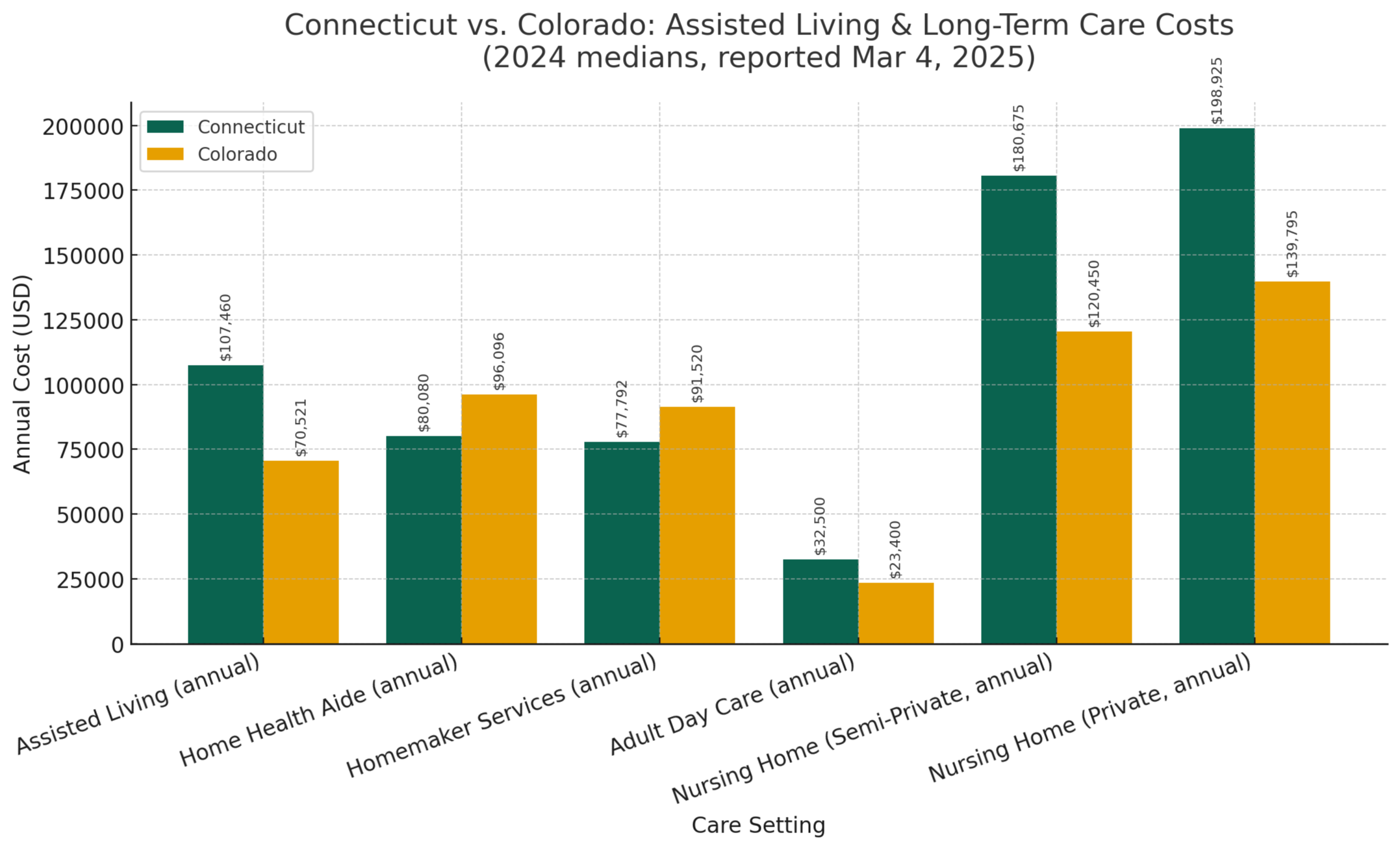
  • Medical expense deductions: Qualifying LTC costs can be itemized deductions when they exceed AGI thresholds; keep detailed documentation.
  • Policy premiums: Some LTC insurance premiums are tax-deductible within IRS age-based limits; benefits are generally tax-free when used for qualified care.
  • Roth conversions (pre-care): Converting in lower-income years before RMDs start can lower lifetime taxes and create tax-free flexibility if care is needed later.
  • Qualified charitable distributions (QCDs): For those 70½+, QCDs can satisfy part or all of RMDs without boosting AGI, useful when care costs are looming and you want to control brackets.

Protecting the Healthy Spouse

When one spouse needs care, the risk is not just the bill; it’s the ripple effect on the healthy spouse’s lifetime plan.

  • Segment income streams: Carve out guaranteed income (pensions, Social Security, annuity income) to meet the healthy spouse’s baseline needs.
  • Title and beneficiary review: Align accounts and property titles to help ensure continuity of access and avoid probate delays.
  • Update estate documents: Durable powers of attorney (financial and healthcare), updated wills, trusts where appropriate, and HIPAA releases are essential.
  • Claim timing: With LTC insurance, weigh the benefit trigger timing carefully to help maximize total value; don’t delay claims unnecessarily.

Care at Home vs. Assisted Living: Building a Flexible Plan

Most retirees prefer to age in place as long as possible. A practical plan includes:

  • Home modifications: Grab bars, zero-threshold showers, improved lighting, ramps, and fall-prevention layouts.
  • Technology: Medication dispensers, emergency response devices, remote monitoring, and telehealth.
  • Care coordination: A care manager (geriatric care manager) can help optimize services and avoid unnecessary hospital visits.
  • Respite and backup: Budget for respite hours to help protect family caregivers from burnout; identify short-term stay options in assisted living if needed.
  • Transition plan: If home care becomes unsafe or isolating, have a shortlist of assisted living communities with pricing, waitlists, and quality indicators.

Quality & Culture: How to Vet Assisted Living Communities

Beyond the numbers, lifestyle fit matters. During tours, evaluate:

  • Care philosophy: How are care plans developed and updated? What’s staffing like on nights and weekends?
  • Clinical partners: On-site nursing? Visiting physicians or therapy providers?
  • Engagement: Daily activities, transportation, spiritual and cultural programming.
  • Dining: Nutrition options and flexibility for special diets.
  • Security & memory care: Wandering protocols, secure courtyards, specialized staff training.
  • Contracts & pricing: How are care level increases priced? What’s included vs. add-on?

Capture the details in a comparison worksheet and revisit annually, as needs evolve.

Common Myths, Debunked

“Medicare will pay for long-term care.”
It won’t cover extended custodial care.

“We’ll just sell the house if we need to.”
Housing markets are cyclical; urgent sales can be costly and stressful.

“Insurance is too expensive.”
Partial coverage, shared-care riders, or hybrid solutions can fit many budgets and dramatically reduce risk.

“We’ll cross that bridge when we get there.”
Crisis decisions often lead to higher costs and fewer choices. Planning early preserves control.

A Sample Framework: Funding an Assisted Living Scenario

(This material is for educational purposes only and does not constitute individualized financial, legal, or tax advice.)

Couple, early 70s, with $1.4M in investable assets, Social Security benefits, and a paid-off home.

  1. Establish a care reserve: $120,000 in laddered Treasuries to cover roughly 12 months of assisted living or home care.
  2. Hybrid policy: Allocate $200,000 to a linked-benefit life/LTC policy providing a pool of ~$400,000 for qualifying care events; shared care so either spouse can use remaining benefits.
  3. Annuity income floor: Shift $250,000 to a deferred income annuity starting at age 78 to hedge longevity and sequence-of-returns risk; add an LTC rider that boosts income during a qualifying event.
  4. HSA strategy: Use existing HSA for qualified care expenses and eligible LTC premiums (within IRS limits).
  5. Tax plan: Perform Roth conversions over 3–5 years to reduce future RMDs, keeping conversions within targeted tax brackets; use QCDs post-70½ to control AGI.
  6. Estate docs & titling: Update POAs, healthcare proxies, beneficiary designations, and consider a revocable trust for smoother asset management if incapacity arises.

Result: A blended solution that keeps choices open, cushions the portfolio during a care event, and helps protect the healthy spouse’s lifestyle.

Your NALW Action Checklist

  • Review income sources and monthly essential expenses.
  • Price two to three local assisted living options and at-home care estimates.
  • Inventory policies (LTCi, life with LTC rider, annuities) and confirm benefit triggers.
  • Set up or revisit a care reserve bucket and evaluate inflation risk.
  • Max out HSA contributions if eligible; earmark for future care.
  • Coordinate with an advisor on withdrawal sequencing, Roth conversions, and QCDs.
  • Update legal documents and care directives; share locations and logins with a trusted contact.
  • Discuss roles with adult children or designated decision-makers.
  • Schedule an annual “Care Plan Review” each September during National Assisted Living Week.

How Agemy Financial Strategies Can Help

Planning for assisted living and long-term care is as much about control and dignity as it is about dollars and cents. At Agemy Financial Strategies, our family of fiduciaries help you:

  • Model realistic care cost scenarios and stress-test your retirement plan.
  • Compare insurance vs. self-funding and design blended solutions that fit your goals.
  • Build tax-efficient withdrawal strategies and coordinate with your CPA and attorney.
  • Protect the healthy spouse’s lifestyle and preserve your legacy intentions.

  • Create a clear, written Care Funding Plan you can share with family so everyone knows the “what, where, and how” if care is needed.
Final Word

National Assisted Living Week is a celebration of community and compassion, and an ideal reminder to bring clarity to one of the biggest variables in retirement: the cost of care. With a thoughtful, tax-aware plan and the right mix of solutions, you can transform a major financial risk into a manageable, predictable part of your retirement strategy.

Ready to align your retirement plan with a real-world care strategy?

Schedule a consultation with Agemy Financial Strategies to build your personalized Long-Term Care Funding Plan and move forward with confidence.


Disclaimer: This material is for educational purposes only and does not constitute individualized financial, legal, or tax advice. Consult your professional advisors about your specific situation and state-specific rules.